


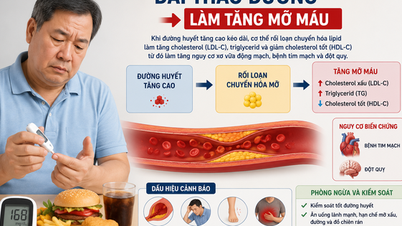
Not all prediabetic patients need medication - Illustration image
What is prediabetes?
According to Dr. Nguyen Quang Bay, Head of the Endocrinology and Diabetes Department at Bach Mai Hospital, prediabetes is a condition where blood sugar levels are higher than normal but have not yet reached the threshold for diagnosing diabetes.
A person is diagnosed with prediabetes if they meet one of the following criteria: fasting blood glucose of 5.6 mmol/L or higher; HbA1c of 5.7% or higher; or impaired glucose tolerance with blood glucose levels 7.8-11.0 mmol/L two hours after a glucose tolerance test.
According to Dr. Bay, many countries and medical organizations worldwide recommend early intervention in people with prediabetes to reduce the risk of developing type 2 diabetes. However, recent studies show that this is not a uniform condition.
"People with prediabetes have very different pathogenesis and risk factors for developing diabetes. Therefore, a single treatment strategy cannot be applied to all patients," Dr. Bay emphasized.
According to studies analyzing large datasets, various metabolic phenotypes of prediabetes have been identified based on insulin sensitivity, pancreatic beta cell function, liver fat content, visceral fat distribution, and genetic factors.
Of these, three groups were assessed as being at high risk.
- Group with fatty liver disease and severe insulin resistance: This group is at very high risk of rapidly progressing to type 2 diabetes.
- Fatty liver disease is not only a warning sign but also directly promotes metabolic disorders, increases insulin resistance, and accelerates disease progression.
- Group with impaired pancreatic beta cell function: In this group, the main cause is a decrease in the insulin-secreting ability of beta cells.
According to experts, this group has a different pathogenesis compared to those primarily suffering from obesity or insulin resistance, and therefore may require a separate long-term prevention strategy.
The group with slow progression but early complications: These patients often have hyperinsulinemia due to insulin resistance and only develop diabetes at a late stage.
However, a worrying aspect is that target organ damage, particularly to the kidneys, can appear very early. This group has also been noted to have a higher risk of premature death compared to many other prediabetic groups.

Doctors providing advice on diabetes - Illustration
Who needs medication when they have diabetes?
According to Dr. Bay, lifestyle changes remain the most important foundation in the treatment of prediabetes.
Measures include weight loss if overweight, increased physical activity, dietary adjustments, and management of cardiovascular risk factors.
However, the reality is that maintaining long-term behavioral change programs is not easy. The well-known DPP (Diabetes Prevention Program) study noted that adherence to weight loss and lifestyle changes gradually decreases over time.
Therefore, some patients may need medication to prevent or slow the progression to type 2 diabetes.
Currently, several groups of drugs have been studied for diabetes prevention, such as Metformin; GLP-1 receptor agonists and dual GLP-1/GIP agonists; SGLT-2 inhibitors, etc.
According to Dr. Bay, prediabetes is a very common condition. The prevalence in many countries ranges from 10-12% of the population.
In Vietnam, a 2021 study showed that nearly 17% of adults have prediabetes.
Because the number of people affected is so large, treating all patients with medication is neither feasible nor necessary.
High-risk cases should be prioritized for drug treatment, such as those with HbA1c above 6.0%. Obesity with a BMI above 30 kg/m²; for Vietnamese people, this threshold of BMI above 25 kg/m² may be considered.
There are comorbidities such as cardiovascular disease, hypertension, or dyslipidemia. Adverse biomarkers such as Dicarbonyl/L-xylulose reductase or Glutathione S-transferase A3 are present.
Many people can maintain stable blood sugar levels for years or bring them back to normal if they manage their weight, diet, and lifestyle well. Conversely, some high-risk groups need close monitoring and consideration of medication treatment from the pre-diabetic stage to prevent complications.
Therefore, the important thing is not to worry about receiving test results, but to have a proper risk assessment in order to choose the appropriate intervention strategy for each individual.
Source: https://tuoitre.vn/mac-tien-dai-thao-duong-co-can-uong-thuoc-2026053122065078.htm


![[Photo] General Secretary and President To Lam and the President of the Philippines hold talks.](https://vphoto.vietnam.vn/thumb/1200x675/vietnam/resource/IMAGE/2026/06/01/1780283481955_vna-potal-tong-bi-thu-chu-tich-nuoc-to-lam-va-tong-thong-philippines-hoi-dam-8797519-1429-jpg.webp)





























![[Image] Hanoi Police officially crowned champions of V-League 2025/2026](https://vphoto.vietnam.vn/thumb/1200x675/vietnam/resource/IMAGE/2026/05/31/1780244769054_ndo_br_039d561b692be875b13a-jpg.webp)
![[Photo] The General Secretary, President and his wife begin their state visit to the Philippines.](https://vphoto.vietnam.vn/thumb/1200x675/vietnam/resource/IMAGE/2026/05/31/1780230559452_anh-man-hinh-2026-05-31-luc-19-28-11.png)








































































Comment (0)