

The current state of school nutrition in Hanoi
The nutritional status of schools in Hanoi is raising many noteworthy issues, with malnutrition persisting alongside a rapidly increasing trend of overweight and obesity among students, especially in the inner city. In response to this situation, the Hanoi health and education sectors have implemented numerous intervention and communication activities, as well as developed models for preventing overweight and obesity in schools.
On May 22nd, the National Institute of Nutrition, in collaboration with World Vision International in Vietnam, organized the workshop "School Nutrition – From Policy to Intervention Program". The workshop was held in a hybrid format, with nearly 100 delegates attending in person in Hanoi and over 70 participants online from provinces and cities across the country.
According to Associate Professor Dr. Nguyen Thi Kieu Anh, Deputy Director of the Hanoi Center for Disease Control (CDC), from 2017 to 2021, the city conducted an assessment of the nutritional status of school-aged children in 90 randomly selected schools. The schools and grade levels 5, 9, and 12 were fixed for consecutive surveys over five years. Approximately 7,300 students participated in the survey each year.

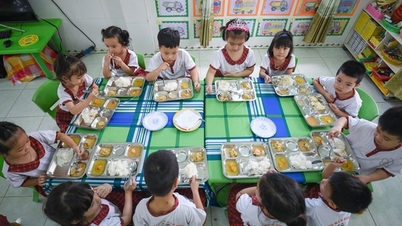
The rate of overweight and obese children in Hanoi schools is quite high. (Illustrative image)
The results show that stunting among students aged 5-19 in Hanoi still persists. However, a more worrying issue is the rapidly increasing rate of overweight and obesity among school children, especially primary school students.
According to the Hanoi CDC, primary school students have the highest rate of overweight and obesity at 37.8%, while this rate is 16.8% for secondary school students and 11.3% for high school students. Notably, the rate of overweight and obesity has increased rapidly over the years, and it is consistently higher in the inner city than in the suburbs. Some inner-city primary schools have recorded overweight and obese student rates as high as 55.7%.
Alongside assessing the current situation, Hanoi is also implementing many school nutrition activities. Communication content is integrated with school health activities, disease prevention, proper nutrition for school-aged children, prevention of risk factors for non-communicable diseases, and prevention of the harmful effects of tobacco.
The health sector continues to organize training courses to enhance the knowledge of health workers and school teachers on school health, proper nutrition, and prevention of non-communicable diseases. Schools also organize many awareness campaigns for students, parents, and guardians.
One of the prominent programs is the School Milk Program, implemented citywide in all preschool and primary schools across 30 districts and towns. Hanoi is also implementing an intervention model to prevent overweight and obesity in primary schools during the 2024-2026 period and a program to support school lunch programs during the 2025-2026 period.
Monitoring, investigation, and evaluation efforts have also been strengthened. The city is conducting surveys on risky behaviors for non-communicable diseases among students aged 13-17 in 60 middle and high schools in 2022 and 2025.
The survey results show that the prevalence of hypertension among students decreased from 5.7% in 2022 to 1.13% in 2025. The prevalence of pre-hypertension decreased from 7.6% to 4.66%. However, the prevalence of overweight increased from 10% to 11.37%, and the prevalence of obesity increased sharply from 2% to 12.82%. The percentage of students who did not eat or did not eat enough fruit decreased from 18.7% to 12.32%.
Intervention model for preventing overweight and obesity in schools.
Faced with the rapidly increasing rate of overweight and obese students in many inner-city schools, the Hanoi CDC has implemented an intervention model to prevent and control overweight and obesity in three primary schools with high rates of obesity among students in the city.
The model was implemented during the period 2023-2026 at La Thanh Primary School (Dong Da District), Le Loi Primary School (Ha Dong District), and Nguyen Du Primary School (Hoan Kiem District). These are all schools with high rates of overweight and obese students, with La Thanh Primary School recording a rate of up to 55.7% and Le Loi Primary School at 49.5%.
According to the Hanoi CDC, the overall goal of the model is to reduce the number of overweight and obese children in participating schools by 10% by 2026 compared to 2023, while increasing the percentage of students participating in recommended physical activities.
Before implementation, the Hanoi CDC conducted an investigation and assessment of the nutritional status of students in three schools. The results showed that out of a total of 3,603 students surveyed, 1,457 were overweight or obese, accounting for 40.4%.
The average rate of overweight and obesity in the three schools reached 43.2%, while the rate of malnutrition was 3.1%. Notably, only 53.7% of students had a normal nutritional status.

Exercise helps children prevent being overweight or obese.
The survey also revealed many limitations in knowledge about nutrition and physical activity within the school environment. Up to 83.1% of students did not meet the required standards for nutrition knowledge; and 89.8% of students did not engage in sufficient physical activity as recommended.
Not only students, but also many parents, teachers, and cafeteria staff lack knowledge about school nutrition. The percentage of parents who do not meet the nutritional knowledge standards is 84.7%; teachers is 96.15%; and cafeteria staff is 80.65%.
Based on this situation, the Hanoi CDC, in coordination with inter-agency units, organized meetings to assess the current situation, develop an implementation plan, and issue an inter-agency plan for implementing the model. Meetings were held directly at schools to unify the coordination methods between the health, education, and local authorities.
One of the key aspects of the model is to improve knowledge and change nutritional behaviors among students, teachers, and parents. The Hanoi CDC organized training for homeroom teachers, physical education teachers, school health staff, and daycare nutritionists. The training focused on proper nutrition, recognizing the risks of overweight and obesity, and guiding students to increase physical activity.
For parents, these awareness campaigns are organized to guide them in establishing a healthy diet, limiting sugary drinks and fast food, and controlling portion sizes for their children.
The innovative aspect of the model is the development of a communication toolkit in the form of games for students of various age groups. Teachers are guided to use these tools to organize weekly interactive activities for students, helping children access nutritional knowledge in a more visual and memorable way. The model's content is also broadcast on Hanoi Radio and Television to spread awareness about preventing overweight and obesity in schools.
Adjusting school meals towards healthier options.
The intervention model places particular emphasis on improving the quality of school lunch programs. Accordingly, the school lunch menu is developed according to the nutritional recommendations of the health sector, increasing the consumption of green vegetables and controlling energy and fat intake.
The school environment is also geared towards limiting advertising of sugary drinks and fast food to reduce the risk of unhealthy food consumption among students. In addition to school meals, parents are also guided in developing appropriate diets for their children at home to ensure a comprehensive approach.
Physical activity is identified as a crucial solution in controlling overweight and obesity in schools. The model encourages students to participate in physical exercise at school and in the community for at least two sessions per week, each lasting at least 60 minutes. Schools also enhance extracurricular sports activities to foster a habit of regular exercise among students.
In addition, healthcare professionals participating in the model receive specialized training to monitor and evaluate the effectiveness of interventions and support students in improving their health.
A key aspect of the model is the implementation of individualized nutritional counseling for parents and students who are overweight or obese. The Hanoi CDC conducted monthly counseling sessions at La Thanh and Le Loi schools for 63 parent-student pairs who voluntarily registered to participate in the program from September 2024 to June 2025.
Experts develop individualized nutrition and exercise plans for each student based on anthropometric measurements, eating habits, and physical activity levels.
Preliminary results show that 57% of students and parents participated in counseling sessions two or more times. Approximately 37% of students lost weight, with an average reduction of 1.06 kg; 69% reduced their BMI by an average of 0.8 kg/m2; and 83% increased their height by an average of 1.5 cm.
According to the Hanoi CDC, the novelty of the model lies in mobilizing teachers, parents, and students to participate as "communicators" in order to create a broader impact within the school community.
However, the implementation process still faces many difficulties, such as limited control over street vendors and unhealthy food around schools; many parents are not yet ready to participate in counseling or find it difficult to maintain changes in their children's eating habits.
Experts believe that effectively controlling overweight and obesity among schoolchildren requires long-term cooperation between schools, families, and the health sector to create a healthy living environment and maintain proper nutritional habits for children.

Source: https://suckhoedoisong.vn/bao-dong-thua-can-beo-phi-hoc-duong-o-ha-noi-169260529215221416.htm
![[Photo] Admire the coral "masterpiece" amidst the million-year-old heritage of Dak Lak province.](https://vphoto.vietnam.vn/thumb/1200x675/vietnam/resource/IMAGE/2026/05/30/1780107638639_y25-jpg.webp)








































































































Comment (0)