


This highlights a noteworthy fact: Young people are not turning their backs on history; they simply need a more accessible and relevant approach.
A great legacy , but a long way to go.
Throughout its nearly 70 years of formation and development (1956-2026), the Central Documentary and Scientific Film Studio (DSF) has produced thousands of works and preserved millions of meters of documentary film about war, peace, social life, science, culture, and the people of Vietnam. However, paradoxically, for many years, a significant number of valuable films remained in storage, little known outside the professional sphere, or broadcast during limited time slots on television.
In the context of social media constantly shaping new consumption habits, young people are increasingly accustomed to short, fast-paced, and highly entertaining content. A documentary lasting several tens of minutes, or even hours, with a slow narrative pace and multi-layered structure, is not easily captivating. This is a reality that filmmakers must acknowledge if they want to bring documentaries closer to a younger audience.
Mr. Trinh Quang Tung, Deputy General Director of the Central Documentary and Scientific Film Company, believes that the important thing is not only to preserve the documents but also to find ways for those memories to emerge from the film archives and live in contemporary life.
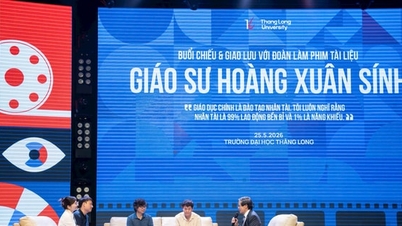
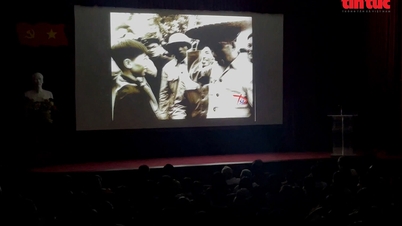
Based on that idea, the "Vietnam: The Untold Story" project, first implemented by DSF, is a new approach where documentaries are not only screened but also placed within a space for dialogue, experience, and interaction. Each month, the program selects a theme related to historical and cultural milestones of the country. Following the screening, there is a Q&A session with witnesses, artists, and filmmakers – an element that creates the program's unique appeal.
In May, leading up to the 136th anniversary of President Ho Chi Minh's birth, the film "Vietnam - Ho Chi Minh" was chosen as a bridge for young people to access the President's journey through authentic documentary footage. When People's Artist and war cinematographer Nguyen Van Nam recounted his experiences working amidst bombs and bullets in Quang Tri or facing B-52 air raids in Hanoi , the atmosphere in the auditorium often became quiet. Through these stories, history appeared much closer and more vivid.
War is revealed through the memories of those who lived through the bombings, through the wounds still borne on their bodies, and through the belief of the older generation of filmmakers who felt compelled to record what was happening so that future generations could understand how their ancestors lived, fought, and sacrificed. This is also the unique value that documentary films still retain amidst the many forms of content today: authenticity and emotional depth.
History is not far from young people; it's just that the way it's told isn't close enough.
According to Mr. Do Le Hung Tu, President of the Vietnam Film Association, the difficulty of documentary films today lies not in a lack of value, but in the distance to reach the public. Vietnam possesses an exceptionally valuable archive of film materials, recording both war and peace, the country's development, and portraits of many generations of Vietnamese people. "Many films today have become cultural heritage because the people in the films, as well as the filmmakers, are no longer alive," Mr. Do Le Hung Tu shared.
According to him, the responsibility of cinema today is both to preserve and to find ways to retell history so that it continues to live on in the consciousness of the new generation. In the digital age, young people receive information through different rhythms and languages. This requires documentary films to increase their storytelling, interaction, and especially to appear in places where young people are present.
That's also why the Vietnam project hasn't fully revealed its choice to partner with BEAT Network – a media platform with a strong ability to reach young people in the digital environment. If DSF brings original films and documentary value, then social media will become an "extended arm," bringing historical moments closer through short clips, introductory content, behind-the-scenes footage, or conversations with witnesses. It's not about replacing traditional documentaries, but about creating a "doorway" to spark curiosity.
Sitting down after the screening of "Vietnam - Ho Chi Minh City ," Nguyen Phuong Dinh, a fourth-year student in Hanoi, said that she rarely watched documentaries before because she felt they were "difficult to approach." "I used to think documentaries were slow and a bit dry. But today, hearing the filmmakers tell their stories firsthand, I found it very interesting and wanted to learn more," Phuong Dinh shared.
According to the student, to make documentaries appealing to young people, it's crucial to create a sense of familiarity. "If there are short preview clips on TikTok, Facebook, or YouTube to let us know what the film is about, it will be easier to access. Additionally, interacting with witnesses after watching the film makes the history and stories in the film feel more relatable and authentic," Phương Dinh expressed.
That opinion partly reflects the challenge facing documentary filmmaking: it's not lacking in value, but it needs a change in how it reaches the public. However, innovation doesn't mean chasing after easy trends. Those in the profession understand that the power of documentary film lies in its authenticity, its ability to reflect, and its depth of understanding. If too much emphasis is placed on entertainment or if it's drastically shortened to suit the speed of social media, documentary filmmaking could lose its identity.
The challenge, therefore, is not to "entertain" history, but to find a new narrative language to make history more accessible. This could involve screenings combined with interviews with witnesses, short introductory segments before the full film, or a more emotionally resonant storytelling approach that is closer to personal experience. The core principle remains maintaining the integrity of documentary filmmaking.
The emergence of "Vietnam's Untold Story" can be seen as a noteworthy experiment in the journey of bringing documentary films back into contemporary life. In an era where the pace of life and information changes daily, history will not become distant if told in a language suitable for the reception of today's young people. From screenings like these, footage that seemed to lie dormant in archives has the opportunity to connect the younger generation with the past, with the people who went through the war to create the present.
Source: https://baovanhoa.vn/nghe-thuat/lich-su-can-mot-cach-ke-moi-232070.html
![[Photo] The courage of new recruits of Brigade 144 on the training ground.](https://vphoto.vietnam.vn/thumb/1200x675/vietnam/resource/IMAGE/2026/05/27/1779881651341_anh-man-hinh-2026-05-27-luc-18-32-52.png)
![[Photo] The heat at the fireworks display site on the opening night of the Da Nang International Fireworks Festival 2026](https://vphoto.vietnam.vn/thumb/1200x675/vietnam/resource/IMAGE/2026/05/27/1779889741485_ndo_br_z7872039145157-fecaba5112f39e8352544099d7ef4738-5140-jpg.webp)






































![[Photo] The courage of new recruits of Brigade 144 on the training ground.](https://vphoto.vietnam.vn/thumb/402x226/vietnam/resource/IMAGE/2026/05/27/1779881651341_anh-man-hinh-2026-05-27-luc-18-32-52.png)















Comment (0)