

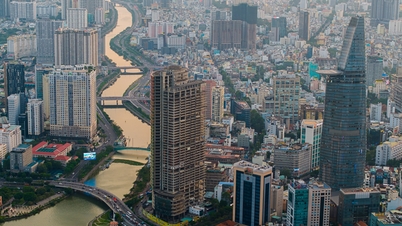
Billion-dollar projects are changing the face of the city.
The centerpiece of this groundbreaking ceremony is the City Center Square project (Component Project 4). Located in the heart of the Thu Thiem new urban area, covering an area of over 20 hectares, this is the most important component in the City Center Square and New Administrative Center complex.
With a projected total investment of thousands of billions of VND for the square and riverside park area alone, the project is expected to be the largest community space in Vietnam, hosting international-level political and cultural events. Upon completion, it will be the new "heart" of the city, harmoniously connecting historical identity with the modernity of a smart city.
With a capacity equivalent to 10 national stadiums, this place is not only a venue for major political events but also an iconic architectural landmark. The combination of a modern plaza and a lush green riverside park creates an absolutely open space where people can truly "touch" the historic Saigon River. This is the final piece to complete Thu Thiem's picture of a continental-level financial and cultural center.

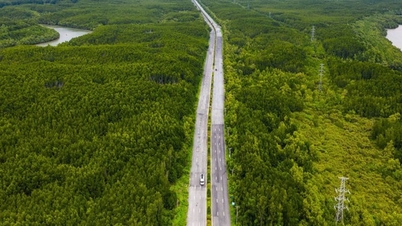
Can Gio is poised to become a new growth hub for Ho Chi Minh City.
PHOTO: TN
On the other side, the renovation project of the Ho Chi Minh Museum - Ho Chi Minh City branch - holds immense spiritual significance. The commencement of the renovation of the Nha Rong Wharf historical site on April 30th is a practical action to honor its historical value, while simultaneously upgrading this space into a world-class cultural and tourist destination, befitting the status of the city named after President Ho Chi Minh.
Also in the field of urban development, the commencement of the Berjaya International University Urban Area (Hoc Mon) holds special significance in relocating residents to the Northwest area. According to the plan, the International University Urban Area will be developed as a comprehensive urban area, linked to training, research, and innovation functions. The projected population is approximately 135,000 urban residents and about 60,000 students, with a complete system of functional areas for housing, education , commerce, services, and social infrastructure. After nearly two decades of stagnation since receiving its investment certificate in 2008, the project has been "revived," becoming the largest project in the Northwest area of Ho Chi Minh City. Expected to be operational in early 2035, this area will become an international standard education-healthcare-commercial complex, comprehensively upgrading the social infrastructure for the suburban areas of Ho Chi Minh City.

Perspective view of Can Gio International Transshipment Port
PHOTO: TL
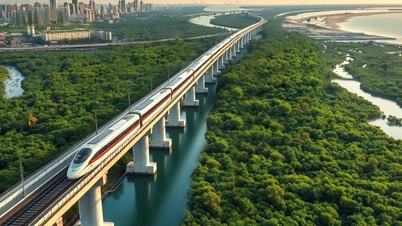
Another "mega" transportation project that commenced during this important holiday was the Metro Line 2, connecting Ben Thanh and Thu Thiem. Following the success of Line 1, the commencement of the section crossing the Saigon River, connecting the old city center with the Thu Thiem peninsula, holds significant importance. According to the Urban Railway Management Board (MAUR), the project is not simply a transportation infrastructure but a "lifeline" connecting the East and West banks, creating a strong impetus for the development of underground space and urban projects along the route; and simultaneously laying the foundation for the first metro line connecting Ho Chi Minh City to Long Thanh Airport.
Leveraging growth for a new breakthrough cycle.
April 30, 2026 also marks a special milestone in Ho Chi Minh City's maritime expansion journey, as the city will issue an investment approval decision for the Can Gio International Transshipment Port project. This project is the "soul" of the strategy to transform Ho Chi Minh City into a coastal city. Unlike inland ports, which are becoming increasingly overloaded and limited by waterways, Can Gio Port is located right at the mouth of the sea and has the capacity to receive the world's largest container ships.
The awarding of the investor approval decision to the consortium comprising Vietnam Maritime Corporation (VIMC), Saigon Port, and MSC, the world's largest container shipping company, not only initiates an infrastructure project but also launches an entire international-scale logistics ecosystem. The greatest significance of this project is the "awakening" of Can Gio, transforming it from a purely agricultural suburban area and biosphere reserve into a global trade gateway.
According to the maritime infrastructure development roadmap, Ho Chi Minh City's initial goal of developing three major ports simultaneously was to have them all. However, only Can Gio Port has completed the necessary procedures to receive the investment approval. The remaining two "links" are Cai Mep Ha General and Container Port (phase 1), covering 351.2 hectares with a total investment of approximately VND 50,200 billion and a designed capacity of 11 million TEU/year, and the Cai Mep Gemadept - Terminal Link Port project (phase 2), with a total investment of approximately VND 8,361 billion, which are being urgently completed in the final stages of preparation for commencement in the next phase in 2026. When these three ports are operational, Ho Chi Minh City and the former Ba Ria-Vung Tau region will form the largest port cluster in the region, capable of competing on equal footing with Singapore or major ports in Shanghai.

Perspective view of the new Thu Thiem administrative center in Ho Chi Minh City.
PHOTO: TL
Economist Tran Anh Tung (Head of Business Administration Department, Faculty of Business Administration, University of Economics and Finance, Ho Chi Minh City) assessed: Looking at the investment efficiency, the series of projects that Ho Chi Minh City is preparing to launch around April 30th are more of a "growth lever" than a simple expenditure. According to urban economic practice, the spillover effect of public investment in infrastructure typically ranges from 1.5 to 2.5 times GDP in the medium term, meaning that every 1 unit of capital invested can generate 1.5 to 2.5 units of added value through construction, employment, consumption, and new productivity.
Specifically, port and related logistics projects have high investment costs but offer good return on investment if they reach their designed capacity and operate efficiently. The economic payback period could be reduced to 10-15 years thanks to port fees, logistics services, warehousing, and attracting international shipping lines. Furthermore, the indirect benefits outweigh the direct benefits, as every 1% reduction in logistics costs can significantly enhance the competitiveness of exports from the southern region.
Meanwhile, the cluster of projects in Thu Thiem, including the central square and the administrative center connected to the Ben Nha Rong - Khanh Hoi park, has economic benefits that should be measured not only by direct revenue but also by the effect of increased land value and expanded urban service revenue. If just 200 hectares of land in the central area around the administrative-financial axis increase in value by an average of 20 million VND/m² thanks to infrastructure and landscaping, the total increase in asset value would reach approximately 40,000 billion VND. If the increase is 50 million VND/m² in key commercial lots, the added value could reach 100,000 billion VND. This represents a significant resource for the city to recover through land auctions, land use fees, transfer taxes, and property taxes in the long term.
When the administrative and financial core is relocated and perfected, the number of tourists, consumer spending, and high-end services will increase significantly. Assuming the Ben Nha Rong - Thu Thiem area welcomes an additional 3 million visitors per year, with an average spending of 1.5 million VND per person, total service revenue could increase by an additional 4,500 billion VND per year. If indirect taxes and related fees are applied, the city budget could collect hundreds to thousands of billions of VND more each year.
Economist Tran Anh Tung
Source: https://thanhnien.vn/loat-sieu-du-an-ha-tang-dot-pha-kinh-te-tphcm-185260423200111477.htm

![[Image] A brilliant symphony and explosive power in the skies of Da Nang.](https://vphoto.vietnam.vn/thumb/1200x675/vietnam/resource/IMAGE/2026/05/31/1780196945787_anh-man-hinh-2026-05-31-luc-10-08-51.png)












![[Video] Sunset at Lap An Lagoon – Where the sun sets over the fishing nets](https://vphoto.vietnam.vn/thumb/340x192/vietnam/resource/IMAGE/2026/05/31/1780192137701_beach-landscape-sea-water-nature-grass-745871-pxhere-com.jpeg)


























































Comment (0)