

Rice stored for consumption before the harvest was flooded.
From November 16th to 19th, heavy and prolonged rainfall covered the entire Gia Lai province. On the evening of November 18th, a devastating flood struck, submerging 19,200 houses, with many areas experiencing water levels of 2-3 meters. The flooding was mainly concentrated in Quy Nhon and Ayun Pa wards; and the communes of Tuy Phuoc, Tuy Phuoc Dong, Ia Sao, Ia Tul, Ia Pa, Ia Rsai, Uar, Phu Tuc, and Po To…
The farmers' habit is to sell a small portion of the previous rice harvest to cover family living expenses, and keep the rest to eat until the next harvest. Most of the 19,200 houses in Gia Lai were submerged in the recent floods, with water levels reaching a common depth of 1.5 meters, and in many places 2-3 meters deep.
In Central Vietnam, few farming families can afford multi-story houses; most live in single-story houses. To protect themselves from floods, farmers often stack sacks of stored rice on chairs and beds to keep them safe. But the recent flood was devastating. The water rose very quickly, submerging many houses almost to their roofs. At that moment, people were preoccupied with finding a way to escape, with no time to think about their belongings. The flood swept away the tables and chairs used to hold the rice, and the stored sacks of rice floated aimlessly in the floodwaters.
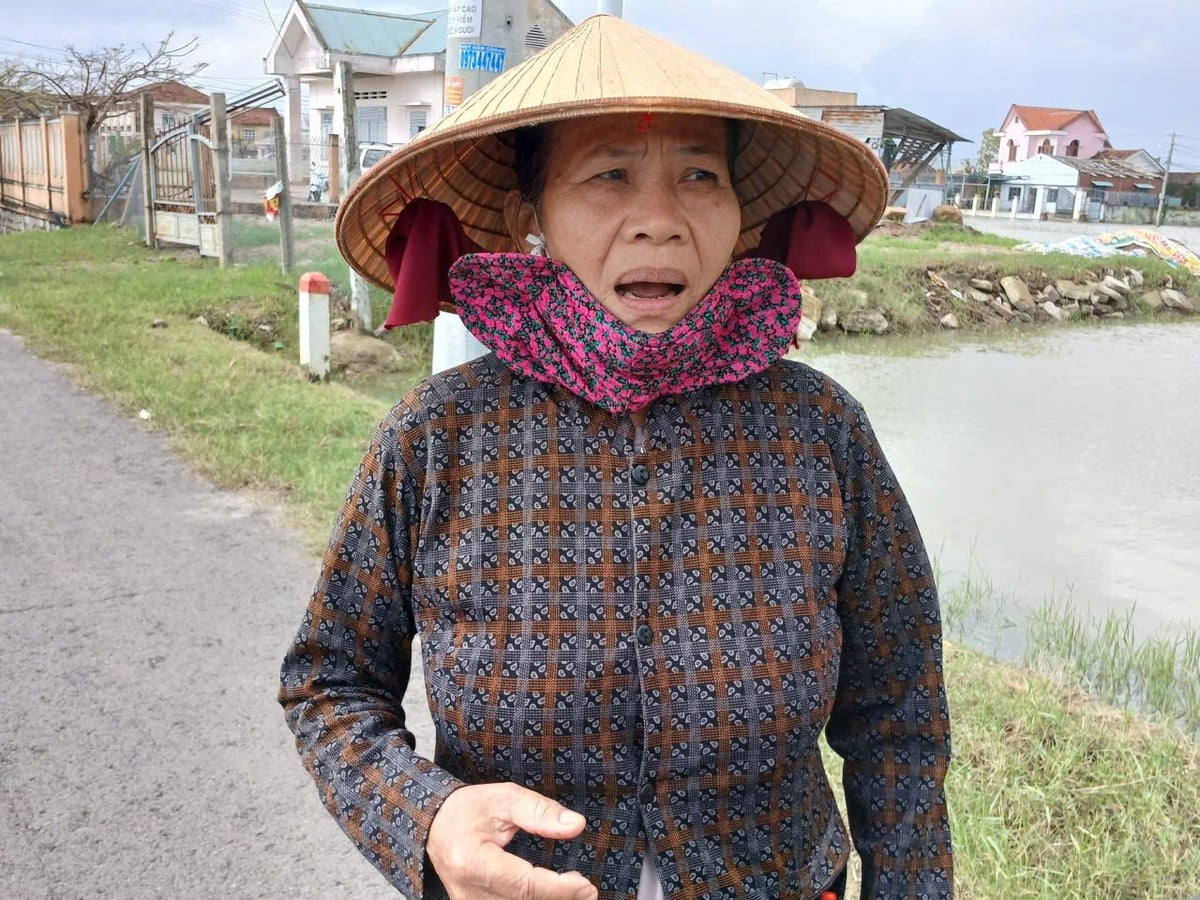
Ms. Pham Thi Bich, a farmer from Tu Cung village (Tuy Phuoc Dong commune, Gia Lai province), whose rice crop was flooded, had to sell it as duck feed at 2,000 VND/kg. Photo: V.D.T.
As the floodwaters receded, the sacks of rice meant for later consumption, now soaking wet, began to sprout, forcing farmers to sell them cheaply to poultry farmers.
Ms. Pham Thi Bich (69 years old), a farmer from Tu Cung village (Tuy Phuoc Dong commune), lamented: “My family cultivates 3 sao (approximately 0.3 hectares) of rice fields. After harvesting the 2025 summer-autumn rice crop, I sold some to pay off debts and kept 10 sacks to last until the 2025-2026 winter-spring harvest. I stacked them high in two piles. Unexpectedly, this flood rose too high, soaking the bottom 6 sacks. Although the commune militia helped move the rice, because it was already submerged, when the water receded and I opened them, the wet sacks had sprouted. I sold them to duck farmers for only 2,000 VND/kg, while commercial rice on the market costs 7,000-8,000 VND/kg. Now, only 4 sacks of rice remain dry, not enough to last until the next harvest. Many households lost tons of rice due to the flooding.”
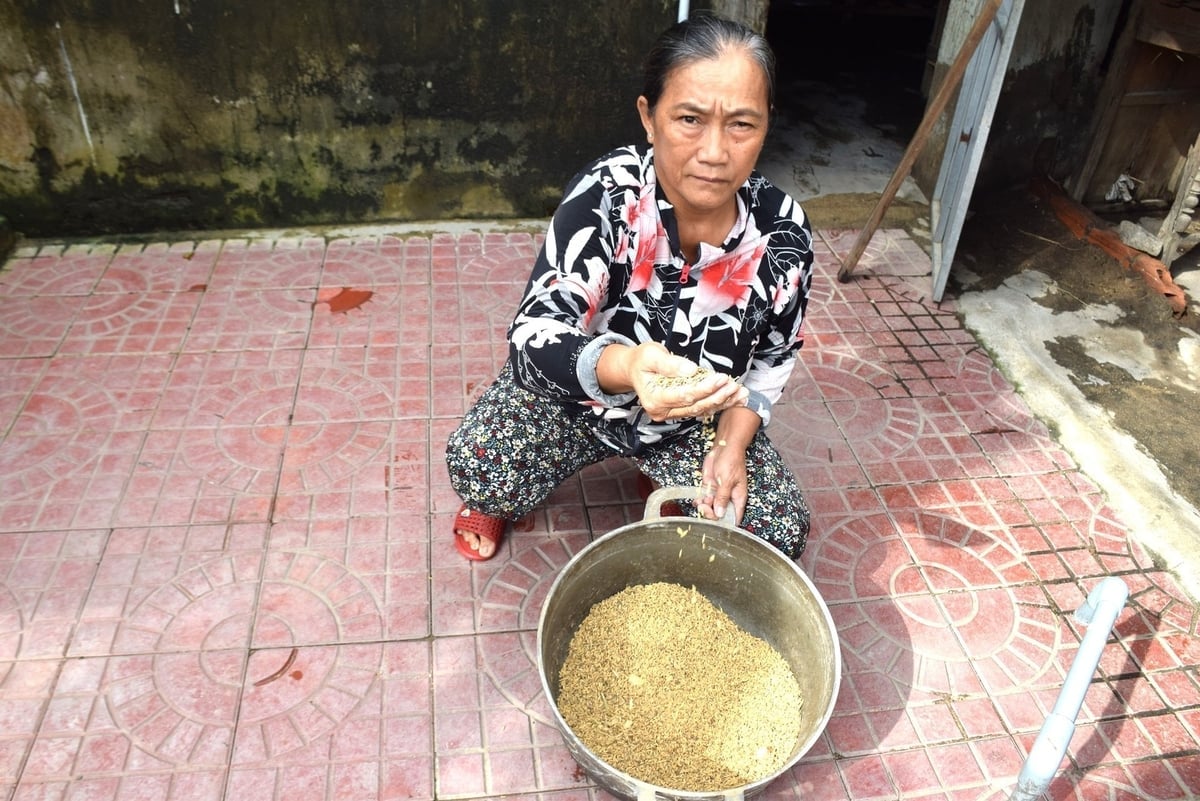
Ms. Nguyen Thi Suong in Tu Cung village also had her rice crop flooded, and although it had been air-dried, it still sprouted. Photo: V.D.T.
The situation for Mrs. Nguyen Thi Suong (56 years old), also from Tu Cung village (Tuy Phuoc Dong commune), was even more dire. By the morning of November 24th, sections of the road to her house were still flooded. Typhoon No. 13, which struck on the night of November 8th, ripped off the roof of their dilapidated single-story house, which hasn't been repaired yet. Her husband had to cover it with a tarpaulin to protect it from the rain, and then this flood submerged Mrs. Suong's house by over a meter. All the rice stored for the family to eat until the next harvest was soaked. In the days following the flood, when the rain subsided, Mrs. Suong spread it out to dry, but the rice had already sprouted, so she had to sell it cheaply to duck farmers.
Mr. Huynh Van Hai, Director of Phuoc Thang Agricultural Cooperative (Tuy Phuoc Dong commune), said: The cooperative has a drying plant with a capacity of 32 tons/batch. In the days after the flood, the cooperative continuously received orders to dry wet rice via phone, but so far the cooperative has only agreed to dry 100 tons because the cooperative's drying plant has a small capacity.
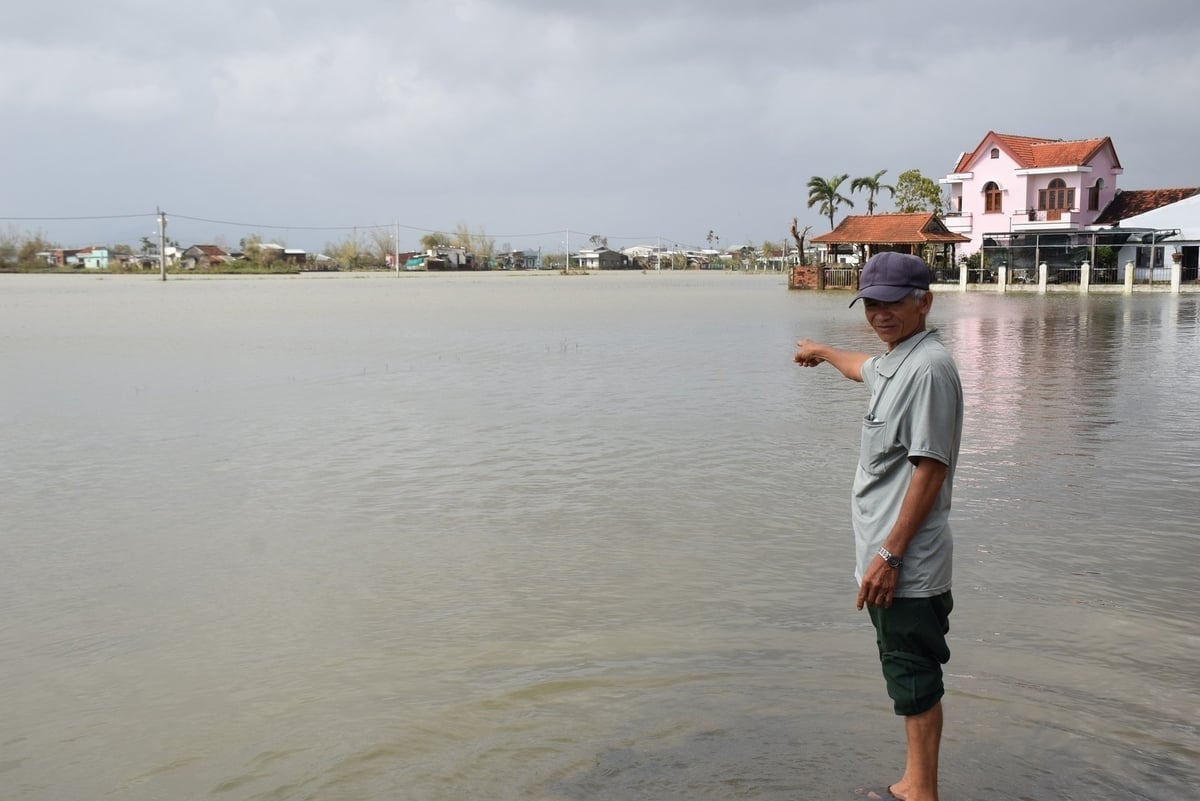
The fields in Tu Cung village (Tuy Phuoc Dong commune) are still completely flooded, making it difficult to produce the 2025-2026 winter-spring crop according to the scheduled timeframe. Photo: V.D.T.
According to Mr. Tran Xuan Dat, head of Tu Cung village, in the past 25 years, they have never seen such severe damage from a flood as this one. “Tu Cung village has 530 households, and this flood submerged 90% of the villagers' houses, with about 25% of them flooded to a depth of over 1 meter. Houses with two floors or attics didn't get their rice wet, but those with single-story houses where the rice was raised low all got soaked,” Mr. Dat shared.
Given the situation, anticipating that households affected by this flood will face food shortages, the Gia Lai Provincial People's Committee has issued a policy to provide each flooded family with 15kg of rice per person per month for a period of three months. This is sufficient to cover the time until the harvest of the 2025-2026 winter-spring rice crop.

As the sun came out, farmers hurriedly emptied the sacks of rice that had been submerged in the floodwaters to dry. Photo: V.D.T.
The winter-spring crop season is under a lot of pressure.
Because it is located downstream of the Kon River, when the floodwaters recede, water from upstream rushes down and completely fills the "water reservoir" of Tuy Phuoc Dong commune. This commune is also situated on the edge of Thi Nai lagoon, so when the tide rises, the floodwaters have no way to drain into the sea, causing prolonged flooding. The annual rainy season and floods often coincide with the winter-spring crop season; in many years, while winter-spring crops have already been sown elsewhere, the fields of this commune remain submerged.
This year, too, while the floodwaters have receded in upstream areas, the rice fields of Tuy Phuoc Dong commune remain completely covered in water. Furthermore, due to heavy rain in eastern Gia Lai on the night of November 23rd, the water level rose again in Tuy Phuoc Dong commune from morning to noon on November 24th, causing many areas to be re-flooded.
According to Mr. Kieu Van Cang, Deputy Head of the Gia Lai Department of Crop Production and Plant Protection, for the 2025-2026 winter-spring crop in eastern Gia Lai, rice paddies producing three rice crops per year will be sown from November 25th to December 5th; rice paddies producing two crops per year will be sown from December 15th to December 25th to ensure concentrated rice flowering in early March 2026; and low-lying rice paddies will be sown as the water recedes, with sowing completed by the end of January 2026.
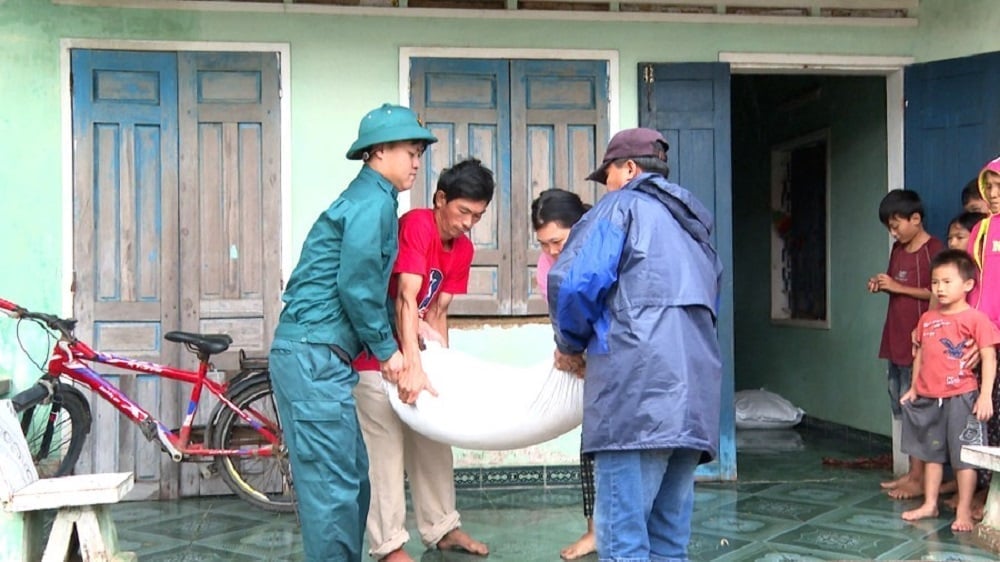
Gia Lai province has issued a policy to support each family whose house was flooded with 15kg of rice per person per month, for a period of 3 months. Photo: V.D.T.
Mr. Huynh Van Hai, Director of Phuoc Thang Agricultural Cooperative (Tuy Phuoc Dong commune), expressed his concern: “Every year during the flood season, the cooperative's rice production area is sown later than other areas because the fields are still flooded. For the upcoming 2025-2026 winter-spring crop, according to the planting schedule of the Provincial Department of Agriculture and Environment, fields that grow two crops should be sown concentratedly from December 15th, but the cooperative's fields are currently submerged in water, so sowing will certainly not be on time. If sown late, when the rice is flowering, it will encounter unfavorable weather conditions, affecting yield. The Tuy Phuoc Dong Commune People's Committee has decided that areas where the water recedes first should proceed with land preparation for sowing immediately.”
Farmers in eastern Gia Lai province, when cultivating the winter-spring crop, often follow the traditional wisdom of their ancestors: "The husband forgives, but the wife doesn't; she'll flood the plants on the twenty-third of October," referring to the annual minor flood. The minor flood in eastern Gia Lai usually occurs in mid-December (October 23rd in the lunar calendar). Therefore, the sowing time for the winter-spring crop is arranged by authorities 7-10 days before the minor flood so that the rice plants are already "stuck" and not washed away by the flood, or sown after the minor flood to preserve the seeds.
“Based on the province's seasonal planting schedule framework, we propose that local leaders direct the development of specific planting schedules that are suitable to the local production conditions. At the same time, they should regularly monitor forecasts and developments of rainfall and floods to proactively adjust planting times accordingly, minimizing damage caused by floods,” shared Ms. Nguyen Thi To Tran, Deputy Director of the Gia Lai Department of Agriculture and Environment.
Source: https://nongnghiepmoitruong.vn/loi-khan-cau-tu-vung-lu-can-bo-thoc-truoc-mua-giap-hat-d786375.html


















![The Essence of Viet Bac Villages: [Part 3] The Precious Fragrance of Nghinh Tuong](https://vphoto.vietnam.vn/thumb/402x226/vietnam/resource/IMAGE/2026/05/29/1780020600366_5237-tinh-tuy-ban-lang-viet-bac-bai-3-chuyen-o-nghinh-tuong-050626_700.jpeg)
![The Quintessence of Northern Vietnam's Villages: [Part 2] The Famous Cassava Noodles of Kunming](https://vphoto.vietnam.vn/thumb/402x226/vietnam/resource/IMAGE/2026/05/28/1779937455892_3929-3144-mien-dong-15-nongnghiep-023138.jpeg)
![The Essence of the Village: [Part 1] Wine on the mountain, tea in the clouds - Bang Phuc](https://vphoto.vietnam.vn/thumb/402x226/vietnam/resource/IMAGE/2026/05/27/1779841729178_3821-1jpg-nongnghiep-103814.jpeg)




























































Comment (0)