

Many water supply projects are behind schedule, groundwater extraction has decreased, and water prices are not attractive to investors, which are the main reasons for widespread water shortages in Hanoi .
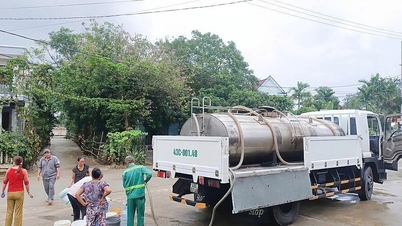
For the past two weeks, numerous residential areas in districts such as Thanh Xuan, Nam Tu Liem, Thanh Oai, Hoai Duc, etc., have been experiencing water shortages. Residents have to queue until 1-2 am to get water from mobile water tankers. Many have had to skip showering, evacuate to relatives' homes, or drill wells.
Meanwhile, Hanoi has been in autumn for two months, and the demand for clean water from its more than 8.4 million inhabitants is not as high as in the summer. The water levels of the Red River, Da River, and Duong River – the city's surface water sources – have been replenished by several periods of rain and flooding upstream after drying up in late May and early June. The water shortage stems from many causes, most of which cannot be resolved immediately.
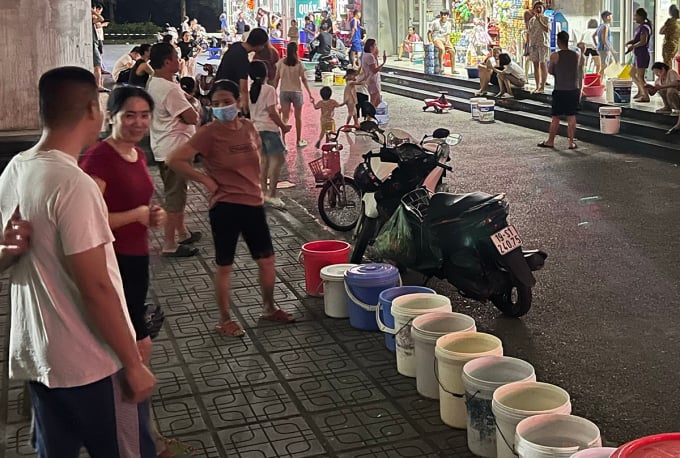
Residents of Thanh Ha urban area line up with buckets and containers to collect clean water on the night of October 15th. Photo: Ngoc Thanh.
Reduce groundwater extraction.
Hanoi is considered to have abundant groundwater resources. Of the 1.5 million cubic meters of clean water supplied to the city daily, groundwater accounts for 770,000 cubic meters and surface water for 750,000 cubic meters. However, due to uncontrolled exploitation over several decades, the groundwater level has decreased, causing land subsidence and arsenic pollution.
In order to protect groundwater resources and ensure a safe and sustainable water supply, the Prime Minister issued Decision No. 554/2021 approving the adjustment of the Capital's Water Supply Plan until 2030, with a vision to 2050. The city will prioritize the exploitation and use of surface water sources, gradually reducing reliance on groundwater.
According to the plan, groundwater extraction per day will gradually decrease from the current 770,000 m3 to 615,000 m3 by 2025; to 504,000 m3 by 2030; and to 413,000 m3 by 2050.
Some water treatment plants have closed their underground wells, such as the Ha Dinh Water Treatment Plant, which has closed 8 out of 17 wells, with 9 wells operating on a rotational basis. From now until 2030, the plant will only operate at a capacity of 10,000 m3 per day, a reduction of one-third compared to before, and by 2050 all underground wells will be closed.
Similarly, the Phap Van Water Treatment Plant, with a designed capacity of 30,000 m3 per day, is reducing its extraction to 5,000 m3; after 2030, it will cease all groundwater wells and put them into reserve mode.
Numerous clean water projects are behind schedule.
With groundwater levels declining, Hanoi must increase the exploitation and use of surface water to compensate. However, a number of surface water projects are behind schedule. The largest is the Red River Surface Water Treatment Plant project in Lien Hong commune, Dan Phuong district, covering an area of over 20 hectares with a capacity of 300,000 m3 per day, which has been delayed by nearly 3 years. The initial plan was to put the project into operation in the first quarter of 2021, but the city has adjusted it twice, allowing it to be extended to the fourth quarter of 2024.
Mr. Nguyen Phuc Hoan, Deputy Head of the Dan Phuong Urban Management Department (the unit managing urban infrastructure), said that the project is in its final stages, with the installation of equipment to draw raw water from the Red River expected in November, and the installation of the treatment line in the plant in December. The current obstacle is that the land where the pipeline passes through has not yet been cleared; construction of the raw water collection station must be halted for 3 months during the rainy season due to regulations under the Law on Dikes.
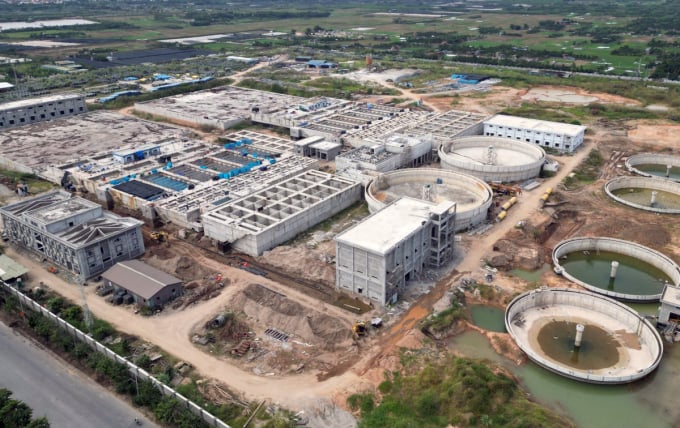
Construction site in disarray at the Red River Surface Water Treatment Plant, photo taken on the afternoon of October 20. Photo: Hoang Phong
In addition to the above project, the first phase of the Da River Surface Water Treatment Plant, completed in 2009 with a capacity of 300,000 m3 per day, was planned to increase to 600,000 m3 by 2020, but it is currently unfinished.
The project to increase the capacity of the Bac Thang Long - Van Tri Water Treatment Plant from 150,000 to 200,000 m3 per day was expected to be completed in 2018, but has not yet been implemented. The Xuan Mai Water Treatment Plant project in Hoa Binh, with a capacity of 200,000 m3 per day, was expected to be completed in 2020, but is currently only in the investment preparation stage.
Lack of suburban water supply network
Over the past 10 years, following the merger of Ha Tay into Hanoi, the western districts have experienced rapid urbanization, with numerous new urban areas forming along the Le Van Luong - To Huu road axis, National Highway 32 through Hoai Duc district, Thang Long Boulevard, and southwestern apartment complexes such as the Thanh Ha urban area (Thanh Oai). In these areas, the population is dense, but the water resources and clean water supply network have not developed proportionally, leading to overload.
According to the conclusions of the clean water supply monitoring report published by the City People's Council at the end of September, the water supply network in the districts is synchronized and meets 100% of the people's needs with a target of 100-150 liters/person/day. However, in the suburbs, many water supply network development projects are behind schedule, and investors are not implementing them. As a result, 139 communes still lack a centralized clean water source.
Specifically, the project to connect the water supply network to 14 communes and towns in Hoai Duc district, invested by Tay Ha Noi Clean Water Joint Stock Company, was expected to be completed in 2018, but is currently unfinished. Many communes in this district have experienced water outages or weak water flow since June, and the problem has yet to be resolved. Water supply network projects for many communes in Soc Son, Dong Anh, Gia Lam, Chuong My, Xuan Mai, and Dan Phuong districts are also behind schedule or have not yet been implemented.
There are even some rural clean water supply network projects that the investors have not implemented, such as the clean water distribution project for 26 communes in Thuong Tin district, 20 communes in My Duc district, 27 communes in Ung Hoa district, and 17 communes in Thanh Oai district, which were invested in by Aqua One Water Joint Stock Company and Duong River Surface Water Company. The project was planned to be completed in 2020, but the procedures for implementation have not yet been finalized.
The price of clean water is unattractive, and investors are reporting losses.
From July 1st, the retail price of the first 10 cubic meters of tap water in Hanoi will increase from 5,973 VND to 7,500 VND, and in 2024 to 8,500 VND per cubic meter per household per month. The price of water after the first 10 cubic meters will increase progressively.
Explaining the price increase at a press conference on June 30, the Chief of the Hanoi People's Committee Office, Truong Viet Dung, stated that Hanoi has not adjusted the price of clean water for the past 10 years, while the cost components of the water price have fluctuated. Due to policies restricting groundwater use, the city has had to call for investment in surface water treatment plants, which have higher production costs than groundwater.
The city has attracted 23 investors with 40 clean water supply projects, including 11 source development projects. Upon completion, these projects will increase the city's clean water supply capacity to over 2.3 million cubic meters per day; 29 water supply network development projects will meet 96% of the rural population's needs (currently 80%).
However, many investors are facing difficulties due to low retail prices while input costs are increasing. At the end of 2022, the West Hanoi Water Supply Company, the unit implementing the project to build a clean water supply system for 14 communes and one town in Hoai Duc district, requested the city to resolve the issue due to losses.
The company cited rural areas in general, and Hoai Duc district in particular, where the majority of the population is engaged in agriculture , has low incomes, is accustomed to using rainwater and well water, and consumes little clean water from the city. The sparse population, long distances between households, and high investment costs for building water supply networks result in higher water production costs compared to other water supply units in the same area.
The high cost of purchasing water from the supplier, coupled with the very low selling price to customers due to the application of a price list from 2013, resulted in the project incurring losses right from the start.
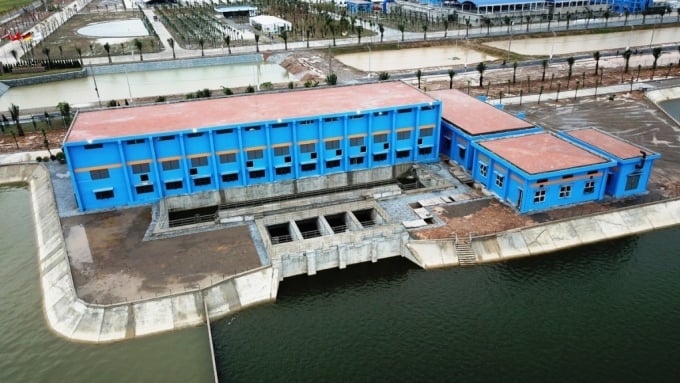
The Duong River surface water treatment plant (Gia Lam, Hanoi) put its first phase into operation at the end of 2018. Photo: Vo Hai
Another shortcoming pointed out by the Department of Construction is the difference in wholesale prices between water suppliers. The wholesale price of surface water from the Duong River is about 3,000 VND/m3 higher than that of surface water from the Da River, so Viwaco Company (which distributes water to Thanh Xuan, Hoang Mai, Dong Da, and Ha Dong districts - areas with low ground levels) buys the maximum amount of water from the Da River. This leads to water shortages in areas with high ground levels such as Thach That, Quoc Oai, and Chuong My, despite being close to the Da River.
Mr. Le Van Du, Deputy Head of the Technical Infrastructure Department of the Hanoi Department of Construction, stated that with the current pace of investment in the construction of water treatment plants and the operation of the water supply network, localized water shortages in many areas will continue to recur. In the summer of 2024, Hanoi faces a risk of a water shortage of approximately 50,000 cubic meters per day, concentrated in the west and southwest.
The government's goal of ensuring sufficient drinking water for the population by 2020 has not been achieved, and it is unclear when it will be reached.
Vo Hai - Pham Chieu
Source link

![[Photo] General Secretary and President To Lam presides over a meeting on assessing national development resources.](https://vphoto.vietnam.vn/thumb/1200x675/vietnam/resource/IMAGE/2026/05/20/1779253785852_a1-bnd-2943-8519-jpg.webp)



![[Photo] National Assembly Chairman Tran Thanh Man working with the Standing Committee of the Economic and Financial Committee](https://vphoto.vietnam.vn/thumb/1200x675/vietnam/resource/IMAGE/2026/05/20/1779249584387_ndo_br_1-jpg.webp)










































































Comment (0)