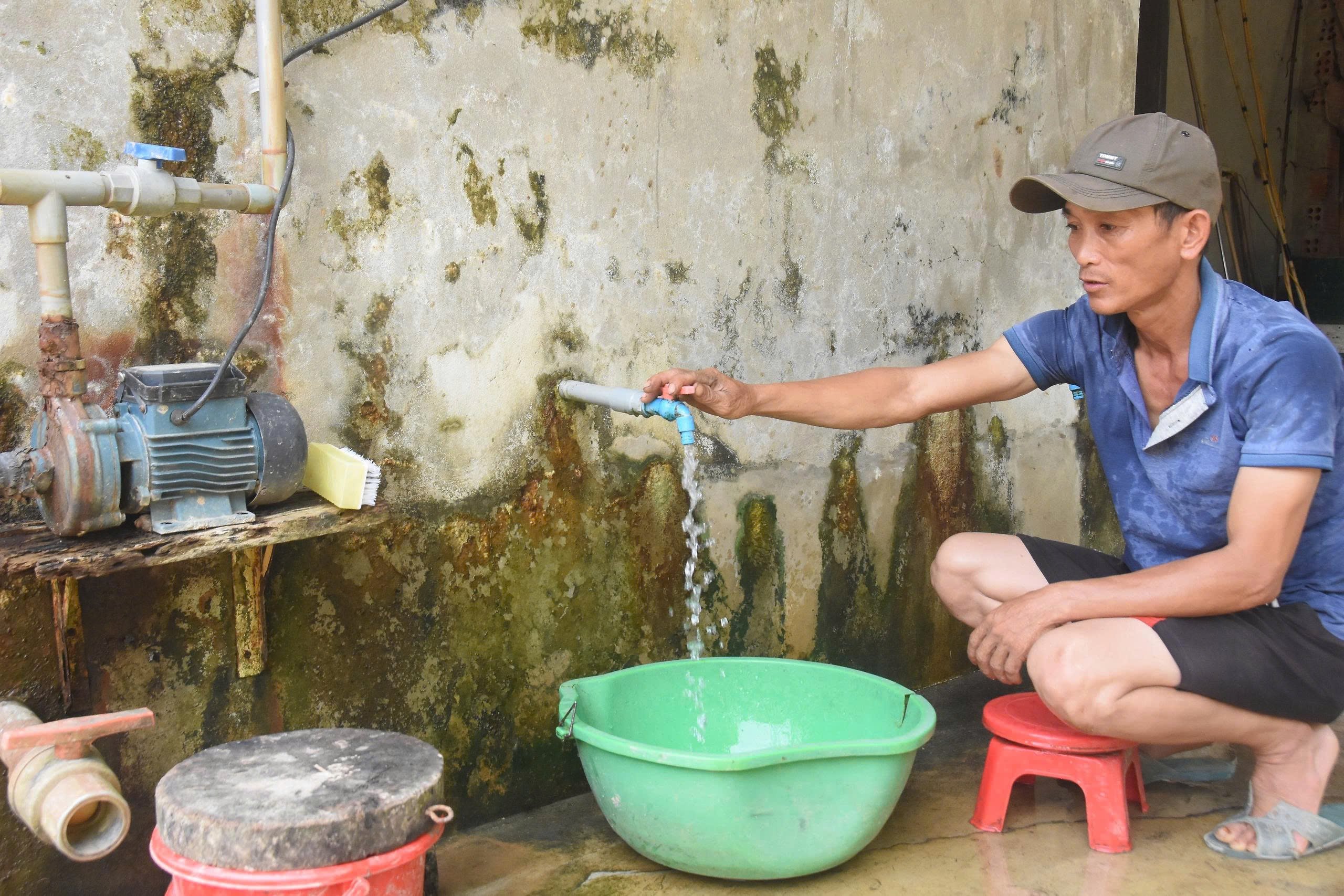
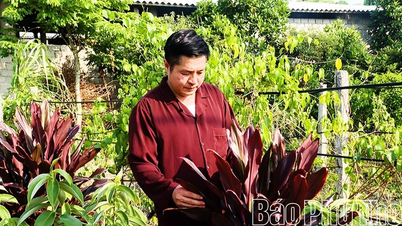
Mr. Tran Quang Ngoc, from Cuu Vinh Dinh hamlet, Don Que village, Vinh Dinh commune, stands beside his family's daily water tank - Photo: D.V.
My Thuy is one of the communes where, to this day, the majority of households still lack access to clean water. Almost all daily activities, including drinking and cooking, rely on water from open wells, pump wells, boreholes, and rainwater... which is then roughly filtered through cement tanks and small filtration systems that families have equipped themselves with before it can be used.
Pointing to a 500-liter stainless steel tank mounted on the ceiling, containing water pumped from a well for filtration, Mrs. Doan Thi Thu Loc from Dong Duong village, My Thuy commune, expressed her concern about the issue of drinking water. According to Mrs. Loc, her family has lived in the area since 1975, but to this day they have never had access to clean, hygienic water.
“All the water my family uses is mainly from a drilled well and rainwater that is collected and then filtered. As you can see, the sides of the storage tank are covered with a thick layer of reddish-brown scale, and the bottom is full of sediment. Even though I clean it regularly, the scale builds up again after a few days. Worried about illness, my family now mainly uses this water for bathing and washing,” Mrs. Loc said.
For daily drinking and cooking use, Mrs. Loc's family spends money each month buying 15-20 20-liter bottles of filtered water (8,000-10,000 VND per bottle). For a farming family like Mrs. Loc's, spending hundreds of thousands of dong on drinking water every month is truly difficult.
Mr. Phan Van Quang, a representative of the People's Council of the former Hai Duong commune, said that thousands of households in the commune share the same predicament of lacking clean water, with over 200 households in Dong Duong village alone. "During the annual meetings with constituents at the provincial and district levels, we and the people have raised the issue of the lack of clean water. But so far, there has been no result. We hope that the competent authorities will pay attention to and consider this very legitimate aspiration of the people," Mr. Quang said.
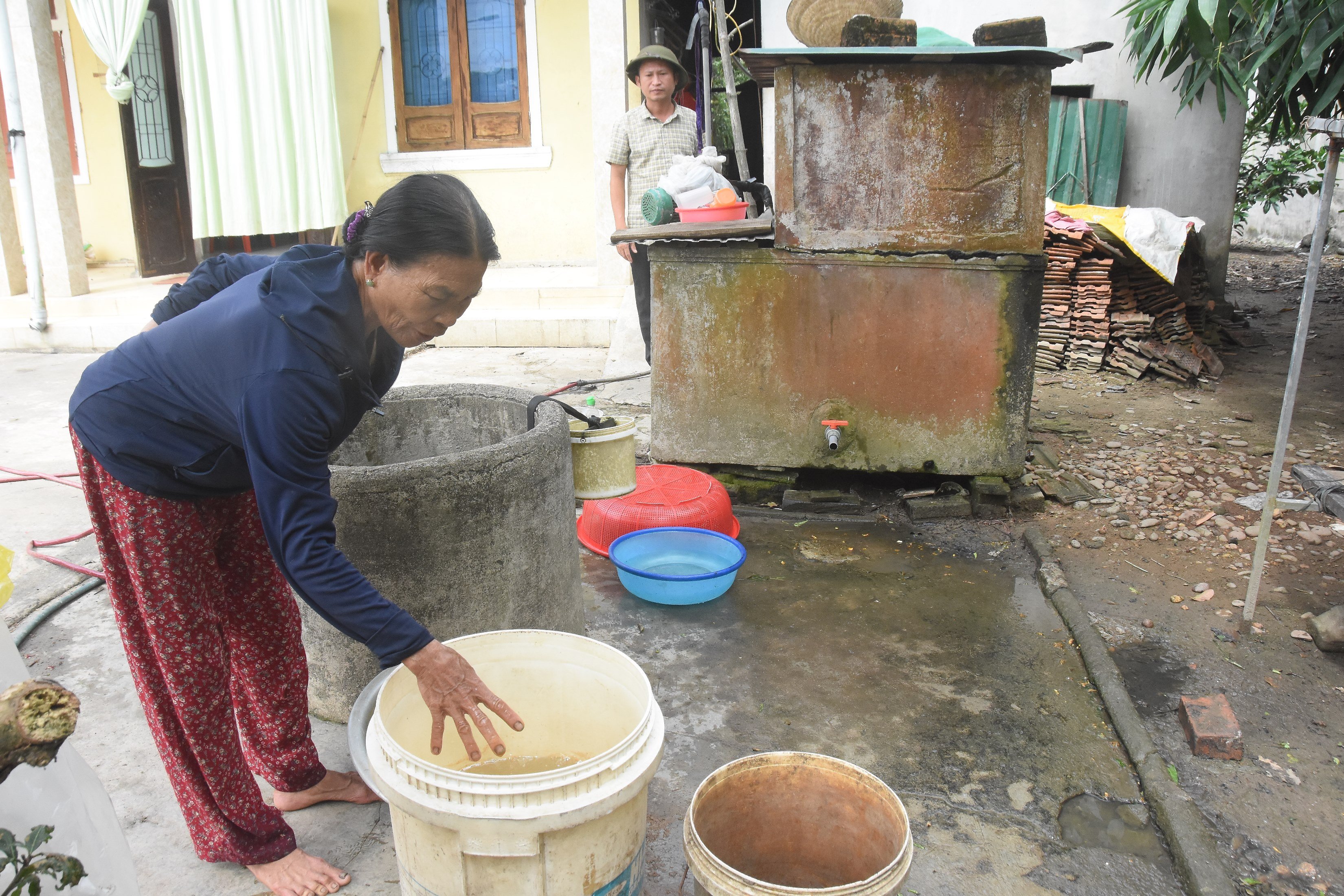
Ms. Ho Thi Chat, from Cuu Vinh Dinh hamlet, Don Que village, Vinh Dinh commune, has been using water contaminated with alum for many years - Photo: D.V.
In the neighboring Vinh Dinh commune, a severe shortage of clean water is also occurring in the villages of Don Que and Kim Long (affecting approximately 500 households). In particular, the Cuu Vinh Dinh and Tan Vinh Dinh hamlets in Don Que village are the most critical and severely affected by the clean water shortage.
According to the head of Don Que village, Ho Nhu Nui, the village currently has nearly 330 households, but over 250 households suffer from a severe shortage of clean water, while the rest only use water that is considered hygienic. Following Mr. Nui, we visited the family of Mrs. Ho Thi Chat (73 years old), who lives right in front of a branch of the Cuu Vinh Dinh river. Mrs. Chat suffers from a serious illness; her face is etched with wrinkles, lacking the vitality of a sick person. In less than a minute, the water pumped from the well used for washing tea turned a worrying dark purple color with foam.
“If you want to test the alum content of the water, you can tell by using tea leaves. The water here is heavily contaminated with alum. My family built a cement tank to filter it through multiple layers, then filtered it again with a small filter installed inside the house, but it didn't help much. My family is struggling financially and can't afford filtered water, so we have no choice but to use this source,” Mrs. Chắt said, pointing to a bucket of freshly pumped water with a thick layer of alum on the surface, speaking worriedly.
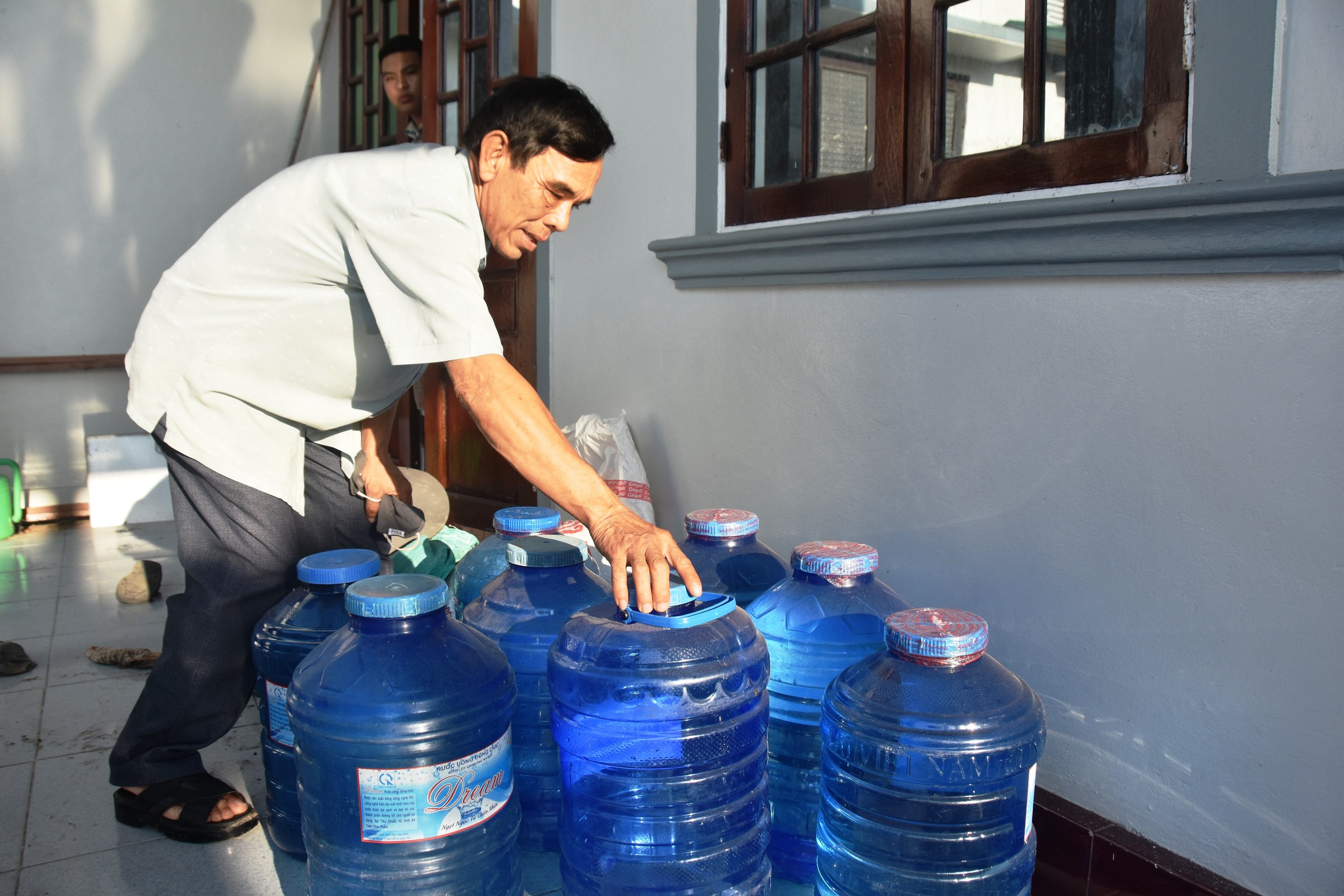
Residents of Dong Duong village, My Thuy commune, spend money each month buying 15-20 bottles of filtered water for drinking and cooking - Photo: D.V.
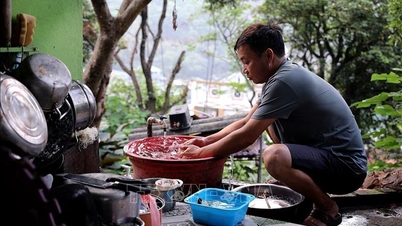
Not far away, Mr. Tran Quang Ngoc (46 years old) and his wife, Ms. Vo Thi Nguyet, were also busy preparing lunch for their family. Mr. Ngoc recounted that previously, his family spent money each month buying about 20 bottles of filtered water for drinking and cooking. However, to reduce costs and become more self-sufficient, in 2021, he and his wife invested in building a 5-cubic-meter cement tank with a multi-layered filter system including sand, gravel, and charcoal. The water from the tank is then filtered again in a filter installed inside the house before being used for drinking and cooking. However, every 1-2 months, Mr. Ngoc has to replace 3 filter cartridges at a cost of 150-180 thousand VND because of the excessive buildup of sediment.
Mr. Ngoc said, "Building a water filter is about as expensive as buying bottled water, but it's more proactive and less time-consuming." Mr. and Mrs. Ngoc said that most people in the village are very worried and anxious because serious illnesses are becoming increasingly common. "Even our parents have rectal cancer. And in this village, there are many people with cancer. Last year, two people in the village were diagnosed with esophageal and lung cancer, and they died just a few months after their diagnosis. We think the main reason for the increasing number of serious illnesses in the village is the long-term use of polluted water. We're very worried, but what can we do?" Mr. Ngoc shared.
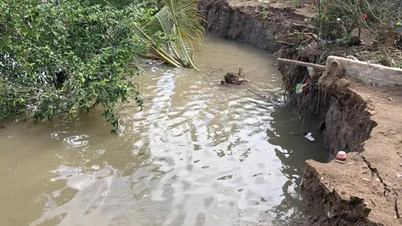
Village head Ho Nhu Nui added that because the Cuu Vinh Dinh river branch passing through the village is located downstream and is only about 3 meters wide, a lot of water hyacinth, garbage, rotting animal carcasses, and pesticide containers accumulate after each rainy season. Nui said: “After outbreaks of disease, dead sows often float down and get stuck in the Cuu Vinh Dinh river. We have had to repeatedly ask the health authorities to come down and help control the outbreak to limit environmental pollution.”
According to Mr. Nui, in recent years, the rate of people in the village suffering from cancers related to the liver, lungs, stomach, nasopharynx, rectum, etc., has been very high. Incomplete statistics show that in the past 5 years, more than 10 people have died from cancer, many of them young people.
According to Mr. Nui, during meetings with voters at all levels, people have repeatedly expressed their confusion and concern about their health if they continue to use polluted water sources.
On behalf of the local people, Mr. Nui proposed: “We hope that higher-level authorities and relevant agencies will soon pay attention to and meet the urgent need for clean water for the people. To suit the local situation and the wishes of the people, it is necessary to invest in building a piped water system to the villages and hamlets to ensure sustainable and long-term use. The people are eagerly awaiting and are ready to contribute additional resources to bring clean water directly to their homes.”
Duc Viet
Source: https://baoquangtri.vn/nhieu-lang-que-moi-mon-cho-nuoc-sach-195548.htm


![[Photo] General Secretary and President To Lam presides over a working session with the Central Policy and Strategy Committee on the development of the materials industry.](https://vphoto.vietnam.vn/thumb/1200x675/vietnam/resource/IMAGE/2026/05/21/1779359935432_a3-bnd-3129-1412-jpg.webp)






















































Comment (0)