

China has launched a large-scale construction project to establish a network of launch pads, shelters, and communication centers in desert areas near missile launch facilities housed in isolated silos.
This information was published by Reuters, based on an analysis of recent satellite imagery verified by international security analysts and arms control experts.
This new military infrastructure is designed to protect China's strategic nuclear arsenal from the threat of a preemptive strike from the United States, while also ensuring its ability to retaliate.
The published data reveals the discovery of more than 80 new concrete platforms, which could be used to deploy mobile launch platforms for intercontinental ballistic missiles and air defense systems.
The construction of specialized facilities for electronic warfare, satellite communications, and secure military command and control systems has also been noted in the desert region.
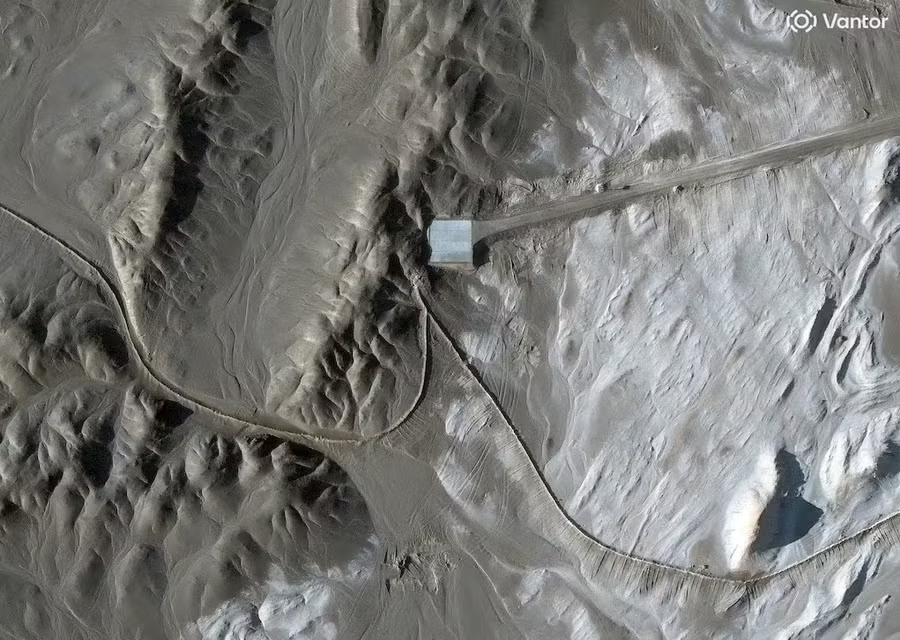
Construction activity is currently centered around two large octagonal structures, which have been underway for the past six years in eastern Xinjiang Uygur Autonomous Region. These fortified structures are located approximately 140km and 230km southwest of the large nuclear missile launch site in the Hami area.
Satellite imagery reveals that the octagonal complexes contain living quarters for personnel and large-scale military equipment storage. Surrounding these are reinforced concrete bunkers, secure weapons storage facilities, and a system of railways and runways connecting to the silos.
Analysts also noted heavy military exercises around the northern octagon during April and May. Nearby, large tents were seen, launch sites were camouflaged in the desert, and anti-aircraft missile batteries were operational to protect the area from airborne threats.
From each octagonal center, a network of dirt roads and underground communication lines stretches across thousands of square kilometers deep into the desert. According to experts from the Federation of American Scientists, these underground channels contain fiber optic cables that ensure secure communication between command centers and missile launch sites.
Senior researcher Tong Zhao at the Carnegie Endowment for International Peace said that the observation towers and satellite antennas are directly related to the C3 (command, control, communications) system, ensuring the operational control and management of China's strategic nuclear forces in the Hami region.
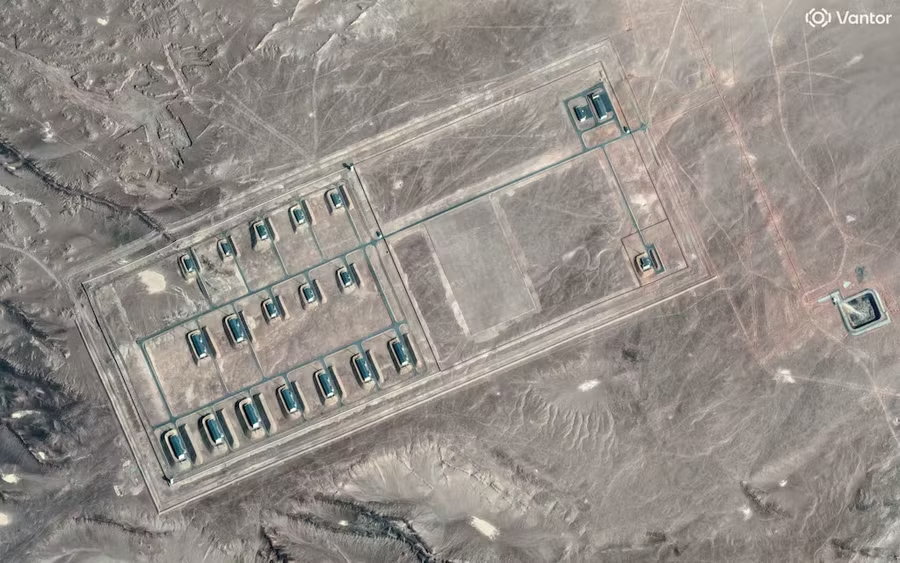
U.S. military commanders and weapons experts believe China is modernizing and expanding its nuclear capabilities at the fastest rate in the world .
According to a Pentagon report from December 2025, China's military-industrial complex aims to increase the number of deployed nuclear warheads to 1,000 by 2030.
Simultaneously, China has significantly enhanced its missile early warning system through the Huoyan-1 satellite series. This system is capable of detecting enemy intercontinental ballistic missile launches within 90 seconds and transmitting signals to the command center within 3-4 minutes, giving the country time to react before an attack occurs.
Source: https://giaoducthoidai.vn/ly-do-trung-quoc-dung-mang-luoi-quan-su-lon-giua-sa-mac-post779912.html






























![[Photo] Reception to welcome General Secretary and President To Lam and his wife on their State visit to the Philippines](https://vphoto.vietnam.vn/thumb/1200x675/vietnam/resource/IMAGE/2026/06/01/1780295488620_vna-potal-chieu-dai-chao-mung-tong-bi-thu-chu-tich-nuoc-to-lam-va-phu-nhan-tham-cap-nha-nuoc-toi-philippines-8798060-7855-jpg.webp)









































































Comment (0)