

To the land of ancient wells
Due to the many impacts of climate, weather, natural and social conditions, and especially the wars between Dai Viet and Champa, Trinh and Nguyen, and then the wars against the French and the Americans, the land of Quang Binh has endured so much fire, bombs, and bullets. Sharing the same fate as the structures on the surface, most of the ancient wells here are not intact as they originally were.
On the other hand, ancient well systems are civil and practical structures closely linked to the daily life of the community. Therefore, to suit the economic and social circumstances and to best meet human needs, some wells have been renovated, restored, and partially renovated, causing changes in materials, scale, structure, and appearance. Others, due to disuse, have been abandoned.
Nevertheless, a large number of ancient wells in the province remain intact and are being effectively utilized in the economic, cultural, tourism , and spiritual life of the local community.
Over 100 ancient wells exist and continue to thrive in the villages of Quang Binh, showcasing diverse and rich characteristics in architecture and construction techniques, proving the value of this precious heritage. The four Cham wells in Phap Ke, Quang Phuong commune (Quang Trach district), as well as other Cham wells in Quang Tung, Quang Phu (Quang Trach district), Thanh Trach (Bo Trach district), Mai Thuy (Le Thuy district)... are remaining Cham heritage sites in Quang Binh, inherited, restored, and renovated by the Vietnamese over several periods.
According to the late Professor Tran Quoc Vuong, the Cham people were very experienced in finding water sources to dig wells for daily life and production.
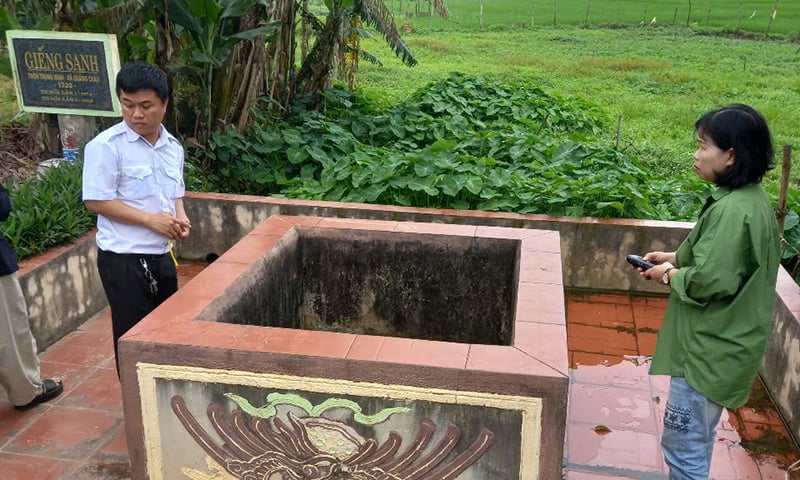 |
The ancient well systems in Quang Binh are water extraction structures built by the Cham people or by the Vietnamese using Cham techniques. They are abundant and diverse, depending on the topography, geomorphology, and ecology.
That is, ancient wells, if located in coastal areas with sandy soil, mostly have a bottom lined with ironwood or teak, followed by a layer of stone, possibly boulders or boulders, and then brickwork. These wells are mainly found in coastal villages of Quang Trach and Bo Trach districts, such as Di Luan, Xuan Kieu, Thanh Khe, Ly Hoa...
Some other wells, located in hilly, midland, and riverside areas, also have wooden planks at the bottom, followed by honeycomb stone and brickwork, resulting in very clear water. There are also some more unique wells where the well bottom is not lined with bricks horizontally but with bricks arranged vertically, making the well very stable and less prone to collapse compared to wells in sandy coastal areas.
The ancient wells are all located in or near residential areas and are surrounded by beautiful natural landscapes, with banyan trees by the water's edge, village courtyards, fig trees, banyan trees, coconut trees... providing shade, next to transportation routes, at the beginning or center of the village, places where villagers gather when the moon rises at night, and meeting places for many people when they go to fetch water...
Depending on the terrain and mountainous landscape, people have built wells to suit the conditions. Besides the wells dug after exploring and discovering underground water sources (both Cham and Vietnamese), wells formed by naturally flowing underground springs are also used, such as the Vot well in Tien Hoa (Tuyen Hoa), the Con Ca well in Vo Ninh (Quang Ninh), the Ruc Ba Nuong well, the Boi well in Cau Loi village, Xuan Hoa commune (Minh Hoa), the Boong well in Xuan Lai village, Mai Thuy commune (Le Thuy), and the Bun well in Quang Chau commune (Quang Trach)... The materials and architecture are also very diverse and rich, depending on the soil and land conditions of each locality.
Unlike ancient wells in the North and South of Vietnam, ancient wells in Quang Binh mainly have basic structural forms: square wells, wells with a square base and a round top, wells that are round from bottom to top, and some with square walls but a round interior. Depending on the local land and water source, ancient wells can be pond wells, holding rainwater, such as the Van well and Ho well in Hien Loc (Duy Ninh, Quang Ninh), with diameters up to 12 and 15 meters, and well walls built of earth. Most are wells with springs, left behind by the Cham people and subsequently restored and used by the Vietnamese.
The architecture of ancient wells carries special cultural and religious significance; their shapes are diverse, sometimes round from bottom to top, sometimes square at the bottom and round at the top, sometimes round at the bottom and square at the top, and sometimes square from bottom to top...
The structure consists of the well walls, the well body, and the well bottom. The bottom may or may not be lined with wood; the well body is the part that holds the water, usually constructed of stone or brick; the well walls are sometimes built of stone, sometimes of brick, or even of earth, with earthen walls being the most common type of well used for ponds and wells that collect rainwater.
Ancient wells in Quang Binh province have existed for thousands of years. In the past, these wells were the main water source for both communities and tourists from all over, such as the ancient wells in Quang Phu and Canh Duong (Quang Trach), where foreign merchant ships often stopped to get fresh water during their long voyages at sea.
Ancient wells are closely linked to cultural life.
Ancient wells in Quang Binh, like ancient wells in Vietnam in general, are the heart, the eyes, and the soul of the village. They believe that wells also have souls and spirits; therefore, every ancient well has a solemn altar or shrine beside it. The four Cham shrines in Phap Ke, Quang Phuong commune, all have shrines and altars. Every year, the village organizes two well cleaning ceremonies (the first in the fifth lunar month to prepare for the blessing ceremony and the second in the twelfth lunar month to obtain clean water for the Tet (Lunar New Year) offering). When cleaning the wells, if the water flows evenly in all four directions, it is considered auspicious. If the flow is weak in one direction, the elders organize a ceremony to pray for the flow to be restored. A smooth flow of energy brings good fortune to future generations.
Next to the ancient well is an altar for wandering souls, often called the "Altar of Wandering Souls" of the village. Therefore, every year on the 14th day of the first lunar month, people from all the villages clean the graves of unclaimed souls and prepare offerings to bring to the Altar of Wandering Souls to worship those souls who have no one to worship them. This is a precious custom of the local residents, closely associated with the ancient well.
Even the Dong well in Bac Ha, Quang Tung commune (Quang Trach district) has a shrine covering the ancient well, a large altar, a well cover, and a clean environment and landscape around the well. In some villages, the well water is used to make tea for offerings or to replace the water on the ancestral altar, such as the Sanh well and Quan well in Tho Ngoa, Quang Thuan (Ba Don town)...
Ancient wells, in addition to providing fresh water for daily life and agricultural production, also hold special cultural and religious significance for the local communities across generations, being considered symbols of life, prosperity, and sacredness.
Ta Dinh Ha
>>> Lesson 2: Preserving and promoting the value of ancient wells
Source: https://baoquangbinh.vn/van-hoa/202506/mach-nguon-gieng-co-bai-1-gieng-co-trong-doi-song-van-hoa-lang-xa-2226994/


![[Photo] Prime Minister Pham Minh Chinh attends the Conference on the Implementation of Tasks for 2026 of the Industry and Trade Sector](/_next/image?url=https%3A%2F%2Fvphoto.vietnam.vn%2Fthumb%2F1200x675%2Fvietnam%2Fresource%2FIMAGE%2F2025%2F12%2F19%2F1766159500458_ndo_br_shared31-jpg.webp&w=3840&q=75)



































































Comment (0)