

Nostalgia for the misty harbor
"The trees are naturally strong and their leaves are tough. No matter how the wind blows, no one can resist it," a folk verse speaks of the generous and courageous spirit of the merchants in the Mekong Delta region in the past. But today, Ms. Ha (46 years old), a long-time small trader, laments: "Looking at the embankment construction, it seems like it wants to shut down all the trading. The merchants are all leaving. The market is about to sink, not thrive anymore."
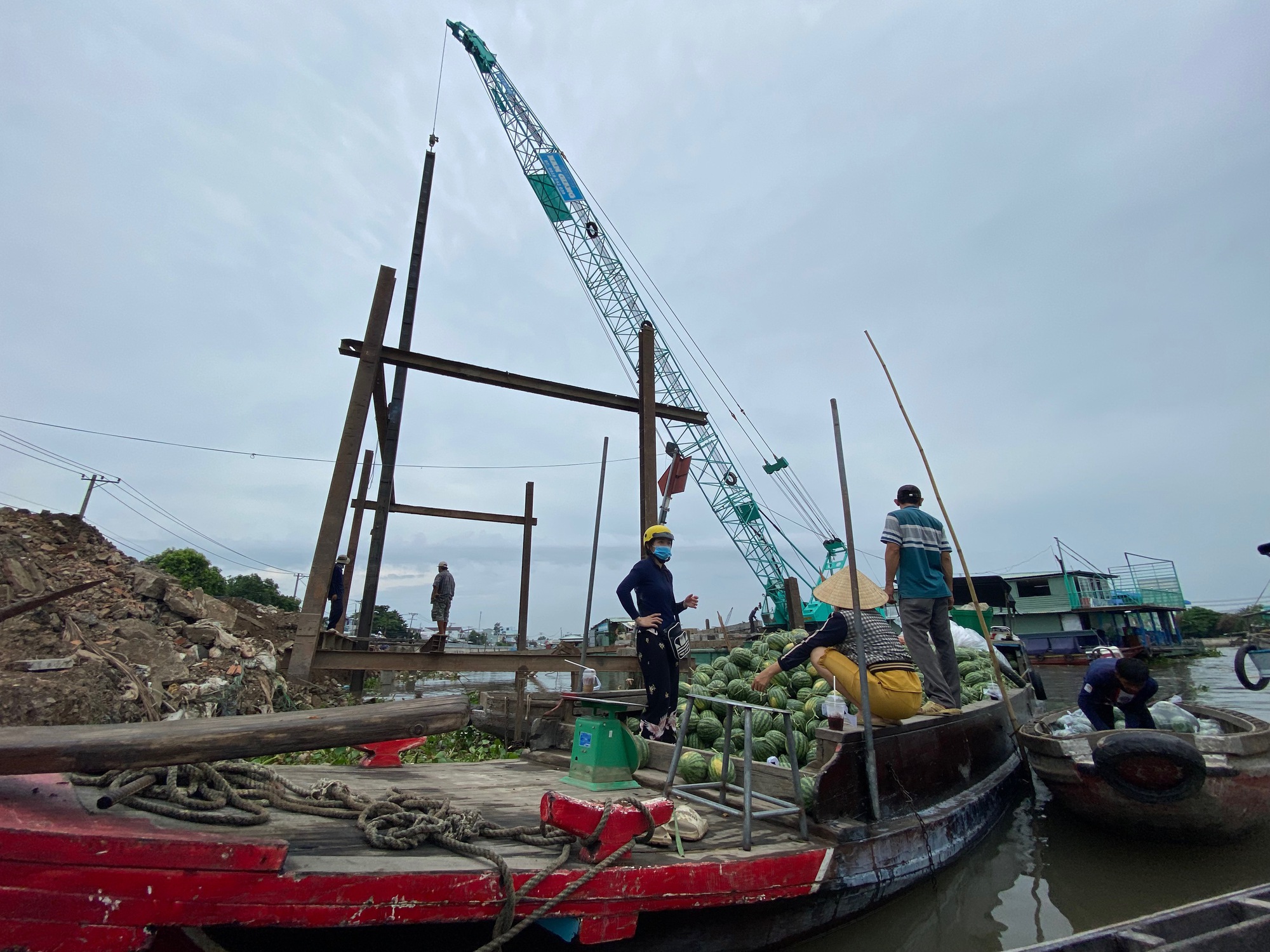
Watermelon boats dock at the empty space of the embankment construction site to unload their cargo in the old Mù U wharf area.
Mr. Nguyen Van Cong (51 years old), Ms. Ha's husband, recounted: "About forty years ago, the market had four wharves. There was the Cau Cai Rang wharf, then the Mu U wharf because there were Mu U trees there for decades, so the locals called it that. It was very convenient for boats to come and go. After the embankment was built, the other wharves were also dismantled, such as the Nam Thong wharf and the Mrs. Tuyet cabbage wholesale wharf."
The family doesn't own any farmland, so all seven siblings of Mr. Cong and Ms. Ha sell goods wholesale at the floating markets throughout the delta. "Before, I used to pick red water spinach, taro leaves, and banana leaves from Phong Dien to sell at the market. After a while, I saw that this was a good business, the market was lively, so I stayed here. We've been living on this raft since the time we had to register for temporary residence and pay a boat docking tax of 1,000-3,000 dong. Now they don't collect it anymore." Then Ms. Ha pulled out an old 500-dong and 200-dong banknote, saying, "Here, we used to sell these when the ferry fare was only 200 dong per trip, then it went up to 500 dong per trip. Back then, it was a small amount of money, but we could make a living. Now, the currency has lost its value, and whatever we earn is affected by expenses. I kept these old banknotes as souvenirs."
Mr. Cong and Ms. Ha's family lived on a numbered raft, a temporary residence. Every day, Ms. Ha went to the floating market to buy wholesale fruits and then sold them to wholesalers on shore. "In the old days, rowing fruit boats from the orchards to the market at sunset was beautiful. Early in the morning, there were several boats loaded with eggplants, stacked in bundles inside the boat, without wrapping, just using baskets, so sometimes you didn't even need to look at the poles to know it was a boat selling eggplants. Sweet potatoes came from Long An, cassava from An Giang , Ba Tri (Ben Tre), watermelons from Can Tho were the best, and watermelons from Long An were also famous. Merchants bought the produce from the orchards and then transferred it to boats for wholesale. In the old days, the boats sped along. Pineapples from Kien Giang, pumpkins from Vinh Thuan and U Minh (Ca Mau) were all transported by river. Wherever the fields were located, the boatmen would follow that route," Mr. Cong recalled the bustling wholesale trade of the floating market.
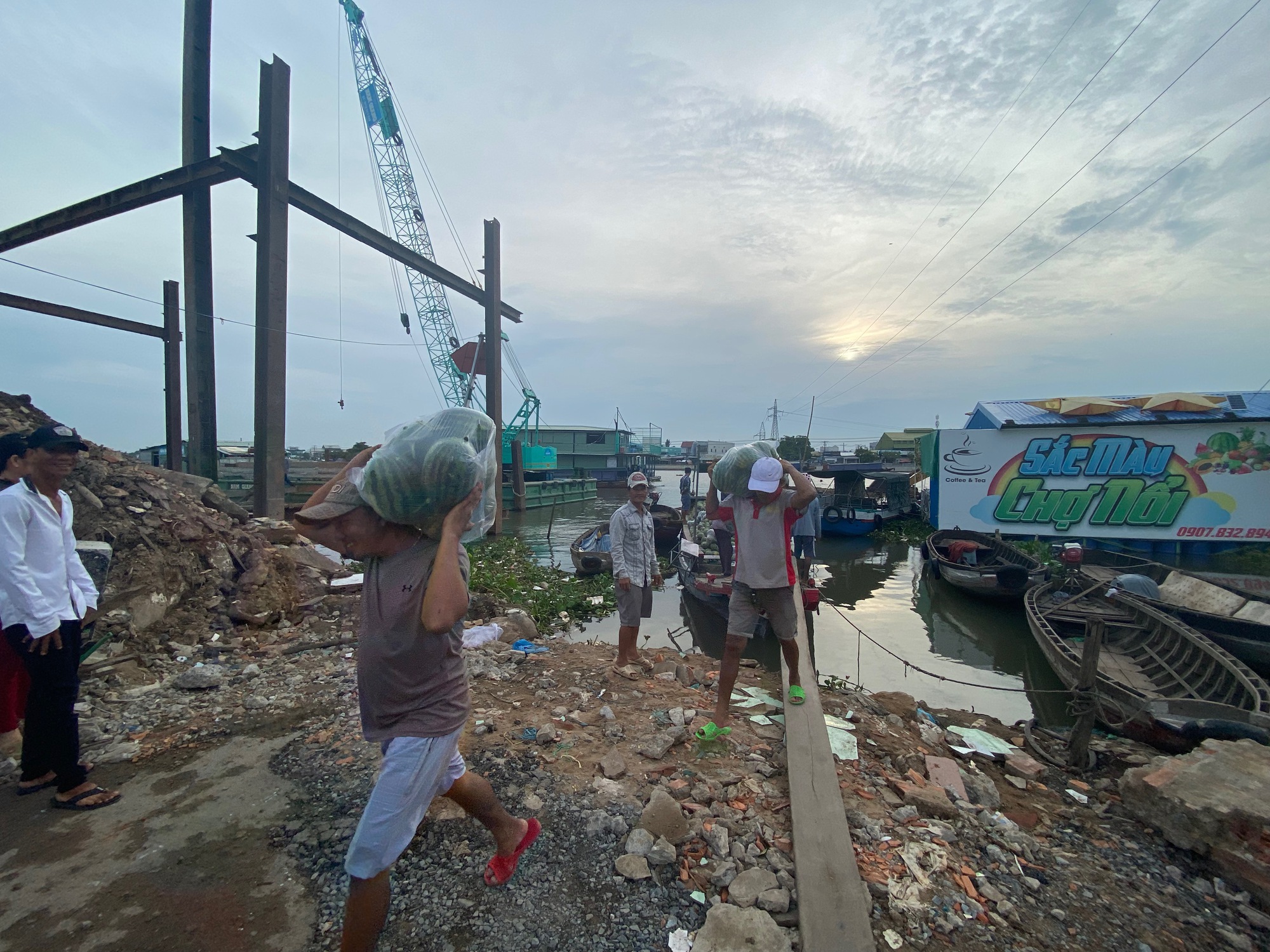
The porters at the Cai Rang floating market dock.
To develop tourism , it is necessary to preserve floating markets.
At the floating market, there are not only long-time traders. Throughout the old docks, there are many teams of porters whose work is passed down from father to son. For example, the family of Mr. Pham Hoang Thai (68 years old), now retired, has his son, Mr. Pham Van Dinh (42 years old), continuing the trade. He has worked in the market's porter team since he was 18. "There used to be a lot of people, now there are only two teams working in shifts: 15 people in the morning and 17 people in the afternoon," Mr. Dinh recounted. Mr. Nguyen Hoang Phuong, 44 years old, from Cai Rang, Can Tho, who used to be the deputy head of a porter team, added: "Dinh and I had two fathers who were the team leader and deputy leader, then they passed the job down to the younger guys. The wages are calculated by the ton, about 200,000 - 300,000 VND per day."
Late in the afternoon, boats loaded with watermelons and sweet potatoes crowded together, vying for mooring spots along the riverbank on Vo Thanh Street, An Binh Ward. Along Vo Thanh Street now stand large concrete blocks, and pile-driving machines rumble all day long. Merchants have added wooden supports to connect their boats to the shore to unload their goods, and porters carry bags of fruit across the road to load them onto trucks. "Before, trucks only needed to dock at the riverbank to load their goods. Now, the embankment is completely built, leaving only this area untouched, so we're taking advantage of the opportunity to load the goods. The porters have to go through 2-3 extra steps to unload. Previously, a truck only needed 5 people, but now it takes 7-8 people to get the goods to customers on time," said Mr. Dinh.

Merchants stand on the bow of their ship, watching the sunset after the afternoon rain on May 25th.
The project for the preservation and development of Cai Rang floating market was approved by the People's Committee of Can Tho City in 2016, comprising 13 main items. Mr. Dang Ngoc Nhan, Director of the Culture, Sports and Broadcasting Center of Cai Rang District, stated that statistics from 2022 show that the number of fixed boats and small boats on the floating market remains at 390. Of these, 240 are merchant boats, 80 are tourist boats, and 70 are boats for street vendors. "The embankment is currently under construction, and preparations are underway to build a pier so that traders have a place to disembark," Mr. Nhan added.
However, according to Ms. Ha, since the beginning of 2023, many of her vendors at the floating market have moved ashore to find warehouses for their goods. Doing business on the river is difficult because there are no docks, and tourist boats are running all day, leaving them with nowhere to go to pick up their supplies. Ms. Ha stepped onto a section of the river where embankment construction was underway, expressing her concern: "The traders have lived off the floating market for generations. They say they want to preserve the market for tourism, but they're building embankments, and without docks, all the boats will leave. What will tourists do then when they come to visit the floating market?"
Like many other traders, the family of Mr. Ho Trang Ngoc Loi in the "sweet potato village" doesn't know what they will do if the floating market becomes a tourist market in the future. "My parents are old now, so I'm the one who mainly helps out. My hometown is in Kien Giang, but I don't even go back for Tet because I consider the market my home. I don't know what I'd do to make a living on land... The space on land to open a warehouse now costs over 10 million dong, and it can't hold much. Just look at this boat, but two or three boats can hold 50-60 tons of goods," Mr. Loi said, watching the tourist boats whizz by, his voice somber. He sighed, "People usually move out on their own after getting married. But I've lived on a boat since I was a child, so if I move to the floating market, I'll probably end up single." Upon further inquiry, it turned out that although he's over 30, he's never married because he's lived on a boat with his parents since he was a child...
Cultural researcher Nham Hung (Can Tho City) shared: "Nowadays, roads have covered all communes and hamlets in the delta region. With rivers below and roads above, it will facilitate the trade of goods. One day, the system of floating markets on the river may gradually decline and disappear. The question is, how to preserve this cultural feature? The government must have policies to preserve the culture of floating markets, such as solutions to create a roadmap for transitioning from natural to artificial floating markets. Particular attention should be paid to solutions that create conditions for traders to continue setting up markets on the river, which is also a cultural feature that attracts tourists."
Source link
![[Photo] General Secretary and President To Lam presides over a meeting with the Central Organizing Committee.](https://vphoto.vietnam.vn/thumb/1200x675/vietnam/resource/IMAGE/2026/06/03/1780482764658_a1-bnd-4741-3342-jpg.webp)
![[Photo] First session of the 14th Congress of the Vietnam Trade Union](https://vphoto.vietnam.vn/thumb/1200x675/vietnam/resource/IMAGE/2026/06/03/1780465947883_ndo_br_img-3852-jpg.webp)

![[Photo] Secretary of the National Assembly Party Committee, Chairman of the National Assembly presides over the meeting of the Standing Committee and Executive Committee of the National Assembly Party Committee.](https://vphoto.vietnam.vn/thumb/1200x675/vietnam/resource/IMAGE/2026/06/03/1780480353201_ndo_br_bnd-2585-jpg.webp)















































![[Video] Sunset at Lap An Lagoon – Where the sun sets over the fishing nets](https://vphoto.vietnam.vn/thumb/1200x675/vietnam/resource/IMAGE/2026/05/31/1780192137701_beach-landscape-sea-water-nature-grass-745871-pxhere-com.jpeg)


































Comment (0)