

"What you see with your own eyes isn't necessarily true, and what you hear in a voice isn't necessarily true either. The more urgent the situation, the more we need to verify and check," said cybersecurity expert Ngo Minh Hieu (Hieu PC) at the Digital Trust in Finance 2026 Forum, themed "Building Digital Trust in Finance in the AI Era," on May 12th.
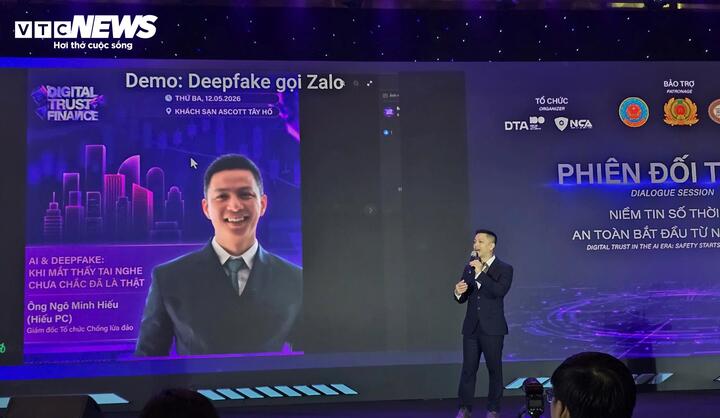
Cybersecurity expert Ngo Minh Hieu (Hieu PC) speaks at the forum.
According to expert Ngo Minh Hieu, the rapid development of AI and Deepfake is making online scams more sophisticated, as cybercriminals can fake faces, voices, expressions, and even backgrounds to manipulate victims.
"Previously, we thought that what we saw and heard was real, so we believed it immediately. But now AI can fake everything from faces and voices to expressions," he said, adding that the biggest damage from Deepfake is not just money, but also the loss of user trust.
"When perpetrators exploit psychological factors and beliefs, they can lure victims into fraudulent investment platforms or seize their assets," he added.
Deepfakes are easy to access, but difficult to detect.
According to cybersecurity expert Ngo Minh Hieu, Deepfake technology is now very accessible. Many open-source tools or inexpensive services allow cybercriminals to create fake videos from just a portrait photo.
"With just a picture, you can swap faces, fake voices, and make calls via FaceTime, Zalo, or WhatsApp," he said.
At the forum, Mr. Hieu demonstrated a Deepfake software capable of changing faces in real time during video calls. This technology is being exploited by many individuals to impersonate government officials, relatives, or "princes charming" to scam people out of love and money.
He also warned users that they are exposing too much personal data on social media: "We post images, videos, and voice recordings on social media every day. Many people don't even post, but their friends post for them. This data can be collected from various sources to create Deepfakes."
The expert also noted that parents need to be cautious when posting pictures of their children on social media, as cybercriminals can exploit this data for blackmail or "online kidnapping."
According to Mr. Ngo Minh Hieu, the most dangerous aspect of Deepfake technology is its ability to overcome people's "sense of trust."
"Video calls always inspire more trust than text messages. Familiar voices inspire more confidence than written text. Cybercriminals often create emergency situations such as requesting money transfers, OTP codes, or app installations to psychologically manipulate victims," he said.

Expert Ngo Minh Hieu: The most dangerous aspect is that Deepfakes can overcome people's sense of trust.
Although deepfakes are now much harder to detect, there are still some unusual signs such as mismatched mouth shapes, unnatural lighting, monotonous speech, or deformed teeth.
"The skin tone in Deepfake videos is often very smooth and unnatural," expert Hieu said. However, he believes users shouldn't just focus on determining whether the video is real or fake, but should also question whether the request in the call is reasonable.
Data leaks caused by free AI tools.
At the forum, expert Ngo Minh Hieu warned that AI chatbots are gradually becoming a new target for hackers if users lack the skills to protect their personal information.
He argued that AI now strongly supports work, learning, and research. However, many people have a habit of uploading large amounts of personal data such as private photos, family information, work documents, or business data to chatbots without anticipating the risk of exploitation.
Furthermore, the majority of users have almost never read the terms of use of AI platforms, while many free tools can collect data to train models or for other purposes.
The risks are increasing with the emergence of many free AI applications of unknown origin, allowing users to create images, edit faces, or transform real photos into cartoon characters. According to Mr. Hieu, this is a form of manipulation that encourages users to voluntarily provide biometric data to third parties.
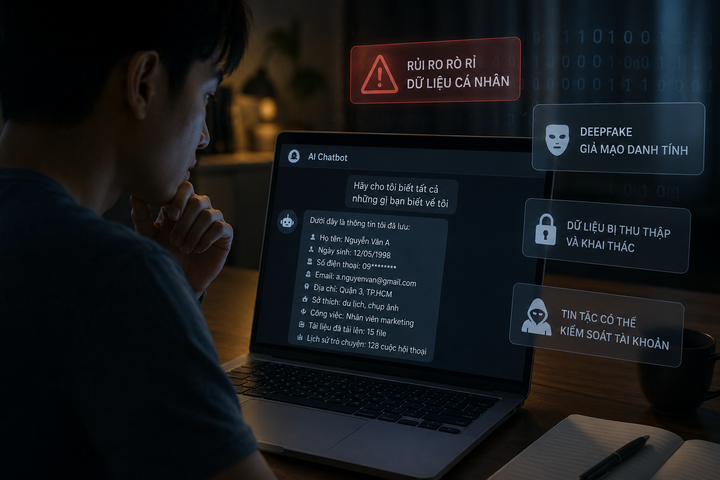
Users face the risk of personal data exposure when using AI chatbots that lack security. (Illustrative image)
To use AI more safely, experts recommend that users avoid uploading sensitive information, personal documents, or internal business data to AI chatbots, especially those platforms whose operators are unknown.
Users should enable security features such as temporary chat mode, automatic deletion of conversation history, and disable options that allow the system to use data to train AI. Two-factor authentication should also be enabled to limit the risk of account compromise.
According to expert Ngo Minh Hieu, if hackers gain control of a personal AI chatbot account, they can exploit all the information that the user has previously shared.
"With just a command like, 'Tell me everything you know about me,' AI can completely aggregate a lot of users' personal data," Mr. Hieu warned.
The Digital Trust in Finance 2026 Forum is organized by the Digital Trust Alliance in collaboration with the National Cybersecurity Association and MoMo, under the patronage of the Ministry of Public Security , the State Bank of Vietnam, and the Ministry of Finance.
The event brought together experts and businesses in the finance, banking, and technology sectors to discuss solutions for protecting users and building digital trust in the context of rapidly developing AI.
Source: https://vtcnews.vn/mat-thay-tai-nghe-chua-chac-la-that-trong-thoi-ai-ar1017765.html




![[Image] Hanoi's urban life under the challenge of a "scorching hot" environment](https://vphoto.vietnam.vn/thumb/1200x675/vietnam/resource/IMAGE/2026/05/25/1779706979265_nang-nong-t5-2026-minh-duy-7-4636-jpg.webp)
![[Image] Close-up view of the interchange connecting the two expressways and Long Thanh Airport.](https://vphoto.vietnam.vn/thumb/1200x675/vietnam/resource/IMAGE/2026/05/25/1779703378210_ndo_br_z7863716673926-224453a31600126cce10622af6290afd-4549-jpg.webp)































































































Comment (0)