

The Swiss Sirius Jet electric aircraft is equipped with approximately 20 propellers for vertical takeoff and uses liquid hydrogen fuel for a long operating range.
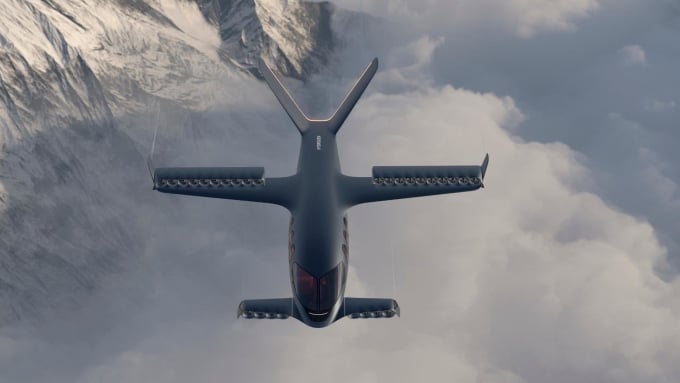
The design of the Sirius Jet electric aircraft, powered by liquid hydrogen. Photo: Sirius Aviation AG
Swiss startup Sirius Aviation AG is developing the Sirius Jet, an electric vertical take-off and landing aircraft with a range of 1,850 km and a top speed of 520 km/h, using a clean liquid hydrogen propulsion system, New Atlas reported on January 10. To take off vertically, this aircraft uses approximately 20 electric propellers with a diameter of only 30 cm.
The engineering team at Sirius Aviation AG began developing the Sirius Jet in 2021. The company stated that they have begun the process of applying for certification from the Federal Aviation Administration (FAA). The prototype is expected to make its first flights in 2025. The aircraft is expected to receive full certification and begin commercial flights in 2028.
The Sirius Jet resembles a smaller version of the Lilium Jet, Germany's electric vertical take-off and landing (VTOL) aircraft, but it runs on hydrogen for higher energy storage density and a longer range. The vehicle also uses thrust redirected from rows of propellers instead of simply tilting the thrusters like the Lilium Jet.
To achieve a maximum flight range of 1,850 km, passengers need to use the Business version with a capacity of 3 passengers. With the Millennium version, which carries 5 passengers, part of the space reserved for the hydrogen tank is replaced with 2 seats, reducing the range to 1,046 km. However, this is still more than four times the 200-250 km range of electric aircraft using Lilium Jet batteries. Thus, the Sirius Jet can operate on routes such as Los Angeles - San Francisco, London - Berlin, Melbourne - Sydney, or Beijing - Seoul.
The production and deployment of the Sirius Jet will face numerous challenges. One of the major issues is liquid hydrogen fuel. Liquid hydrogen has enormous energy potential and is suitable for long-haul flights. However, this fuel needs to be kept at extremely cold temperatures, around -253 degrees Celsius, throughout all stages of delivery, filling, and flight. The use of liquid hydrogen in aviation is also underdeveloped. The world's first manned flight using liquid hydrogen only took place last September, conducted by the German company H2Fly with an HY4 aircraft.
Thu Thao (According to New Atlas )
Source link


![[Photo] General Secretary and President To Lam presides over a meeting on preparations for the review of one year of operation of the three-tiered government system.](https://vphoto.vietnam.vn/thumb/1200x675/vietnam/resource/IMAGE/2026/06/02/1780391821195_a1-bnd-4595-9717-jpg.webp)
































































































Comment (0)