

- Summary of the first two years of implementing Government Project 06.
- Meeting of the Government Steering Committee on Science , Technology Development, Innovation, Digital Transformation and Project 06
- The Prime Minister chaired the session on science and technology development, innovation, digital transformation, and Project 06.
Clean data standard
This change began with data. When the national population database was cleaned up, standardized, and interconnected across sectors, previously fragmented information became a unified system. As a result, numerous administrative procedures were streamlined, reducing the number of required documents and significantly shortening many processes. Citizens no longer had to carry multiple documents or repeatedly fill out information already available to them by the government.
Mr. Nguyen Huu Duc, from Bong Sung hamlet, Tam Giang commune, compared the process of getting paperwork done before and now: “Sometimes I had to run back and forth several times, missing this document, making that mistake, wasting a whole day. Now, with the level 2 electronic identity verification account, I only need to bring my phone, and the officer can look up all the information. I don't have to go back and forth to supplement it anymore, the procedures are processed quickly, efficiently, and cost less.”
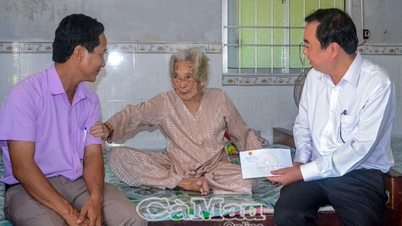
The story of Ms. Truong Thi Ut, from Lung Rong hamlet, Dinh Thanh commune, illustrates another aspect of administrative reform. At over 60 years old, she used to be apprehensive whenever she had to deal with administrative procedures. "Now, with the guidance of the officials, the process is quick and I'm no longer as afraid as before," Ms. Ut said.
 Citizens carry out administrative procedures at the Ca Mau Provincial Public Administrative Service Center.
Behind these seemingly simple conveniences lies the persistent effort of the police force, those who directly "bring the data to life." From the early days of collecting population information, to issuing citizen identification cards, and then integrating electronic identification, it has been a long journey, requiring accuracy, perseverance, and even silent sacrifice.
Lieutenant Luong Tran Mai Anh, an officer from the Administrative Management and Social Order Police Department of the Provincial Police, is one of the people directly involved. Her work doesn't stop at the application reception desk. During peak days, she and her colleagues bring equipment to remote hamlets, sometimes traveling by boat, going to each house to issue identity cards to the elderly, the infirm, and those who lack the means to travel. On some days, the team sets up a mobile service point right at the school to promptly issue identity cards to students before the exam. "There are days when we work until late at night, even on Saturdays and Sundays without rest. But when I see the people, especially those in need, receiving timely support, I feel the work is much more meaningful," Lieutenant Luong Tran Mai Anh shared.
The core of Project 06 is creating data interoperability. When population data, identity cards, and electronic identification and authentication are connected to the systems of various sectors, citizens will no longer need to re-provide existing information. This is a crucial step in administrative procedure reform.
Transparent administration
Practical implementation shows that when data becomes the foundation, the transparency of the administrative system is significantly enhanced. Every piece of information has a source, is verified, and used consistently. The process of handling documents is standardized, minimizing errors and limiting "gaps" that can easily lead to corruption. Citizens can monitor, check, and feel more secure when conducting administrative transactions.
However, digital transformation is not a smooth road. In some places, the habit of using traditional paper documents still persists; a segment of the population, especially the elderly, is still unfamiliar with technology. This requires perseverance in communication and guidance, as well as flexibility from enforcement forces to both modernize and ensure that no one is left behind.
 To avoid requiring residents to travel far, the Vinh Hau commune police force proactively processed identity cards and electronic identification for the people.
Therefore, in addition to maintaining points for issuing identity cards and electronic identification, the police force throughout the province has proactively organized mobile teams to go directly to residential areas, schools, and social welfare centers to support the people. This "going door-to-door" approach is not only aimed at meeting targets but also at bringing policies closer to people's lives.
In the future, as the system continues to be improved and deployed synchronously to every commune and ward, the gap in accessing public services will continue to narrow. At that time, every citizen, whether in remote or urban areas, will be able to access administrative procedures conveniently and quickly.
 Police officers are diligently guiding citizens through the procedures for obtaining identity cards and electronic identification, bringing public services closer to the people.
From a broader perspective, Project 06 is contributing to reshaping the relationship between the State and the people in the digital age. When data is connected and processes are transparent, trust is no longer an abstract concept, but is measured by concrete experiences: a shortened procedure, a reduced number of trips, and a timely resolution of a case.
Nguyen Dao
Source: https://baocamau.vn/mo-duong-cho-nen-hanh-chinh-minh-bach-a128393.html
![[Image] Close-up view of the interchange connecting the two expressways and Long Thanh Airport.](https://vphoto.vietnam.vn/thumb/1200x675/vietnam/resource/IMAGE/2026/05/25/1779703378210_ndo_br_z7863716673926-224453a31600126cce10622af6290afd-4549-jpg.webp)




![[Image] Hanoi's urban life under the challenge of a "scorching hot" environment](https://vphoto.vietnam.vn/thumb/1200x675/vietnam/resource/IMAGE/2026/05/25/1779706979265_nang-nong-t5-2026-minh-duy-7-4636-jpg.webp)
















































































Comment (0)