


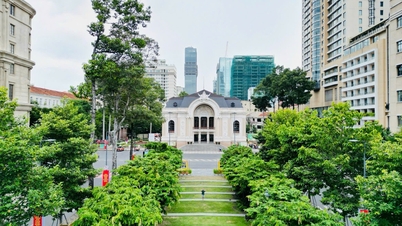
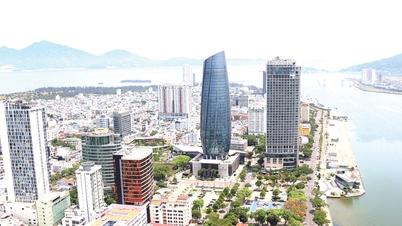
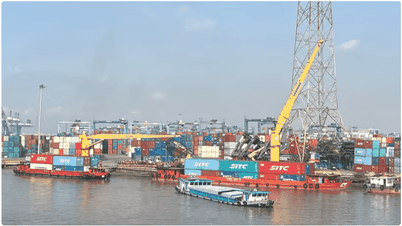
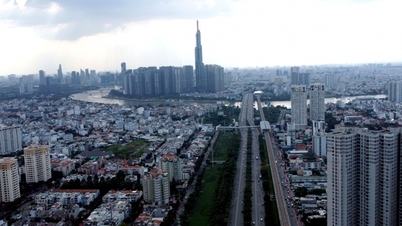
Resolution 09 opens up a new development space for Ho Chi Minh City by addressing the issue of building a breakthrough, superior mechanism that allows for proactively piloting new mechanisms and policies - Photo: QUANG DINH
Resolution 09 opens up a new development space for Ho Chi Minh City by addressing the issue of building a breakthrough, superior mechanism that allows for proactively piloting new mechanisms and policies, conducting controlled trials of the "sandbox" model, or implementing models different from current legal regulations in necessary cases.
This represents a significant empowerment, demonstrating the central government's confidence in Ho Chi Minh City's leading role, while also placing very high demands on its organizational capacity for implementation.
Ho Chi Minh City is aiming to become an international financial center, a smart city, a digital economy , a green economy, a provider of high-quality services, modern logistics, and an innovation ecosystem.
These are all fast-moving fields, with many new models emerging from practice before the law has a chance to be perfected.
If we wait until all the regulations are fully in place before implementation, the city may miss out on development opportunities.
Conversely, rushing into action without adequate oversight can shift risks to the public, the budget, and the investment environment.
Therefore, the key is to transform the right to pilot into a systematic enforcement capacity. A "sandbox" must have clear public objectives, a specific scope, a defined timeframe, an independent monitoring mechanism, quantifiable evaluation criteria, and conditions for stopping when risks exceed thresholds.
For Ho Chi Minh City, the "sandbox" should not be simply understood as "being allowed to do things differently," but rather as a modern development governance method where new models are tested within safe limits, unprecedented issues are validated with data, and legal obstacles are assessed for impact before proposed adjustments.
Innovation needs to pave the way, but it must proceed within safe corridors. Businesses are encouraged to innovate, but they must demonstrate social benefits, data transparency, and accountability for quality, costs, and resulting impacts.
Regulatory bodies are given more autonomy, but they must provide evidence, results, and tangible impacts on people's lives.
The city can proactively announce major problems that need solutions, such as reducing traffic congestion, combating flooding, developing land around metro lines, developing social housing, greening industrial zones, sharing urban data, green finance, the night-time economy, digital healthcare, smart education , regional logistics, and public asset management. When the government assigns the right tasks, businesses, universities, experts, and associations will have a basis to participate with more specific and responsible projects.
Ho Chi Minh City also needs a capable institution to support urban policy testing. This could be a council or a "sandbox" coordination center, operating efficiently and professionally, without creating additional administrative layers.
This institution is responsible for receiving initiatives, standardizing documentation, organizing independent reviews, assessing risks, proposing the scope of pilot programs, monitoring implementation, and recommending scaling up, adjustments, or discontinuation.
An indispensable principle is to put people at the center of every experiment. A new policy is only truly meaningful when it helps people travel more conveniently, live more safely, access better public services, and have more opportunities in terms of employment, housing, healthcare , education, and living environment.
Therefore, each "sandbox" needs to have indicators measuring social benefits, citizen satisfaction levels, impacts on vulnerable groups, the environment, and the resulting social costs.
In implementation, the city should select a few priority areas to focus on first, with a clear direction and a clear evaluation process. Successful models should be standardized for wider application. Even models that haven't achieved success are valuable if they help the system identify risks early, avoiding bigger mistakes when implemented on a larger scale.
Resolution 09 gives Ho Chi Minh City a new space to pave the way. The remaining challenge is for the city to transform that space into a concrete system of action, with processes, data, people, institutions, and enforcement discipline.
Source: https://tuoitre.vn/mo-hinh-sandbox-cho-tp-hcm-20260603085303367.htm
![[Photo] First session of the 14th Congress of the Vietnam Trade Union](https://vphoto.vietnam.vn/thumb/1200x675/vietnam/resource/IMAGE/2026/06/03/1780465947883_ndo_br_img-3852-jpg.webp)
![[Photo] General Secretary and President To Lam presides over a meeting with the Central Organizing Committee.](https://vphoto.vietnam.vn/thumb/1200x675/vietnam/resource/IMAGE/2026/06/03/1780482764658_a1-bnd-4741-3342-jpg.webp)



![[Photo] Secretary of the National Assembly Party Committee, Chairman of the National Assembly presides over the meeting of the Standing Committee and Executive Committee of the National Assembly Party Committee.](https://vphoto.vietnam.vn/thumb/1200x675/vietnam/resource/IMAGE/2026/06/03/1780480353201_ndo_br_bnd-2585-jpg.webp)








































![[Video] Sunset at Lap An Lagoon – Where the sun sets over the fishing nets](https://vphoto.vietnam.vn/thumb/1200x675/vietnam/resource/IMAGE/2026/05/31/1780192137701_beach-landscape-sea-water-nature-grass-745871-pxhere-com.jpeg)



























Comment (0)