

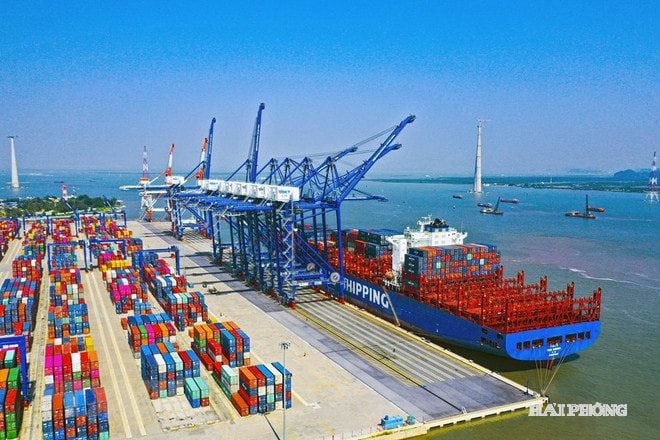
This is not only an inevitable trend but also a commitment to implementing the spirit of Resolution 08-NQ/TU of the City Party Committee on green transformation for the period 2026 - 2030.
The foundation of the modern economy
For the period 2026-2030, Hai Phong identifies green transformation as a central and overarching task for the entire political system. The goal is to build the city into a modern, smart industrial and port center, placing the port at the forefront, but based on high technology and environmental protection. The city also aims to meet stringent standards for "carbon credits" to truly achieve green transformation.
Accordingly, Hai Phong not only aims to increase cargo volume but also aims to reduce the proportion of road transport and strengthen inland waterway and rail transport – methods with emissions 3-5 times lower per ton of goods. The formation of new-generation logistics centers in Nam Do Son and Lach Huyen is considered a strategic step to realize this goal.
In fact, green transformation is no longer just on paper but is already evident in projects by leading enterprises such as Macstar Group and Vietnam Maritime Corporation (VIMC). For example, Macstar Group operates a coastal container route connecting Hai Phong and Nghi Son. The shift from road to waterway transport significantly reduces traffic pressure on National Highway 10, while also yielding tangible environmental benefits. A coastal container ship has a carrying capacity equivalent to 80-135 tractor-trailers; with a distance of approximately 200 km, each trip helps reduce 15-20 tons of CO2 emissions. The company also saves 15-30% on logistics costs and reduces the risk of traffic accidents by up to 90%.
Mr. Tran Tien Dung, Chairman of the Board of Directors of Macstar Group, said: “We not only provide transportation services but also offer green solutions for the global supply chain. The demand for green certifications from international customers is increasing, and the coastal route is a suitable solution.”
At the Lach Huyen deep-water port area, berths 3 and 4 (VIMC) and 5 and 6 (Hateco) have commenced operation with fully electric gantry cranes (STS) and yard cranes (e-RTG). This electrification helps reduce direct greenhouse gas emissions by approximately 2,500 tons of CO2 per year per berth. In addition, the vehicle scheduling system (TAS) shortens turnaround time from 35 minutes to 16 minutes, contributing to reduced fuel consumption and local pollution in the Dinh Vu - Lach Huyen area.
Logistics experts believe that reducing emissions is not only environmentally significant but also directly related to competitive advantage. With the widespread implementation of the Carbon Border Adjustment Mechanism (CBAM) from 2026, exported goods using "green transport routes" could significantly save on carbon tax costs.
.jpg)
To keep the "green lane" flowing smoothly.
Despite its great potential, green transport in Hai Phong still faces many obstacles. One of the bottlenecks is the inland waterway infrastructure, for example, the An Thai bridge has low clearance, making it difficult for large container barges to navigate during high water seasons.
In response to this situation, the city has taken decisive steps in decentralizing management. From September 2025, Hai Phong will be granted the authority to manage the national inland waterway system within its territory, enabling proactive dredging of channels, upgrading bridges, and completing infrastructure to ensure smooth operation of 3,000-ton barges. The city is also studying policies to exempt or reduce port infrastructure fees for goods transported by inland waterways to encourage businesses to switch to low-emission transportation methods.
According to Dr. Nguyen Minh Duc, Vice President of the Hai Phong Logistics Association, the city's major advantage is its extensive river system connecting deeply to industrial zones in Bac Ninh. The development of inland ports such as Quang Binh - Dinh Vu or Tan Cang - Que Vo ICD, coupled with barge transport, is an effective model for green logistics. Furthermore, the proposed construction of a Free Trade Zone with high environmental standards is expected to attract large technology corporations.
By 2030, Hai Phong aims to increase the proportion of inland waterway transport to over 15%, while accelerating the progress of infrastructure projects such as the railway line directly connecting to Lach Huyen port. Expanding the green transport network is not just a trend but an inevitable path for the city to maintain its role as the leading economic hub. With the support of the government and the business community, the "green waterways" on Hai Phong's seas and rivers are expected to become increasingly smooth and sustainable.
THU HANGSource: https://baohaiphong.vn/mo-rong-luong-van-tai-xanh-539141.html






















































































Comment (0)