

 |
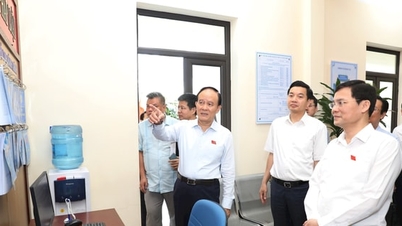
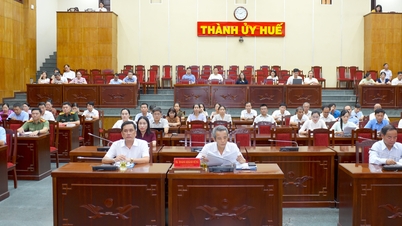
| Election monitoring activities were organized in Huong Tra ward. |
"The eyes and ears of the people" at the construction site.
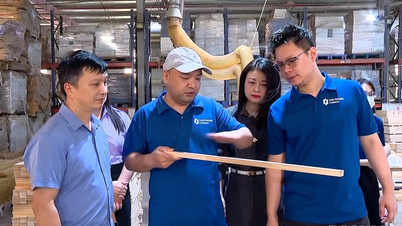
One morning in early April, in Quang Dien commune, the community-based monitoring team was present at the construction sites. These weren't just formal inspections; this monitoring activity focused directly on the issues of greatest concern to the residents: dust, scattered materials, traffic safety, and construction progress.
At the construction site, specific and clear requirements were set: Construction materials must not affect the daily lives of residents; adequate barriers and signage must be in place for roads that are under construction while also being used; and traffic controllers must be stationed at high-risk points. These seemingly minor details are a direct measure of the responsibility of the construction company and the investor.
The noteworthy aspect lies not only in the "reminders" but also in how the community monitoring team listens. The opinions of residents living around the construction site are recorded, categorized, and forwarded to the investor for consideration and adjustment. Some minor items are added and completed during the construction phase, avoiding the situation of "finishing first and then fixing later."
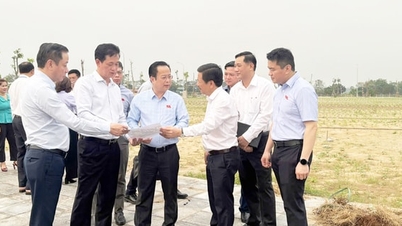
At the Son Tung Village Resettlement Area project in Dan Dien commune, a project spanning nearly 4 hectares and serving the purpose of land clearance for the North-South high-speed railway line, the community investment monitoring team has been involved since the project's inception.
Unlike typical public works projects, resettlement projects require a high degree of coordination, from land leveling and plot division to electricity, water, and lighting systems. Supervision extends beyond progress to the quality of each item, ensuring adherence to the approved design.
According to Ms. Nguyen Thi Bich Ngoc, Vice Chairperson of the Vietnam Fatherland Front Committee of Dan Dien commune and Head of the Community Supervision Team, the participants include village heads and Party branch secretaries, who are familiar with the local area and close to the people. This thorough understanding of the subject matter helps the supervision activities to be focused and not vague.
“The effectiveness is quite evident. After the monitoring sessions, the construction progress has accelerated, and some issues have been promptly addressed. More importantly, those who will move in feel secure knowing that they or their representatives are involved in monitoring the entire construction process,” shared Ms. Nguyen Thi Bich Ngoc.
To make the "eyes and ears of the people" effective.
According to regulations, community investment monitoring teams are established by the Vietnam Fatherland Front Committee at the commune level for each program and project, with a minimum of 5 members, including representatives from the Fatherland Front, people's inspectors, and local residents. This mechanism provides a clear legal basis and grants the team specific powers such as requesting information, monitoring progress and quality, and reporting to competent authorities.
In reality, not all community-based monitoring teams are effectively fulfilling their role. In some areas, monitoring activities remain superficial and lack depth; the handling and response to suggestions are not timely; and in some places, people are not genuinely enthusiastic about participating. The important thing is not whether a monitoring team exists, but whether that team is actually "doing its job."
For community-based monitoring to be effective, it must first start with the people. Members of the monitoring team should not only be "comprehensive" but also reputable individuals who understand the local area and are willing to speak up and report issues. The experience from Dan Dien and Quang Dien shows that when the village head and Party branch secretary participate, the effectiveness of monitoring is significantly improved.
An equally important requirement is clarifying the responsibility for responding. As Ms. Nguyen Thi Bich Ngoc shared, supervision loses its meaning if recommendations are not addressed. Therefore, it is necessary to establish a mechanism that compels the investor, construction unit, and relevant agencies to provide specific and timely responses to each issue raised by the supervisory team.
The scope of supervision needs to be expanded. It shouldn't be limited to construction projects; community-based supervision should be implemented more strongly in areas such as environmental protection, social welfare payments, and the implementation of support policies. These are all areas directly related to daily life and are prone to problems if there is a lack of transparency.
Mr. Hoang Phuoc, Chairman of the Vietnam Fatherland Front Committee of Thuan An Ward, believes that it is necessary to strengthen the conditions for the operation of community-based monitoring teams. According to regulations, the commune-level government is responsible for arranging a workplace and providing communication support. This may seem like a small factor, but it determines the ability to maintain stable operation. At the same time, it is necessary to encourage the participation of the people; when opinions are listened to, responded to, and lead to real change, participation will become more proactive and sustainable.
Public oversight is a way to make the administrative apparatus operate more efficiently. When the "eyes and ears of the people" are properly expanded, every project and every policy is placed under multi-faceted observation. This allows for early detection of errors, timely adjustments, and the creation of a solid foundation for strengthening trust at the grassroots level.
Source: https://huengaynay.vn/chinh-polit-xa-hoi/mo-rong-tai-mat-cua-dan-tu-to-giam-sat-cong-dong-165054.html


![[Image] Hanoi's urban life under the challenge of a "scorching hot" environment](https://vphoto.vietnam.vn/thumb/1200x675/vietnam/resource/IMAGE/2026/05/25/1779706979265_nang-nong-t5-2026-minh-duy-7-4636-jpg.webp)
![[Image] Close-up view of the interchange connecting the two expressways and Long Thanh Airport.](https://vphoto.vietnam.vn/thumb/1200x675/vietnam/resource/IMAGE/2026/05/25/1779703378210_ndo_br_z7863716673926-224453a31600126cce10622af6290afd-4549-jpg.webp)




















































































Comment (0)