According to data from the World Diabetes Federation, by 2025, more than 11% of adults worldwide will be living with diabetes. This disease is considered a "silent killer" because of its high risk of death due to complications that cause serious damage to the cardiovascular system, liver, eyes, etc. The causes of the disease can include unhealthy eating habits, life stress, and the consumption of foods high in sugar and fat.
Currently, various medications for diabetes have been researched and produced, but they are expensive and have many undesirable side effects. These are major obstacles for patients, especially those from low-income families. Furthermore, most diabetic patients tend to take oral medication because oral administration leads to better adherence, less pain, and reduced risk of complications.
Given this reality, the trend of searching for and applying natural bioactive compounds from plants to support the treatment of diabetes has attracted the attention and research of scientists . However, some bioactive compounds extracted from plants exhibit limitations, such as poor solubility, instability in the stomach, low pharmacological efficacy, and short degradation time. Therefore, these limitations restrict the interactions and biological effects of the compounds.
The application of science and technology to create oral drug delivery systems that improve drug absorption and treatment effectiveness for patients in general, and diabetic patients in particular, has become an urgent requirement. Vitexin is a natural active ingredient, the main component of fruits of the gourd family, pumpkins, mung beans (Vigna radiata L.), pigeon bean leaves (Cajanus cajan Mill sp.), and bamboo leaves (Phyllostachys nigra var. Henonis).



Vitexin from mung bean husks has been shown to have diverse pharmacological effects, including the treatment of diabetes. However, due to its poor solubility in water, its absorption is low (the absorption rate of vitexin in the small intestine is only about 4.9/5.8%, and most of it is excreted through the kidneys). The low pharmacological effect when administered orally is the biggest bottleneck limiting the therapeutic efficacy of vitexin.
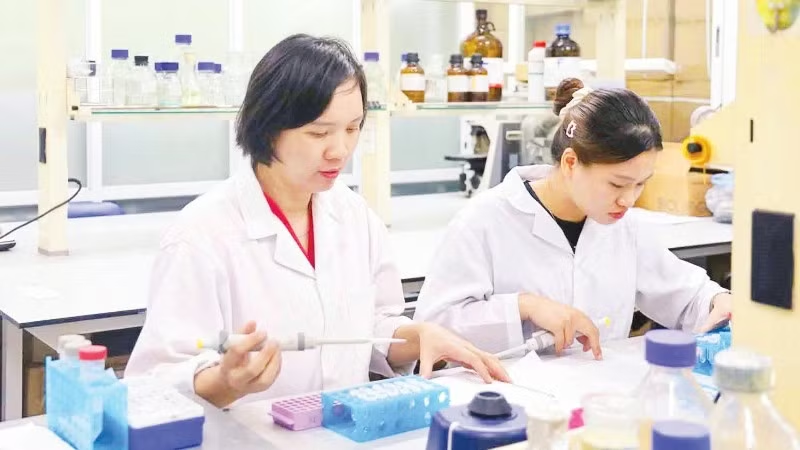
To overcome the aforementioned limitations, a research team from the Institute of Biology and the Institute of Materials Science (Vietnam Academy of Sciences) applied nanotechnology to synthesize the active ingredient vitexin in nano form, increasing its solubility and absorption when taken orally. The scientists undertook the project "Research on the technological process for manufacturing nanovitexin as a raw material for producing health supplements to support the prevention and treatment of diabetes."
Sharing insights into the research process, Dr. Ngo Thi Hoai Thu, from the Institute of Biology and the research team leader, stated that nanotechnology, especially nano drug delivery systems, is one of the optimal solutions due to its special effects such as: increasing the solubility and bioavailability of poorly water-soluble active ingredients; enhancing the stability of active ingredients under the influence of environmental factors such as temperature, light, humidity, and pH; and improving the absorption and pharmacological effects of active ingredients. With its small size (50-70 nm), nanovitexin has superior absorption into cells compared to its free form, while also effectively scavenging free radicals and protecting cells from damage caused by oxidative stress.
In particular, nanovitexin has made a breakthrough in blood glucose control thanks to its ability to inhibit starch-digesting enzymes, minimizing the gastrointestinal side effects commonly associated with Western medicines. With these outstanding biological advantages, nanovitexin is poised to become a potential raw material for the production of health supplements to support the prevention and treatment of type II diabetes.
Furthermore, this ingredient also expands its application to product lines that support liver detoxification and nerve protection, helping to prolong the duration of drug effects while reducing the number of times it is used per day.
According to the Acceptance Council: One of the outstanding results of the research group is the development of a technological process for manufacturing nanovitexin from free vitexin extracted from mung bean pods, with a focus on applications in the pharmaceutical field. The products obtained during the research process are of good quality and can be transferred and commercialized.


Source: https://nhandan.vn/mo-rong-ung-dung-hoat-chat-tu-nhien-bang-cong-nghe-nano-post970451.html



![[Photo] Prime Minister Le Minh Hung presides over the thematic session on promoting science and technology development and innovation.](https://vphoto.vietnam.vn/thumb/1200x675/vietnam/resource/IMAGE/2026/06/23/1782207872934_ndo_br_dsc-1724-jpg.webp)