

For just a few tens of thousands of Vietnamese dong, you can sample authentic street food in China, many of which have a long history.
Taking a leisurely stroll through the streets, enjoying the lively atmosphere, and discovering the traditional flavors of Chinese cuisine is a pleasure any traveler would want to experience when visiting this country. Here are some popular dishes:
Braised pork trotters and knuckles
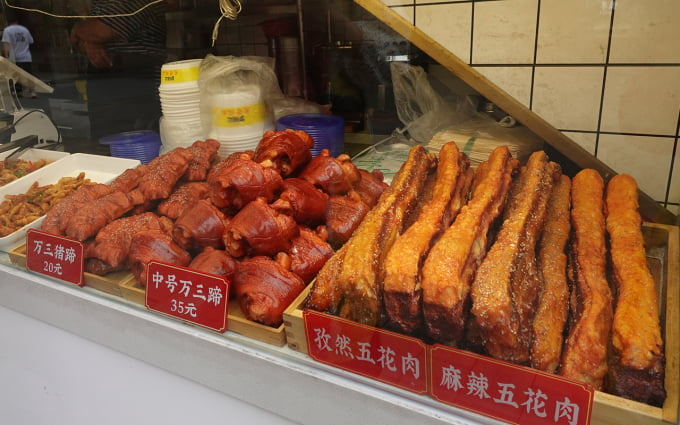
Braised pork trotters and knuckles.
Braised pork trotters is an elaborate dish, usually only eaten at family gatherings or celebrations. However, in China, this traditional dish is commonly sold on sidewalks. Tourists can even enjoy it while strolling and admiring the streets. Many museums in Shanghai, Hangzhou, Suzhou, and other cities also prominently display this dish, showcasing its long history and its place in Chinese life.
The dark brown, glossy skin of the pork trotters and knuckles, along with their rich yet not greasy flavor, can win over even the most discerning diner. Depending on your appetite, you can choose a small portion of pork trotters for 30 RMB (approximately 100,000 VND) or a medium or larger portion for 50-60 RMB.
Large skewers
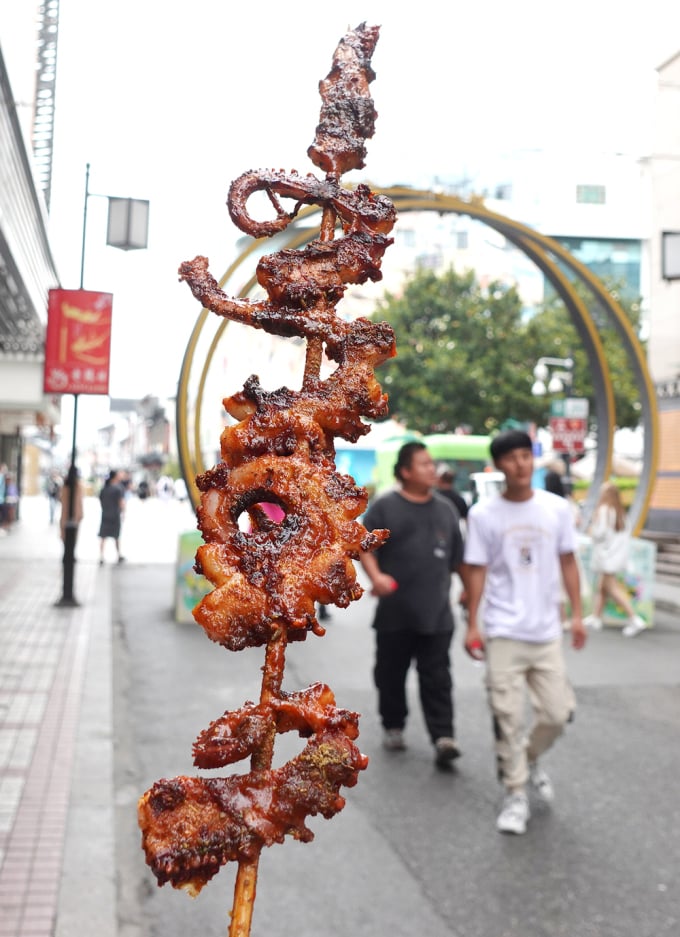
Large grilled squid skewers.
What could be more appealing than walking past a delicious-smelling barbecue stall when you're hungry? To suit the immense consumption capacity of the Chinese, most stalls sell large skewers such as whole squid, whole frogs, whole fish, whole chicken legs, and more.
These dishes are usually pre-cooked. When you order, the owner will grill them again for 5-7 minutes and top them with sauce and spices. Just watching the owner work can whet your appetite. Then you just enjoy the deliciousness of the dish, appealing to your sight, smell, and taste. Each large skewer costs between 10 and 20 RMB, depending on the type.
Candied gourd and sugar-blown candy
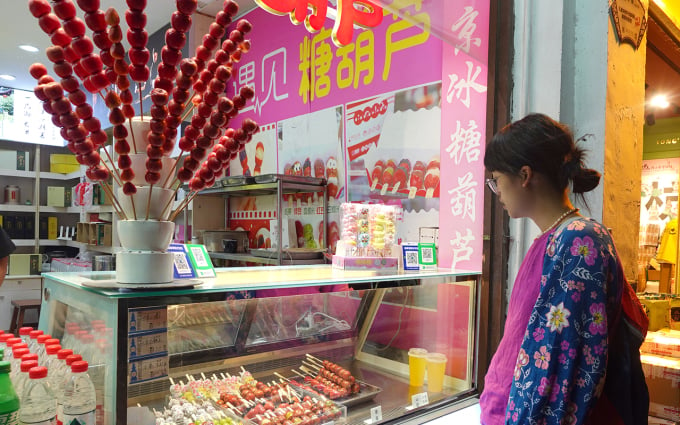
Candied gourds and other candied fruits.
Anyone who has watched Chinese films or read Chinese literature is familiar with candied hawthorn skewers and other sugar candies, popular snacks with a history spanning thousands of years. Today, candied hawthorn skewers can be found everywhere in China. Originally just candied apples, they now come in various flavors such as cherry, grape, and strawberry, costing around 10-15 RMB per skewer.
Blow-blown sugar candies are considered a delicacy for "artists," as only skilled artisans can create elaborate candies in various shapes and with eye-catching details. From familiar animals in everyday life to creatures that only exist in legends, characters from stories and films... all can be transformed by artisans into vividly shaped candies.
Mixed fruit and extra-large ice cream
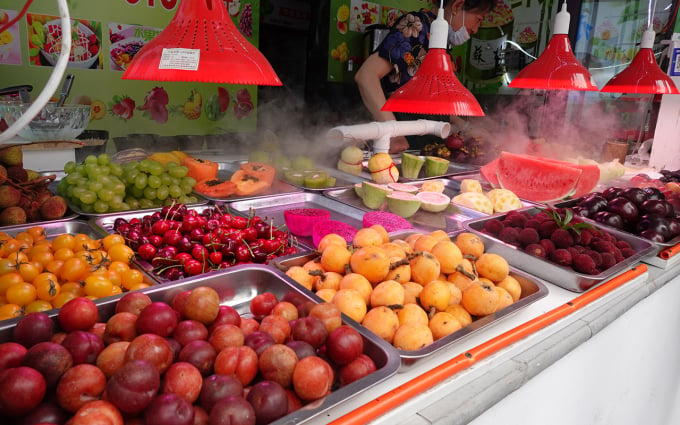
The fruits are mixed together and topped with sauce.
Many streets have stalls selling mixed fruit salads by weight, with a common price of 9.9 RMB for 250 grams (approximately 130,000 VND per kilogram). You can choose from dozens of toppings such as strawberries, grapes, kiwi, apples, melon, mango, tapioca pearls, jelly, and countless types of nuts. The vendor will chop your chosen ingredients, mix them with yogurt or yogurt drink, and then weigh them to calculate the price. A box of mixed fruit salad for two people usually costs around 100,000 VND, enough to fill you up.
Ice cream is also a very popular snack in the world's most populous country, so you can easily find all kinds of ice cream on the streets. Some types look very similar to the ice cream from the subsidy era, costing only a few thousand dong each, while others are huge portions served in cups as big as beer mugs, costing over 100,000 dong. You can choose from dozens of flavors to suit your preferences.
Traditional cakes
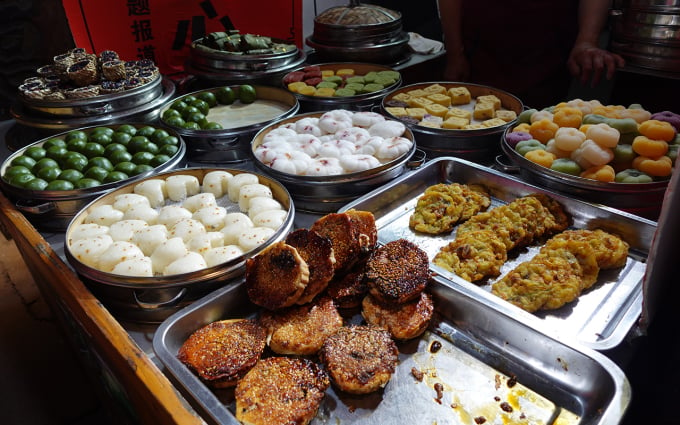
Traditional cakes.
There are hundreds of types of traditional Chinese pastries, most of which foreign tourists can't name, but they're well worth trying. Some are freshly made daily, while others are beautifully packaged with a shelf life of several months, making them ideal souvenirs.
In the old quarters, you can find bakeries that are over 100 years old, bustling with customers, offering dozens of different types of cakes and candies, all attractively presented. A box of these treats costs only a few tens of thousands of dong, while others are packaged in a "royal" style and cost millions of dong.
Street food in China is quite strictly regulated. Most stalls display prices publicly, often with photos of each dish. Kitchen utensils are clean, and there is no trash or wastewater around the stalls. There are no tables, chairs, umbrellas, or advertising signs spilling onto the sidewalk; everything is kept indoors. Many stalls only use environmentally friendly and health-conscious items such as paper bags, paper cups, wooden spoons, and paper straws.
Trinh Hang
Source link
![[Photo] General Secretary and President To Lam presides over a meeting on preparations for the review of one year of operation of the three-tiered government system.](https://vphoto.vietnam.vn/thumb/1200x675/vietnam/resource/IMAGE/2026/06/02/1780391821195_a1-bnd-4595-9717-jpg.webp)

















































































Comment (0)