
The characters in the film.
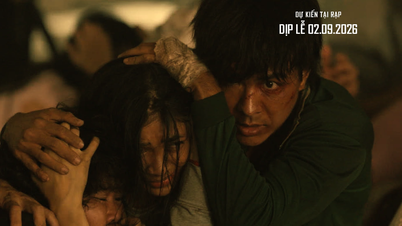
The first impression viewers get when watching the film is one of ferocity. From the opening scene depicting countless civilians losing their lives during evacuation to the intense, back-and-forth battles between our forces and the enemy throughout the film, the tension isn't limited to the battlefield but extends to diplomatic negotiations in Paris. We are determined to hold the Citadel to gain an advantage in international talks.
Viewers were repeatedly shocked by scenes of casualties and death, the amputation of wounded soldiers' legs without anesthesia, or the military doctor's choked exclamation, "Hundreds of people are dying every day." They were then moved to tears and sorrow as the soldiers fought from the fiery summer to the muddy rainy season, their sacrifices and losses occurring every minute. Each realistic, raw scene powerfully impacted the viewers' emotions.
Furthermore, the audience can easily see that the enemy was continuously supplied with modern weapons and elite forces by the US. So what enabled our troops to hold out for 81 days and nights in this unequal war? It was the ideal, the belief in the just cause of the nation. This clearly shows the difference in thinking and perception between the soldiers on both sides. When the character Hai was captured, tortured, and forced to call on his comrades to surrender, he urged them: "Don't lose heart, don't give up, we will win!" Meanwhile, Quang, a South Vietnamese officer, admitted to being haunted and tormented by the fact that this was a war of delusion!
The film clarifies the ideals without romanticizing or darkening the characters. This is one of the elements of its success. The characters, from main to supporting, are all clearly defined in terms of image and personality. Among them, the seven members of Squad 1—Ta, Cuong, Sen, Binh, Hai, Tu, and Tan—are the core characters, united and steadfast in their fight, holding their ground in this fierce battlefield. They are young and full of enthusiasm, yet they still have moments of weakness when facing death. It is these moments that make the characters authentic, relatable, and easily touch the hearts of viewers. On the other side of the battlefield, the character Quang is also portrayed with a new image: he shows compassion by helping women and children in distress and refrains from killing wounded soldiers; he displays a chivalrous spirit when engaging in a fair duel with Cuong at the end of the film…
And finally, as they fell one by one, each death, though different, left a deep impression on the audience, highlighting the price of war and peace. The film's meaning therefore transcends simply recreating a historical battle. Beyond its heroism and tragedy, the film also offers sweet moments of tender wartime love, the poignant expression of sacred maternal love, and the humor and optimism of the soldiers amidst hardship… In particular, the metaphorical images and details in the film further demonstrate the depth and humanity of the work. For example, Squad Leader Ta couldn't bring himself to kill the enemy when he saw a photograph of the soldier's wife and children fall to the ground. Or the checkered scarf, cut in half, forming the letter S, held by two soldiers as they died. Even more poignant is the image of two mothers sitting together on a boat, releasing flowers into the Thach Han River in their grief over the loss of their sons…
"Red Rain" is a symphony composed by Cuong, a music conservatory student, during the fighting days at the Citadel. At the end of the film, that symphony resounds like an immortal anthem, reminding generations of Vietnamese people that they must never forget: every inch of homeland and the peace we enjoy today were bought with the blood of our ancestors.
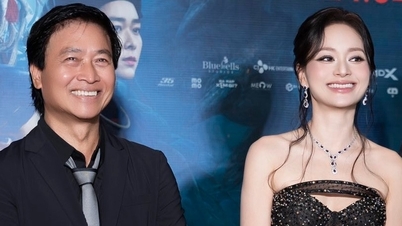
"Red Rain" was produced by the People's Army Film Studio, and directed by Dang Thai Huyen.
The script is adapted from the novel of the same name by Colonel and writer Chu Lai - a work that won the A Prize of the Ministry of National Defense in the 2015 scriptwriting competition on the theme of revolutionary war.
The producers invested in a film set spanning approximately 50 hectares in Quang Tri , on the banks of the Thach Han River, to recreate the Quang Tri Citadel battlefield featured in the film.
The film officially premiered on August 22nd and grossed over 100 billion VND after just 3 days. As of the afternoon of August 26th, it had earned over 138 billion VND and remains at the top of the box office with a packed screening schedule in theaters.
CAT DANG
Source: https://baocantho.com.vn/-mua-do-khuc-trang-ca-ben-dong-thach-han-a190198.html


![[Photo] First session of the 14th Congress of the Vietnam Trade Union](https://vphoto.vietnam.vn/thumb/1200x675/vietnam/resource/IMAGE/2026/06/03/1780465947883_ndo_br_img-3852-jpg.webp)
![[Photo] General Secretary and President To Lam presides over a meeting with the Central Organizing Committee.](https://vphoto.vietnam.vn/thumb/1200x675/vietnam/resource/IMAGE/2026/06/03/1780482764658_a1-bnd-4741-3342-jpg.webp)
![[Photo] Secretary of the National Assembly Party Committee, Chairman of the National Assembly presides over the meeting of the Standing Committee and Executive Committee of the National Assembly Party Committee.](https://vphoto.vietnam.vn/thumb/1200x675/vietnam/resource/IMAGE/2026/06/03/1780480353201_ndo_br_bnd-2585-jpg.webp)








![[Podcast] Capital City Law 2026: Increased penalties for violations in the fields of culture and advertising](https://vphoto.vietnam.vn/thumb/402x226/vietnam/resource/IMAGE/2026/06/03/1780487283783_4522222.png)



































![[Video] Sunset at Lap An Lagoon – Where the sun sets over the fishing nets](https://vphoto.vietnam.vn/thumb/1200x675/vietnam/resource/IMAGE/2026/05/31/1780192137701_beach-landscape-sea-water-nature-grass-745871-pxhere-com.jpeg)





























Comment (0)