

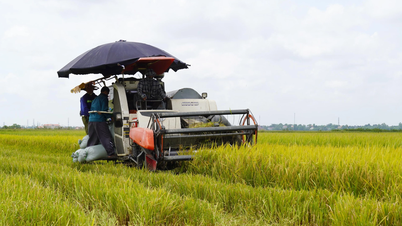
In the final days of the winter-spring harvest season, the K-Ai rice fields are bustling with the laughter and chatter of the villagers as they head down to harvest the rice. On the golden rice paddies at the foot of the mountains, groups of people enthusiastically cut and bundle the rice stalks, then transfer them to the banks to prepare for threshing.
Ms. Ho Nhung hugged a bundle of freshly cut rice stalks and brought them ashore, her face beaming with joy. Her family owns over 1,200 square meters of rice paddies and has been involved in this model for over 12 years. “This year the weather wasn’t favorable, with little rain, so the villagers were quite worried. But thanks to the border guards regularly coming down to the fields to guide us on how to care for the rice, the grains are firm and we have a good harvest. My family is very happy,” Ms. Nhung shared.
 |
| The people of K-Ai village are busy harvesting the winter-spring rice crop - Photo: QN |
Not far away, Ms. Ho Lan and her husband, Mr. Ho Binh, were busy gathering the freshly harvested rice stalks to feed into the threshing machine. The sound of the machine echoed steadily across the field, blending with the laughter and chatter of the villagers, making the harvest season in this border region even more vibrant.
Previously, the K-Ai people mainly cultivated upland rice in the mountains, and their lives were heavily dependent on the weather, so food shortages during the lean season were frequent. Since being guided by border guards in cultivating wet rice, the lives of many families have gradually become more stable. "Before, people didn't know how to grow wet rice; they only cleared the land to plant rice. In years with erratic rain and wind, there was a food shortage. Now, the villagers know how to plant rice, how to take care of the fields, and how to conserve water. With wet rice, many families have enough rice to eat all year round," said Ms. Lan.
Few would have imagined that, to create the nearly 5-hectare rice paddy field it is today, the officers and soldiers of the Cha Lo International Border Gate Border Guard Post spent many years working with local people to reclaim land, improve the soil, and bring water to the fields. The rice paddy project in K-Ai was implemented by the unit in 2014. In the early days, almost the entire area was barren land, and the people were unfamiliar with rice cultivation methods.
Major Bui Van Hai, Deputy Political Officer of the Cha Lo International Border Gate Border Guard Station, said: “Initially, the soldiers had to level the ground themselves and build a water supply system from the highlands down to the rice fields. After that, the unit continued to research rice varieties suitable for the soil and climate conditions before guiding the local people on cultivation and planting techniques.”
Previously, the villagers mainly cultivated upland rice, resulting in low yields and unstable production. Therefore, introducing wet rice cultivation to the village not only aimed to change traditional farming practices but also helped the people secure a stable long-term food supply. After more than 10 years of implementation, 86 households in K-Ai village have now participated in wet rice cultivation alongside border guards. Each year, the villagers produce two crops, with yields reaching approximately 4-4.5 tons/ha.
Major Nguyen Thanh Trung, Team Leader of the Reconnaissance Team, Cha Lo International Border Gate Border Guard Station, shared: “The most encouraging thing is that the local people have now taken the initiative in production, from land preparation and planting to care and harvesting. The PC6 rice variety introduced to K-Ai is quite suitable for the soil here, producing fragrant, sticky rice with stable yields.”
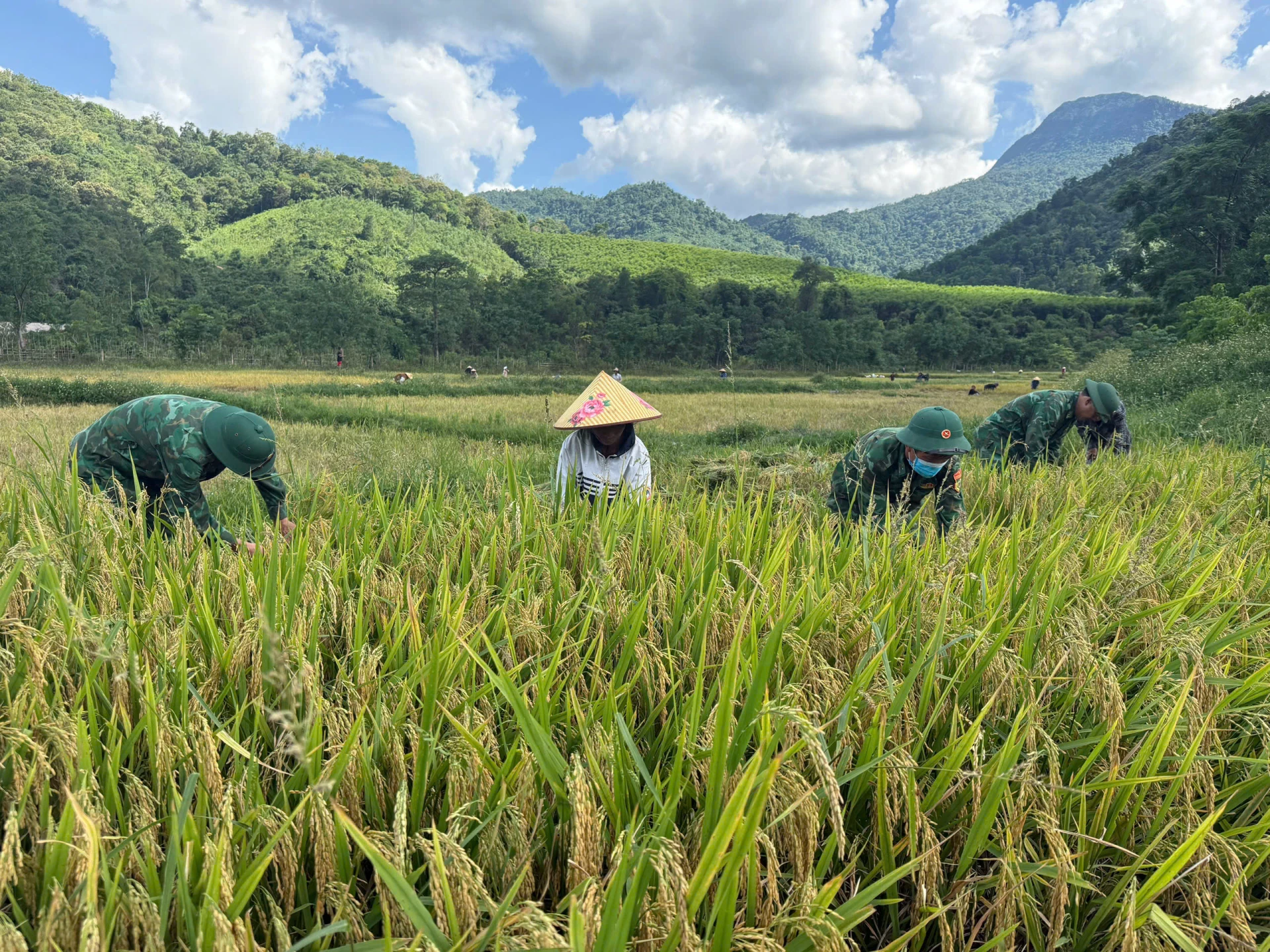 |
| Officers and soldiers of the Cha Lo International Border Gate Border Guard Station, along with villagers from K-Ai hamlet, harvest rice - Photo: QN |
This year, despite unfavorable weather conditions, thanks to proactive drainage, most of the rice fields were not flooded or flattened. The rice stalks remain golden and full of grain in the fields. Village head K-Ai Ho Hung watched the villagers carrying sacks of freshly harvested rice home, his voice filled with excitement: “Thanks to the border guards’ help, both rice crops this year have yielded good harvests. Today the sun came out, and the soldiers came down to the fields to harvest rice with the villagers. Having a local food source makes the villagers feel much more secure than before.”
For over 10 years, in addition to the rice cultivation model, the Cha Lo International Border Gate Border Guard Station has implemented many activities to support people in the border region in developing their economy and stabilizing their lives. Officers and soldiers of the unit regularly stay in the villages, working alongside the people to build roads, providing seedlings and livestock, and guiding production. The lives of many households in the border region have gradually changed.
As evening falls over the K-Ai fields, along the small paths leading into the village, villagers carry sacks of newly harvested rice home. For the people of this border region, the greatest joy is that their food supply is now stable, thanks to the rice grown in their own fields.
Quang Ngoc
Source: https://baoquangtri.vn/kinh-te/202605/mua-vang-no-am-noi-vung-bien-9a8216f/

![[Photo] The heat at the fireworks display site on the opening night of the Da Nang International Fireworks Festival 2026](https://vphoto.vietnam.vn/thumb/1200x675/vietnam/resource/IMAGE/2026/05/27/1779889741485_ndo_br_z7872039145157-fecaba5112f39e8352544099d7ef4738-5140-jpg.webp)
![[Photo] The courage of new recruits of Brigade 144 on the training ground.](https://vphoto.vietnam.vn/thumb/1200x675/vietnam/resource/IMAGE/2026/05/27/1779881651341_anh-man-hinh-2026-05-27-luc-18-32-52.png)





































![[Photo] The courage of new recruits of Brigade 144 on the training ground.](https://vphoto.vietnam.vn/thumb/402x226/vietnam/resource/IMAGE/2026/05/27/1779881651341_anh-man-hinh-2026-05-27-luc-18-32-52.png)



















Comment (0)