

If Tay Tri village (now part of Dong Ha ward) and Dieu Ngao village (now part of Nam Dong Ha ward) are considered ancient villages located in the center of present-day Dong Ha urban area, then the area of former Ward 3, now part of Dong Ha ward, also bears a special mark with its core being the ancient village of Dong Ha, which was formed hundreds of years ago.
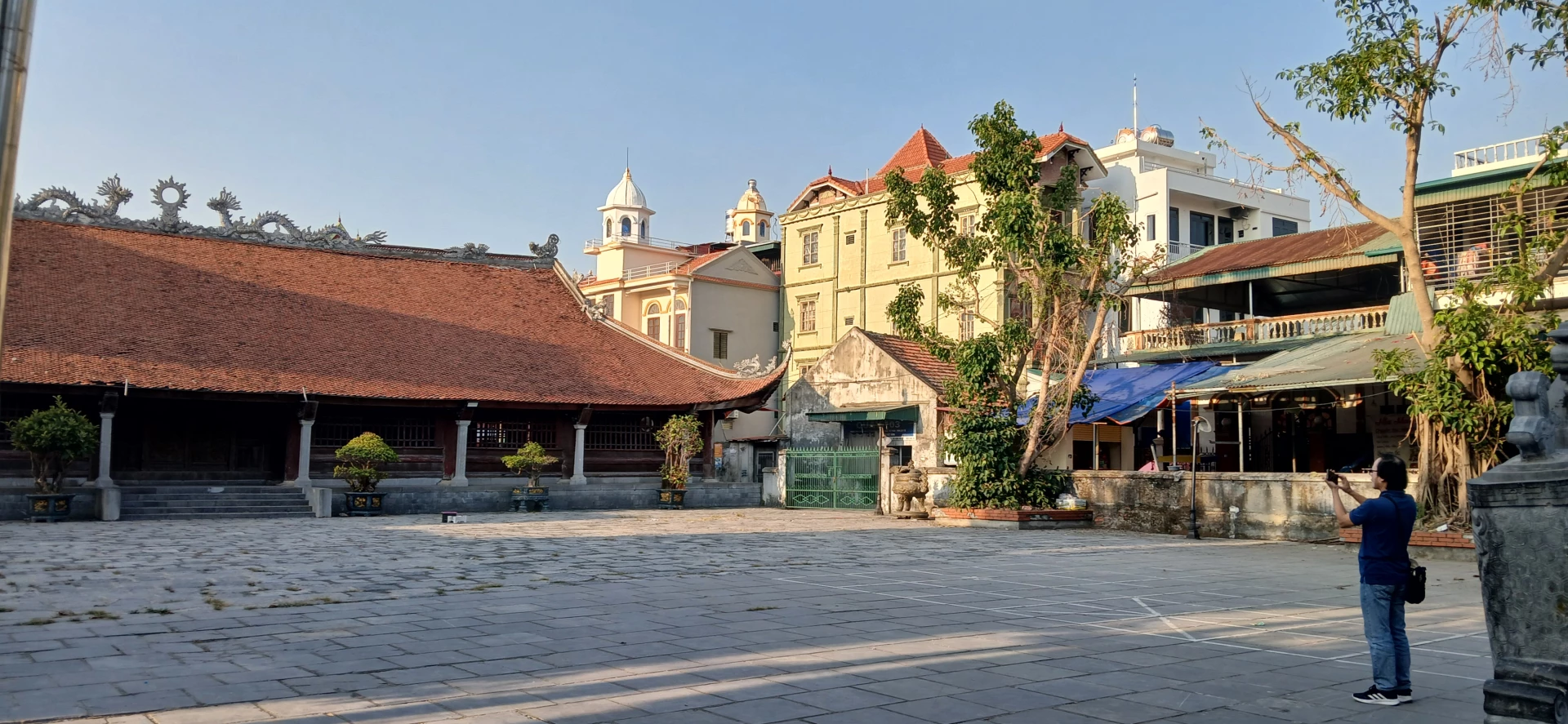 |
| Trung Chi village communal house is a provincial-level historical and cultural relic - Photo: PXD |
According to Lê Quý Đôn's "Phủ biên tạp lục," the ancient village of Đông Hà belonged to the An Lạc commune, Đăng Xương district, Triệu Phong prefecture. This administrative unit existed until the French colonial period and is now part of Đông Hà ward (formerly Ward 3, Đông Hà City). Đông Hà village enjoyed a favorable geographical location, being close to the river and market, and later to the North-South railway line, making it easy for its inhabitants to establish their livelihoods. People here could cultivate rice and vegetables, raise fish and shrimp, and engage in trading at the market. Over time, from a few initial households, the village developed into a community of 11 clans, bound together by strong community ties and contributing to the development of their homeland through various historical changes.
During a visit to the founding site of the Party branch in Dong Ha village, I was told by officials and villagers that, during the long night of enslavement, Comrade Nguyen Duc Ky and other patriots embraced the revolution and established the first Party branch in the Dong Ha area. Their members came from the villages of Dong Ha, Tay Tri, and Thiet Trang, determined to fight alongside their compatriots to regain independence and freedom. Comrade Nguyen Duc Ky was also the father of Comrade Nguyen Duc Hoan, former Central Committee member, Deputy Head of the Central Internal Political Security Department, and former Secretary of the Quang Tri Provincial Party Committee – a respected leader who was highly regarded by his comrades and compatriots and made many contributions to his homeland and country.
According to "Ô Châu Cận Lục" by Dương Văn An, written in the mid-16th century, this area already had several villages such as Điếu Ngao, Trung Chỉ, Tây Trì... along with Thiên Áng and Tiểu Áng—later renamed Đại Áng and retaining that name to this day. Interestingly, the village name is also the name of the neighborhood: Đại Áng neighborhood belongs to Nam Đông Hà ward. This village has a flat terrain, picturesque scenery, and kind-hearted people. Located near the Thạch Hãn River and important transportation routes, it has traditionally been considered to possess all three elements: favorable timing, advantageous location, and harmonious human relations.
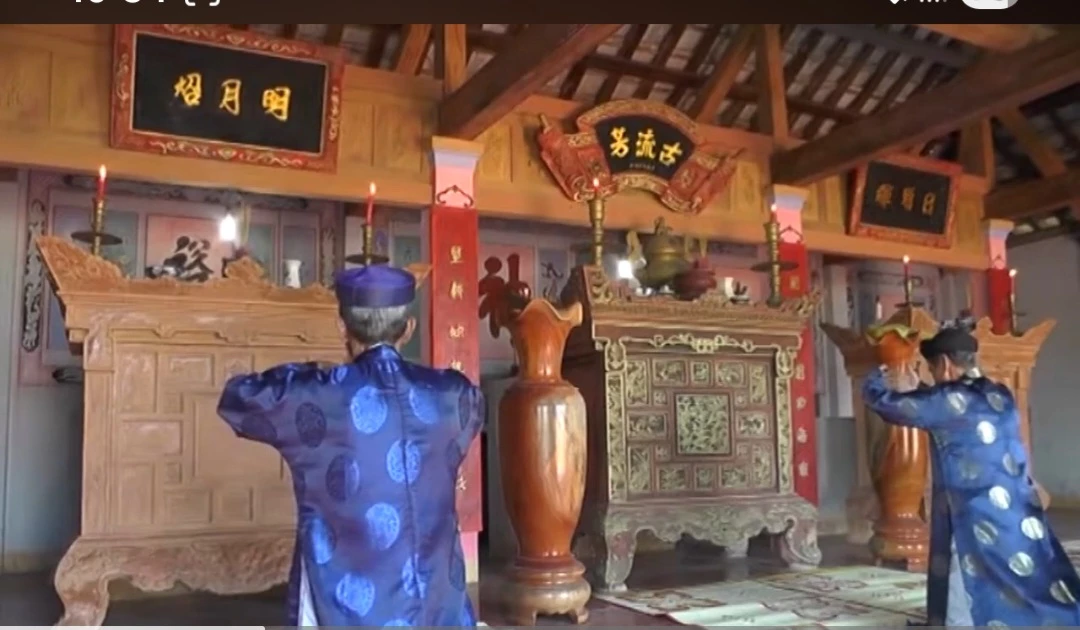 |
| Ritual at Dai Ang village communal house - Photo: PXD |
Not far from Dai Ang village is another village with origins in Dai Ang, namely Dai An village, administratively known as Ward 10, Precinct 5, Dong Ha City (formerly), now part of Nam Dong Ha Ward. Dai An village is over a century old. A local official from Dai Ang, seeing the scattered population, gathered them together and moved them about 1km west of Dong Ha to establish the village. Since then, Dai An village has existed and developed to this day.
According to legend, the ancient village of Trung Chỉ was formed during the time of Lord Nguyễn Hoàng's governorship of Thuận Hóa in 1558. According to Dương Văn An's book "Ô Châu cận lục," in the mid-16th century, 13 of the 59 ancient villages of Võ Xương district belonged to the Đông Hà region, including Trung Chỉ village. Previously, Trung Chỉ village belonged to Triệu Lương commune, Triệu Phong district; today, the village name remains unchanged, and the corresponding neighborhood also bears the name Trung Chỉ – a fortunate circumstance not every village enjoys during the process of urbanization.
Trung Chi village has a long history and rich cultural traditions. Among its spiritual structures, the village communal house (dinh) is the most noteworthy. In the early days of the village's establishment, the communal house was built with thatch, bamboo, and leaves. After settling down, the villagers had the means to build a more solid structure. The current communal house is nearly two centuries old, built during the Nguyen dynasty. It is one of the few ancient communal houses that remains relatively intact in Quang Tri province.
Despite numerous historical upheavals, the location of the village communal house has remained virtually unchanged. The communal house features a traditional three-bay, two-wing structure with a tiled roof, and columns and doors made of precious wood. The intricate decorative patterns and carvings give the communal house a unique beauty. It was at this very communal house, during the August Revolution of 1945, that revolutionary cadres and the masses rose up in unison to support the general uprising and seize power for the people. This communal house also served as a polling station in the first general election to elect the National Assembly of Vietnam in 1946.
Thanks to its historical value and unique, traditional architecture, the communal house has been recognized by the State as a provincial-level historical and cultural relic. Over the centuries, it has become a sacred yet familiar place, nurturing the spirit of the village and passing it down to generations of people.
Pham Xuan Dung
Source: https://baoquangtri.vn/dat-va-nguoi-quang-tri/202605/dong-ha-chieu-sau-cua-dat-59e4e4c/
![[Photo] The heat at the fireworks display site on the opening night of the Da Nang International Fireworks Festival 2026](https://vphoto.vietnam.vn/thumb/1200x675/vietnam/resource/IMAGE/2026/05/27/1779889741485_ndo_br_z7872039145157-fecaba5112f39e8352544099d7ef4738-5140-jpg.webp)
![[Photo] The courage of new recruits of Brigade 144 on the training ground.](https://vphoto.vietnam.vn/thumb/1200x675/vietnam/resource/IMAGE/2026/05/27/1779881651341_anh-man-hinh-2026-05-27-luc-18-32-52.png)





































![[Photo] The courage of new recruits of Brigade 144 on the training ground.](https://vphoto.vietnam.vn/thumb/402x226/vietnam/resource/IMAGE/2026/05/27/1779881651341_anh-man-hinh-2026-05-27-luc-18-32-52.png)






















Comment (0)