


Border guards are helping the Hmong people in Suoi Long village, Tam Chung commune, harvest cassava.
When policies haven't reached remote areas
More than ten years ago, accompanying a working group up to the border communes of the former Muong Lat district, we vividly remember the single-track road winding along the mountainside – it would collapse whenever it rained, the red soil turning into mud, causing the vehicle to skid along in stretches. By the time we arrived, it was already dusk, and the villages were sparsely lit by flickering oil lamps amidst the mountains and forests. A colleague accompanying us sighed, "The lives of the people in this border region are so impoverished, from the roads to the most basic lighting."
During that trip, we visited Trung Ly Ethnic Boarding Junior High School. Around the school grounds, makeshift shelters were erected, where students stayed because the road back to their villages was dozens of kilometers away. Their meals consisted only of white rice and wild vegetables. Seeing the thin, frail children gathered around the meager meal, no one in the delegation could hold back their emotions. Mr. Doan Van Son, the former principal of the school, recounted the story of students dropping out of school midway through their studies in the somber voice of someone who had witnessed it firsthand but still felt a pang of regret: "The percentage of Hmong girls attending school is very low. Extremely difficult economic conditions are the biggest reason preventing them from continuing their education." That statement lingered in our minds, because behind those dimly lit houses of yesteryear was not only immediate poverty, but also the uncertain future of these children from the border region.
Returning this time, we took the same route, met the same colleague, but the place looked different. The asphalt road was smooth and wide enough for two cars to pass each other comfortably. Solar-powered lights illuminated the entire village. The community center resounded with the sounds of party branch meetings. In each family, the children's study corners were no longer dimly lit by oil lamps. "Having roads and electricity means a sense of prosperity!" my colleague whispered. We understood that achieving this transformation was a long and arduous journey, one that not everyone knows about.
In previous years, border villages were not only poor due to harsh natural conditions or limited arable land. More troubling was that despite the Party and State's policies and the resources reaching the villages, transforming the situation into a better life for the people in the most remote and isolated areas remained an unresolved problem. The villagers were still caught in a vicious cycle, unsure where to begin the change. Elder Ho Chu Ho, former head of Ca Noi village, Pu Nhi commune, remained silent for a long time before calmly saying: "Many officials have come to visit the villagers. But when they leave, the villagers go back to their old ways. The village remains the same." His words held no resentment, only the anxieties of an old man who had witnessed the village's struggles for so many years. We asked him – did the villagers believe in the support policies? He nodded: "Yes! But the people aren't smart enough; they can't succeed at growing crops or raising livestock. Some even spend all the money on alcohol after receiving support." This wasn't a reproach, but rather a reflection of reality, raising a big question: how can policies truly be implemented and change the mindset and practices of the people?
And the soldier chose to stay.
It was only much later, while reviewing the audio recordings from our field trips to the border region, that we realized: it wasn't a lack of policies or resources, but rather a sufficiently long-term and patient presence to translate policies into concrete actions in every household and every field – so that the people would believe that this time would be different. And it was from this understanding that, in the overall journey of the entire political system, the Thanh Hoa Provincial Border Guard contributed its own approach: not starting with a new plan, but starting with the decision to stay.

The border villages of the former Muong Lat district were once impoverished, with precarious houses and a lack of essential infrastructure. (Photo: Archival material)
Major Nguyen Van Thien, Political Officer of the Trung Ly Border Guard Post, still vividly remembers his first night sleeping in the village more than ten years ago, when he was still working at the Tam Chung Border Guard Post. At that time, the village had no electricity, no phone signal, and mosquitoes buzzed all night. In the morning, the village elders looked at him searchingly and asked, "Are you still staying today?" He nodded. The villagers said nothing, silently giving him another bowl of rice and a salty stewed stream fish.
That first night, he listened intently and pondered deeply. The village elder recounted that while support policies were readily available, a mentality of waiting and relying on others remained prevalent. What the villagers needed most was someone to stay, guide them step-by-step, and help them become self-reliant. The elder's words that night—"If the villagers know what crops to grow and what livestock to raise, the government won't need to provide support forever"—have stayed with Thien for over ten years as a reminder.
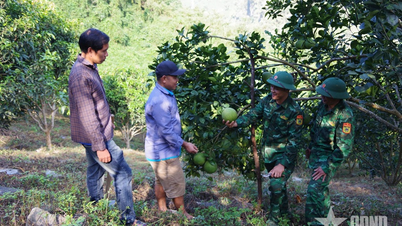
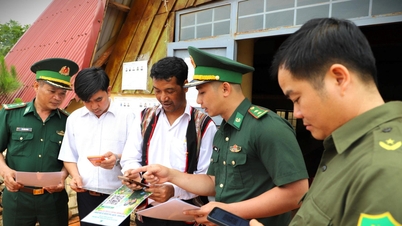
Later, he visited the villages more often and stayed longer. Some assignments lasted a whole week in remote villages, where border guards slept in stilt houses with bamboo walls that leaked whenever it rained. At dawn, they joined the villagers in their work, walking for hours up steep slopes and across streams to reach the production areas. Beyond verbal communication, the border guards directly assisted the villagers in digging ponds, raising fish, building livestock shelters, and guiding them in raising ducks, breeding cattle, and planting corn and cassava. On days with heavy rain, they carried sacks of seedlings across streams to the villages so the villagers could plant their crops in time for the season. Many officers even knew the names of students who had dropped out of school, and at night they would follow the mountain paths to each house to encourage the children to return to class.
It was through these simple acts that the gap between officials and the people gradually narrowed. People in the border region began to believe: this time, the officials were not just coming and going, but were truly staying to help change their lives. This wasn't a milestone recorded in a report, but it marked the beginning of a ten-year journey for the Thanh Hoa Provincial Border Guard.
Since 2015, the Party Committee and the Provincial Border Guard Command have implemented a comprehensive range of models and programs to participate in the economic, cultural, and social development of border areas. What makes the difference lies not only in resolutions or support resources, but in the way border guards directly go down to the villages, eating, living, and working alongside the people in the truest sense of the word. Major Nguyen Van Thien told us a concise statement that encapsulates the entire purpose of this journey: "When the people are prosperous, the border is secure. When the people trust and love the officers, they themselves become soldiers protecting the border."
Along the 213km land border, the footprints of border guards can be found everywhere, guided by the motto: "To make the villages brighter, we must first ignite the people's faith." This faith doesn't come from dry paperwork, but is nurtured daily through shared meals, nights spent in the villages, and mornings spent working in the fields alongside the villagers.
The land border area of Thanh Hoa province comprises hundreds of villages and hamlets, with ethnic minorities accounting for over 97% of the population. Over the years, the Party Committee and the Command of the Border Guard Force of Thanh Hoa province (now the Border Guard Force Command of Thanh Hoa province) have issued numerous plans and resolutions contributing to the socio-economic development of the border area; sustainable poverty reduction; building "Good People-Mobilizing Units" and "Skilled People-Mobilizing Units"; and developing model "Bright Villages in Border Areas"... The common thread in these programs is not only providing resources but also aiming to change perceptions and unleash the potential of the people. |
Milky Way - Dinh Giang
Lesson 2: The Season of Abundance
Source: https://baothanhhoa.vn/muoi-nam-thap-lua-bien-cuong-bai-1-khoi-dau-tu-niem-tin-289338.htm


![[Image] A brilliant symphony and explosive power in the skies of Da Nang.](https://vphoto.vietnam.vn/thumb/1200x675/vietnam/resource/IMAGE/2026/05/31/1780196945787_anh-man-hinh-2026-05-31-luc-10-08-51.png)








![[Video] Sunset at Lap An Lagoon – Where the sun sets over the fishing nets](https://vphoto.vietnam.vn/thumb/340x192/vietnam/resource/IMAGE/2026/05/31/1780192137701_beach-landscape-sea-water-nature-grass-745871-pxhere-com.jpeg)



































































Comment (0)