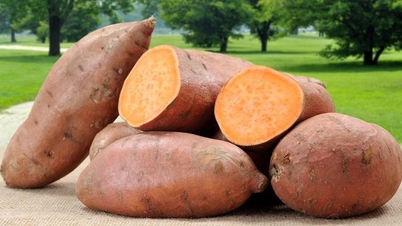
With an area of approximately 900 hectares, My Thuan commune is currently a key sweet potato growing area in Vinh Long province. However, behind this prosperity lies the local government's concern about the problem of plastic waste in agriculture . Empty pesticide bottles and plastic packaging scattered along canal banks or buried deep in the mud not only detract from the landscape but also directly threaten the health of the soil and water sources.
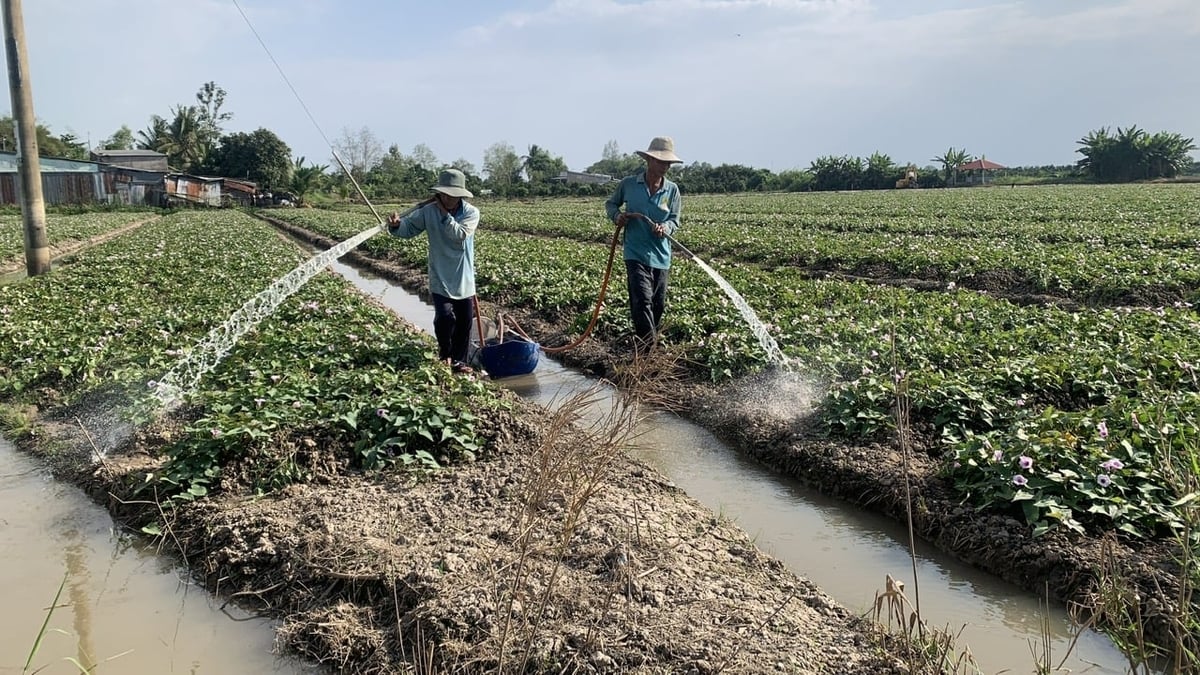
A close-up view of the process of applying pesticides (pouring directly onto the base of the plants) using a motorboat in a sweet potato field in My Thuan commune. Photo: Ho Thao.
Increase the amount of pesticide applied by 2-3 times.
In My Thuan, pests affecting sweet potato crops are becoming increasingly difficult to control. To maintain yields, farmers are forced to maintain a frequent spraying schedule, inadvertently leading to a growing amount of plastic waste in the fields.
Elderly farmer Tran Van Tiem (Thanh Loc hamlet) expressed his worries about the sudden wilting disease plaguing his sweet potato fields. "The plants are lush and green one moment, but the next, the sun comes out and they wilt, forcing us to constantly uproot them. Therefore, we have to water them with pesticides at every stage. Depending on the severity of the infection, if it's mild, we water them every 10 days; if it's severe, we have to water them every 2-3 days," Mr. Tiem sighed.
Due to the intensive irrigation schedule to save the potatoes, the amount of empty pesticide bottles and packaging generated has increased two to three times compared to before. However, according to Mr. Tiem, the collection process still depends entirely on self-awareness. While meticulous farmers proactively collect the waste and bring it home or put it in containers, in reality, many farmers still carelessly throw it directly into the fields or canals after use, causing plastic waste to continuously surround their own farmlands.
Sharing the same concern, Mr. Nguyen Ngoc Dang (Tan Luoc commune), who specializes in spraying pesticides for the surrounding area, shared that from the moment the sweet potato vines are planted for a few days, farmers have to start applying root protection chemicals, especially in old soil – where many pests and diseases remain in the rice stubble, making the use of pesticides a mandatory requirement to maintain their livelihood.

Farmers collect empty pesticide bottles and dispose of them in designated containers to protect the environment. Photo: Ho Thao.
The paradox is that valuable waste like hard plastic bottles is collected thoroughly, while worthless packaging and empty bottles are often left forgotten on the banks of fields or floating along canals and ditches.
"If businesses had programs to exchange old packaging for gifts or agricultural supplies, people would certainly respond more enthusiastically. As it is now, it's done spontaneously, making it very difficult to control," Mr. Dang said.
Using the environment as a measure of credibility.
Mr. Chau Minh Tuan, Vice Chairman of the People's Committee of My Thuan commune, said that the locality has utilized all resources to build 93 cement tanks and 80 specialized plastic containers along the internal roads in the fields so that people have a place to properly store pesticide packaging. The commune also mobilized core forces from the Youth Union to coordinate with specialized units to periodically collect waste from these tanks and transport it to the collection site for processing.
However, since the administrative unit merger and the dissolution of the district level, signing contracts for the collection and processing of pesticide packaging has become difficult due to a lack of contact points and limited funding. The commune plans to continue seeking a processing unit in 2026 using the old model; if funding is insufficient, they will request provincial support to maintain the system long-term.
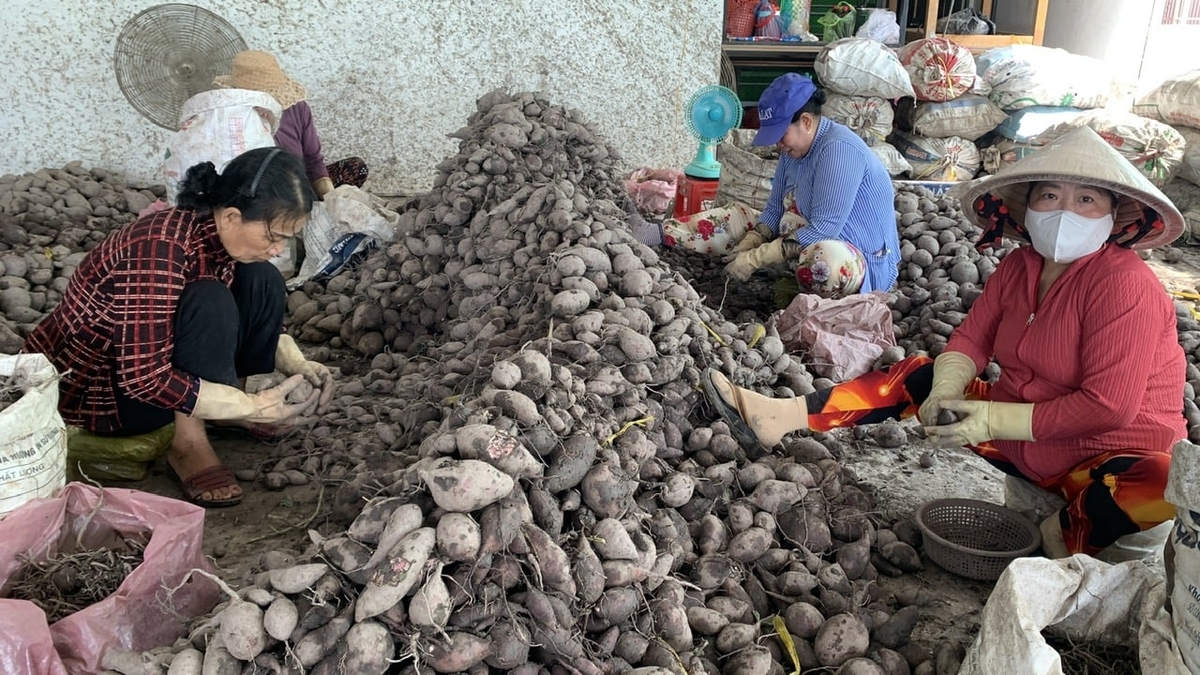
My Thuan commune is building a brand for clean and environmentally friendly sweet potatoes. Photo: Ho Thao.
According to Mr. Tuan, the most fundamental solution is to raise people's awareness. The local authorities have directed hamlets to establish Zalo groups, and various organizations and departments also have their own groups. The commune develops propaganda content and sends it to the relevant organizations to post on the groups, helping people receive information quickly and accurately.
“Traders and businesses will look at the process we use before evaluating product quality. A field littered with plastic waste is proof of irresponsible production. Therefore, building 'clean fields, delicious potatoes' is a strategic goal. We use the environment as a measure of credibility to enhance the value and competitiveness of My Thuan sweet potatoes in the market," Mr. Chau Minh Tuan emphasized.
.
Source: https://nongnghiepmoitruong.vn/my-thuan-xay-thuong-hieu-ruong-sach-khoai-ngon-d795378.html











![When forestry is a 'weakness' for Nghe An?: [Part 3] Forest owners worry about the challenge of financial self-sufficiency](https://vphoto.vietnam.vn/thumb/402x226/vietnam/resource/IMAGE/2026/06/01/1780328200116_pu-hoat-014846_425-223223.jpeg)


![Transforming from Resolution 57: [Part 1] 'Digital Field' in the Heart of the City](https://vphoto.vietnam.vn/thumb/402x226/vietnam/resource/IMAGE/2026/06/01/1780313803412_2848-htx-nong-nghiep-tuan-ngoc-8-173833_249-173836.jpeg)




![The Essence of Viet Bac Villages: [Part 3] The Precious Fragrance of Nghinh Tuong](https://vphoto.vietnam.vn/thumb/402x226/vietnam/resource/IMAGE/2026/05/29/1780020600366_5237-tinh-tuy-ban-lang-viet-bac-bai-3-chuyen-o-nghinh-tuong-050626_700.jpeg)
![The Quintessence of Northern Vietnam's Villages: [Part 2] The Famous Cassava Noodles of Kunming](https://vphoto.vietnam.vn/thumb/402x226/vietnam/resource/IMAGE/2026/05/28/1779937455892_3929-3144-mien-dong-15-nongnghiep-023138.jpeg)
![The Essence of the Village: [Part 1] Wine on the mountain, tea in the clouds - Bang Phuc](https://vphoto.vietnam.vn/thumb/402x226/vietnam/resource/IMAGE/2026/05/27/1779841729178_3821-1jpg-nongnghiep-103814.jpeg)
![[Photo] Reception to welcome General Secretary and President To Lam and his wife on their State visit to the Philippines](https://vphoto.vietnam.vn/thumb/1200x675/vietnam/resource/IMAGE/2026/06/01/1780295488620_vna-potal-chieu-dai-chao-mung-tong-bi-thu-chu-tich-nuoc-to-lam-va-phu-nhan-tham-cap-nha-nuoc-toi-philippines-8798060-7855-jpg.webp)






















































Comment (0)