


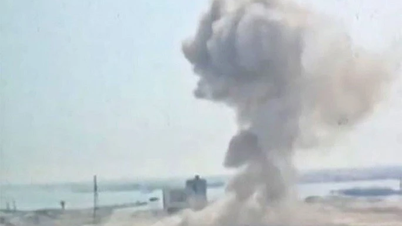
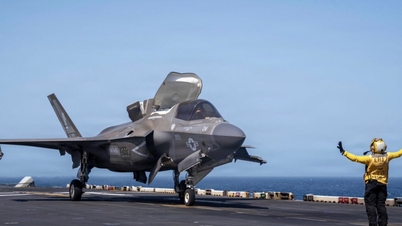
The U.S. conducted airstrikes targeting Iranian radar and drone control facilities in Goluk and Qeshm Island. (Photo: NBC News)
The U.S. Central Command (CENTCOM) announced on June 1 that U.S. forces had conducted attacks on several military targets in Iran's Gulf region. According to CENTCOM's statement, the operation was carried out in response to what Washington considers aggressive actions from Tehran, including the downing of a U.S. MQ-1 drone operating in international waters.
CENTCOM confirmed that the airstrikes destroyed an Iranian air defense system, a ground control station, and two attack drones. The U.S. military said it will continue to protect its forces, assets, and interests in the region.

A man holds an Iranian flag near a billboard featuring U.S. President Donald Trump and the Strait of Hormuz, in Tehran, Iran, on May 30, 2026. Photo: Reuters
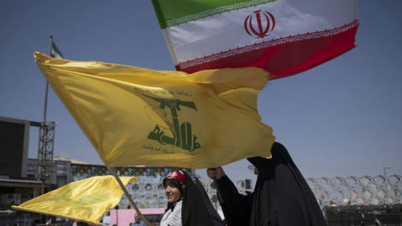
In response to the US statement, Iran's Islamic Revolutionary Guard Corps (IRGC) said it had carried out an attack on a US-used air base. However, Iran did not specify the exact location of the base.
On the same day, Kuwait's state news agency (KUNA) reported that the country's air defense system had intercepted numerous missiles and drones, while air raid sirens were activated in many areas across the country. Kuwait is currently home to one of the largest US military bases in the Gulf region.
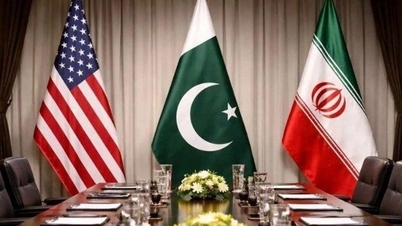
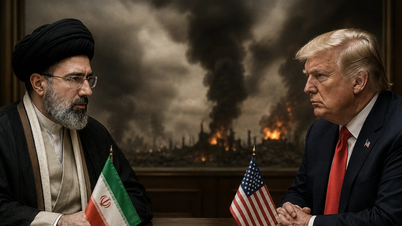
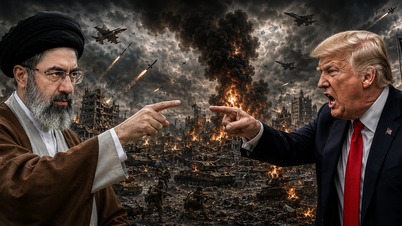
This is the latest military response between the two sides since the ceasefire came into effect in early April. Despite ongoing diplomatic contacts, the US and Iran have yet to reach a lasting agreement to end the conflict.

US President Donald Trump. Photo: BBC
In related developments, US President Donald Trump continued to express hope that negotiations with Iran would yield positive results. In a message posted on social media, he stated that Tehran wanted to reach an agreement, while urging people to avoid pessimistic assessments of the negotiation prospects.
According to observers, disagreements over Iran's nuclear program, the lifting of economic sanctions, the release of frozen Tehran assets, and regional security remain major obstacles to the negotiation process. Meanwhile, ongoing tensions in the Middle East and disruptions to maritime traffic through the Strait of Hormuz are increasing concerns about the risk of prolonged instability and putting pressure on global energy markets.
Minh Phuong
Source: https://baothanhhoa.vn/my-va-iran-tiep-tuc-tan-cong-tra-dua-lan-nhau-289598.htm



















![[Infographics] Criteria and procedures for evaluating and classifying OCOP products](https://vphoto.vietnam.vn/thumb/402x226/vietnam/resource/IMAGE/2026/06/01/1780307493571_infographics-bo-w1200t0-di2622d199d1164352t11358l1-ocop-023.webp)
![[Photo] Reception to welcome General Secretary and President To Lam and his wife on their State visit to the Philippines](https://vphoto.vietnam.vn/thumb/1200x675/vietnam/resource/IMAGE/2026/06/01/1780295488620_vna-potal-chieu-dai-chao-mung-tong-bi-thu-chu-tich-nuoc-to-lam-va-phu-nhan-tham-cap-nha-nuoc-toi-philippines-8798060-7855-jpg.webp)





















































Comment (0)