

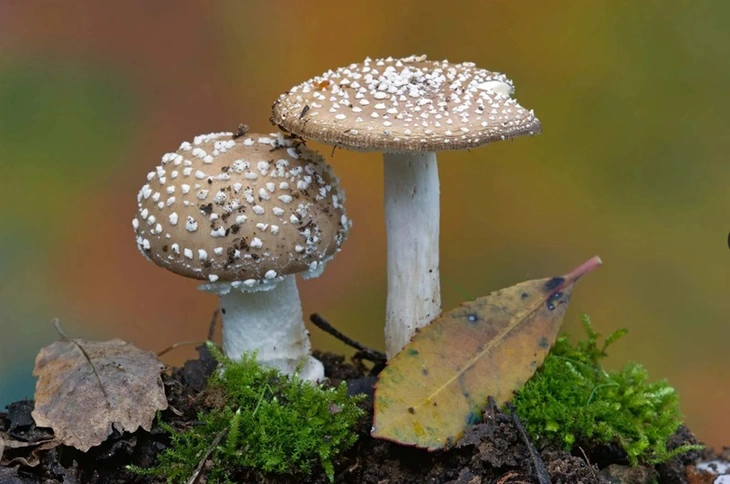
Illustrative image of mushrooms - Photo: BRITANNICA
Scientists have long known that certain bacteria can produce proteins that help water freeze at relatively high temperatures (around -5°C), through a process called "iconic nucleation".
However, whether fungi also possess similar capabilities remains a mystery. A research team led by microbiologist Boris Vinatzer, working at Virginia Tech University (USA), has sought to decipher this mechanism, according to LiveScience on April 28.
The discovery, published in the journal Science Advances , opens up a completely new perspective on the role of microorganisms in Earth's climate system.
By analyzing the genomes of two fungal strains belonging to the Mortierellaceae family, the research team identified a DNA segment that is almost identical to the InaZ gene found in bacteria.
When they transferred this gene into yeast cells, the yeast also began to be able to form ice. This confirmed that this gene is responsible for producing the protein that initiates the ice formation process.
This discovery suggests that in the distant past, possibly millions of years ago, the ancestors of some fungal species acquired this gene from bacteria through a process called "horizontal gene transfer." They then developed their own abilities, turning this gene into a useful biological tool.
However, the specific evolutionary benefits of this ability are not yet fully clear.
One theory suggests that fungi use it to draw water from the air. For example, in lichens, a symbiotic relationship between fungi and algae, ice-forming proteins can cause water vapor to condense into frost in the morning, which then melts into water, providing the organism with water throughout the day.
Notably, scientists believe these proteins can escape into the atmosphere and act as "ice nuclei," helping to form ice crystals in clouds.
As these crystals grow larger, they can fall as rain or snow. This mechanism is similar to how some bacteria, such as Pseudomonas syringae, participate in the water cycle.
Because a single fungus can secrete a large amount of protein, the number of "ice nuclei" from fungi in the atmosphere may be greater than that from bacteria, meaning that fungi may play a more significant role in regulating rainfall.
This discovery is not only of scientific significance but also opens up practical applications. Currently, cloud seeding technology often uses silver iodide, a chemical that can raise environmental concerns.
Researchers believe that proteins from mushrooms could become a safer, more bioavailable organic protein in the future.
Source: https://tuoitre.vn/nam-co-the-tac-dong-den-mua-va-thoi-tiet-20260428130522565.htm

![[Image] Hanoi's urban life under the challenge of a "scorching hot" environment](https://vphoto.vietnam.vn/thumb/1200x675/vietnam/resource/IMAGE/2026/05/25/1779706979265_nang-nong-t5-2026-minh-duy-7-4636-jpg.webp)

![[Image] Close-up view of the interchange connecting the two expressways and Long Thanh Airport.](https://vphoto.vietnam.vn/thumb/1200x675/vietnam/resource/IMAGE/2026/05/25/1779703378210_ndo_br_z7863716673926-224453a31600126cce10622af6290afd-4549-jpg.webp)































































































Comment (0)