


MEMBER OF THE CENTRAL COMMITTEE OF THE PARTY, SECRETARY OF THE CITY PARTY COMMITTEE LE NGOC QUANG:
A comprehensive review of disaster prevention and control efforts is needed.
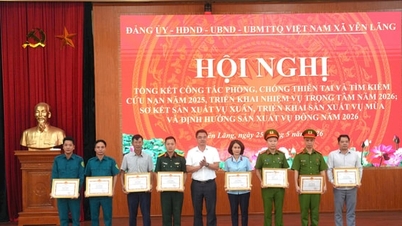
Speaking at a recent conference summarizing civil defense work in 2025 and outlining tasks for 2026, City Party Secretary Le Ngoc Quang emphasized the need for a comprehensive review of disaster prevention and control work across all stages, from forecasting and management to implementation at the grassroots level, based on practical lessons learned from the major floods and heavy rains of the past year.
In addition, it is necessary to strengthen propaganda work, raise awareness and responsibility of the entire political system and society; the heads of Party committees and governments at all levels must directly lead and direct this, considering it a regular task closely linked to socio-economic development and ensuring the safety of the people.
In particular, based on practical lessons learned in 2025, it is necessary to urgently address the shortcomings that have been identified, while continuing to promote the effectiveness of the two-tiered local government model and the "four on-the-spot" principle in organizing response at the grassroots level.
In the organization of forces, it is necessary to build a strong civil defense force, with the armed forces as the core, while promoting the role of specialized forces and the community; strengthening training and exercises, improving command and control capabilities and coordination among forces.
Simultaneously, attention should be paid to investing in and upgrading equipment and facilities for disaster prevention, search and rescue, and incident response, while strengthening coordination mechanisms among all levels, sectors, localities, and social forces to improve the effectiveness of command and control in all situations.

Dr. Le Hung, Lecturer, Faculty of Hydraulic Engineering, University of Technology - Da Nang University:
Reservoir operation under new conditions
Recent weather patterns have necessitated a readjustment of the approach to reservoir operation. Data from 2025 shows that rainfall at many upstream stations has exceeded records from 1999 to the present, putting significant pressure on river systems and downstream areas, leading to unpredictable flooding that deviates from established patterns.
Under these circumstances, maintaining the flood control capacity of reservoirs at a reasonable level becomes a mandatory requirement to ensure the ability to reduce flood peaks when unusual situations occur.
Meanwhile, the current inter-reservoir operating procedure, issued in 2019, needs to be reviewed and updated based on the rapid changes in climate, especially given the significant improvements in meteorological and hydrological forecasting capabilities recently.
With the existing data, calculating short-term inflow into the reservoir is entirely feasible, thereby allowing for proactive lowering of the reservoir water level before the rainy season to near the sluice gate threshold, creating additional flood storage capacity.
If implemented synchronously across the entire Vu Gia - Thu Bon river basin, this solution could create a significant flood control capacity, helping to reduce pressure on downstream areas during prolonged periods of heavy rainfall.
In addition, building and operating a real-time operational support system, in which forecast data is continuously updated at short intervals, allows management agencies to develop appropriate regulation plans at specific times, and even quickly simulate flood scenarios to serve command and control work.
In this context, reservoir management needs to gradually shift from a rigid, process-based approach to a data-driven, flexible one, where decisions are made based on real-time, updated information and analysis. This will enhance practicality and minimize risks in situations of heavy rainfall, rapid and unpredictable developments, and flooding.

MR. PHAM PHONG, MEMBER OF THE BOARD OF DIRECTORS OF SONG BA JOINT STOCK COMPANY (THE UNIT MANAGING AND OPERATING KHE DIEN RESERVOIR AND HYDROELECTRIC POWER PLANT, KRONG H'NANG):
Enhancing the role of forecasting and information
In practice, reservoirs have contributed to reducing flood peaks downstream; however, this effectiveness is limited by the geographical characteristics of Central Vietnam, with its steep river basins, narrow riverbeds, and the relatively small flood control capacity of many reservoirs.
Under these conditions, the function of the reservoir is primarily limited to flood mitigation, making it difficult to comprehensively control large floods occurring in a short period of time with high intensity. Therefore, the requirement is to organize reservoir operation in close coordination with the flow forecasting system, ensuring that regulation is carried out according to actual developments rather than relying entirely on static procedures.
The key issue now lies in forecasting capabilities and the ability to update information in real time. The operating procedures for interconnected reservoirs have been relatively well-established, but they still rely heavily on water levels at monitoring stations as a basis for operation.
Meanwhile, given practical requirements, it is necessary to improve the accuracy of meteorological and hydrological forecasts, while shortening the data update cycle to enable rapid calculation of inflow into the reservoir, thereby allowing for the development of appropriate regulation plans at specific times.
Furthermore, providing timely and transparent information about reservoir operations will help communities be more proactive in relocating, protecting assets, and organizing production.
Source: https://baodanang.vn/nang-cao-nang-luc-ung-pho-3337583.html
![[Photo] The heat at the fireworks display site on the opening night of the Da Nang International Fireworks Festival 2026](https://vphoto.vietnam.vn/thumb/1200x675/vietnam/resource/IMAGE/2026/05/27/1779889741485_ndo_br_z7872039145157-fecaba5112f39e8352544099d7ef4738-5140-jpg.webp)


![[Photo] The courage of new recruits of Brigade 144 on the training ground.](https://vphoto.vietnam.vn/thumb/1200x675/vietnam/resource/IMAGE/2026/05/27/1779881651341_anh-man-hinh-2026-05-27-luc-18-32-52.png)






































































![[Photo] The courage of new recruits of Brigade 144 on the training ground.](https://vphoto.vietnam.vn/thumb/402x226/vietnam/resource/IMAGE/2026/05/27/1779881651341_anh-man-hinh-2026-05-27-luc-18-32-52.png)




























Comment (0)