

The San Chi ethnic community in Cao Bang mainly lives in the two districts of Bao Lac and Bao Lam. The San Chi culture is rich in identity, reflected in its long-standing festivals, customs, beliefs, folk tales, poetry, architecture, and traditional clothing. With the passage of time, the culture of the San Chi people in Cao Bang has been preserved and promoted by successive generations, contributing to the diversity of the province's ethnic communities.
The San Chi people live in small, clustered hamlets in high mountainous regions. Their characteristic house style is a sturdy, four-roofed stilt house. The interior of the stilt house is similar to that of the Tay and Nung people, but is designed more tightly to suit their needs and living conditions. Inside, there are 2-3 bedrooms arranged logically on the left and right sides. The kitchen is located at the end of the central section of the house; this is where cooking takes place and where family members gather around the fire. Above the fire is a loft, often used for storage and to utilize the heat of the fire to preserve food. In front of the door is a platform, often used for drying rice, embroidery, and sewing; the floor beneath the platform is usually used for storing farming tools and livestock. In addition, the house structure includes a small, always-closed room, which even the homeowner only enters a few times a year. This is where, depending on the San Chi clan, they worship the Jade Emperor, the Kitchen God, etc., which they call the "ancestral shrine." Besides ancestor worship, the San Chi people also worship heaven, earth, the local deity, the midwife goddess, the god of agriculture, the god of livestock, and so on.
The San Chi people are primarily farmers. They have been familiar with and applied wet rice cultivation for a very long time. Besides farming, they raise traditional livestock. This is their main occupation, providing the primary source of income for each San Chi family. In addition, they practice handicrafts such as carpentry, rattan and bamboo weaving, and blacksmithing. However, these products are primarily for self-sufficiency within the community and have not yet become widely available goods. Many of these traditional crafts are still preserved and developed by the San Chi people today.
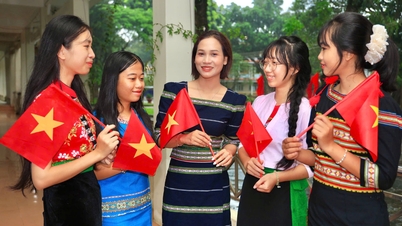
 Traditional clothing worn by San Chi ethnic women during festivals and holidays.
In terms of clothing, San Chi women wear simple, understated attire, unlike the vibrant clothing of the Hmong and Dao people. The traditional attire of San Chi women is a perfect blend of traditional beauty and meticulous stitching. A basic traditional outfit for a San Chi woman consists of: trousers, an inner shirt, an outer shirt, a belt, and a headscarf. On holidays and festivals, the San Chi women's attire may include additional belts, sashes, and various silver ornaments.
In contrast, the traditional clothing of the San Chi men is more rustic and simple, yet still exudes a sense of robustness and strength. Men's clothing is made of indigo-dyed fabric, consisting of a "ba ba" shirt with two large pockets, and long, wide-legged trousers designed for ease of movement, farming, and climbing.
The long-standing customs and traditions of the San Chi people are most vividly reflected in their traditional festivals, most notably the harvest prayer ceremony, the coming-of-age ceremony, and the granary building ceremony... These festivals have been passed down from ancient times and preserved through many generations, rich in humanistic values and expressing the aspiration to conquer nature.
The San Chi people are renowned for their love of singing. Their folk songs are composed and passed down through generations, based on their unique cultural characteristics, customs, traditions, and the process of their labor. San Chi folk singing is closely associated with marriage customs, birthday celebrations, drinking parties, and courtship exchanges, and is performed in various forms, contexts, and spaces. Some of the San Chi folk melodies include Soóng cọ and Sình ca. In addition, there are distinctive folk dances such as Tắc xình dance, drum dance, and fish-stabbing dance. Along with unique folk games like bird-hunting and spinning top games, the lyrics and melodies are an indispensable source of spiritual nourishment for the San Chi people. They encourage and motivate each other, fostering a deeper love for their homeland and villages.
In their traditional rituals, the San Chi people have a unique coming-of-age ceremony (thổm cuổn). When a San Chi boy reaches the age of 11 or 12, his parents must invite a shaman to their home to perform the coming-of-age ceremony – a ceremony recognizing his maturity. The ceremony usually lasts for five days; during the ceremony, everyone attending must observe a vegetarian diet and refrain from killing animals. The shamans recite ten vows, ten oaths, and ten prohibitions to the person receiving the ceremony, such as: not to live dishonestly, not to insult one's parents, etc., all aimed at guiding the person receiving the ceremony to live a virtuous and useful life for society. According to their belief, a man is not yet mature if he has not received the coming-of-age ceremony, and his parents cannot be worshipped after their death. Therefore, if the father has not received the ceremony, the son must perform six steps; if the grandfather and father have not received the ceremony, the son must perform nine steps.
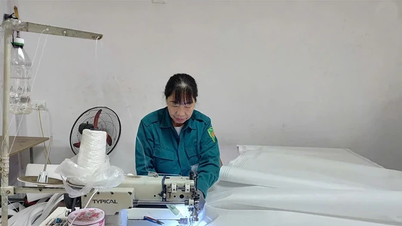
 San Chi women sew clothes by hand.
Regarding funeral rites, according to custom, the San Chi people have two forms of funeral ceremonies (fresh funeral and dry funeral), but they usually choose the fresh funeral method. The schedule of the funeral ceremony is proactively managed by the shamans. When the funeral is held, the bereaved family must cut their hair short to facilitate the observance of taboos. Specifically, sons do not cut their hair for 120 days after the death of their mother and 90 days after the death of their father. In addition, before taking their parents to the burial ground, sons, daughters, and daughters-in-law are not allowed to use bowls and chopsticks to eat rice but use banana leaves to eat rice; they are not allowed to drink water (except water prepared by the shaman); they must eat vegetarian food; daughters-in-law and sons do not sleep in the same bed for 21 days; and especially before the ceremony for the deceased's liberation, the descendants are not allowed to kill any animals.
In the San Chi wedding ceremony, the engagement ceremony is held three times. After each of the three engagement ceremonies, the groom's family must prepare all the required dowry gifts demanded by the bride's family. Typically, this includes 100 kg of pork and silver (today, silver is not used but is exchanged for cash). If the groom's family accepts and fulfills the dowry demands, the official engagement ceremony will proceed. Following the engagement ceremony is the wedding ceremony, which the bride's family holds one day earlier. The wedding ceremony at the groom's house is elaborate and involves many rituals. First, before going to the bride's house, the gifts from those going to fetch the bride are gathered in the center of the house for the village chief to perform a blessing. When departing, the village chief leaves the house first, stands under the roof, performs a blessing, and raises an umbrella. The members of the wedding procession then pass under his arm. This ritual is repeated the following day at the bride's house, when the wedding procession returns to the groom's house. San Chi brides wear a veil over their faces and must leave their homes barefoot, walking slowly and leaving two footprints from the house to the village. Along the way, when crossing bridges or streams, the bride must leave a coin or a few grains of rice on the bridge or throw it into the stream.
The San Chi people highly value emotional life. Those within the same clan always show deep affection and mutual respect. During the annual Lunar New Year, the San Chi people often visit their relatives. They exchange good wishes for health, life, business, and good fortune. These are also lessons they set as examples to raise their children. For the San Chi people, having healthy parents and elders in the family who can guide and teach their children is a source of great pride.
Despite the passage of time and socio -economic changes, the San Chi people have always preserved the beautiful aspects of their traditional culture. This is not only their ethnic identity but also a continuing tradition, a cultural crystallization within the flow of the ethnic communities in the mountainous region of Cao Bang.
Thuy Tien/Cao Bang Newspaper
Source: https://baophutho.vn/net-dep-trong-van-hoa-cua-dan-toc-san-chi-217962.htm
![[Photo] Prime Minister Pham Minh Chinh receives the Ministers of Foreign Affairs, Defense, and Public Security of China.](https://vphoto.vietnam.vn/thumb/1200x675/vietnam/resource/IMAGE/2026/03/16/1773659638054_ndo_br_dsc-4386-6157-jpg.webp)

![[Photo] The General Secretary works with the Executive Committee of the Hai Phong City Party Committee.](https://vphoto.vietnam.vn/thumb/1200x675/vietnam/resource/IMAGE/2026/03/16/1773629925474_vna-potal-tong-bi-thu-lam-viec-voi-ban-chap-hanh-dang-bo-thanh-pho-hai-phong-8644445-332-jpg.webp)




























































Comment (0)