

According to an article on the Valdai Discussion Club website, when discussing Russia's role in the Middle East, three key points stand out. First, Moscow's connection to the region is historically long, dating back centuries, primarily through Christianity and Islam. Second, Russia has strong and balanced relationships with all the key players in the region: Arab states, Iran, Israel, and Türkiye. Third, cooperation between Moscow and Washington is the best way to enhance security in the region.
Regarding its regional ties, Russia has had deep cultural and historical connections with Muslim peoples for centuries, as its role in the Middle East has increased since the 19th century. Initially, this relationship involved protecting Orthodox Christian communities. In the 20th century, Moscow supported the Arabs in their fight against colonialism and later in their conflict with Israel.
Regarding Russia's relations with key countries in the region, Moscow gradually strengthened ties with most Arab republics from the 1950s onwards. Moscow's relationship with these monarchies was neither entirely friendly nor entirely hostile. Furthermore, although the Soviet Union was one of the first countries to recognize Israel in 1948, its relationship with Tel Aviv gradually deteriorated due to Israel's closer alignment with the West.
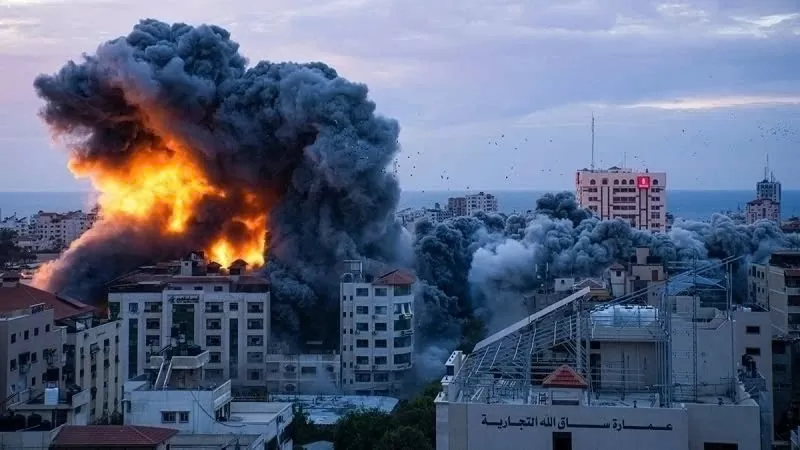 |
| The simultaneous conflicts in Gaza and Lebanon, along with Iran's missile attack on Israel, are fueling a raging Middle Eastern crisis, while diplomatic solutions and initiatives are becoming more obscured than ever. (Photo: AP) |
The real breakthrough for Moscow came in 1955, when the fledgling revolutionary government in Egypt, frustrated by the US refusal to supply weapons, turned to the Soviet Union. From 1955 to 1972, when Soviet military advisors were asked to leave Egypt, Moscow developed extremely close relationships not only with Egypt but also with Syria, Iraq, Algeria, Yemen, and Libya. Undoubtedly, Moscow's support for Arab states in their conflicts with Israel played a crucial role in strengthening the Arab states' position at the international level. Also during that time, Moscow's relations with Iran, Israel, and Turkey were strained due to their Cold War-era ties to the West.
Following the end of the Cold War, Russia attempted to maintain friendly relations, albeit interrupted for about 15 years after Egyptian President Sadat's visit to Jerusalem, with most Arab republics. Moscow transformed these once-strained relationships with the monarchies into mutually beneficial partnerships in various areas, including energy and military cooperation.
With the victory of the Iranian Revolution in 1979, Moscow was able to mend relations with Tehran. Since then, relations have generally improved, and cooperation has increased, particularly in Syria. After the end of the Cold War, Moscow was able to establish better relations with both Israel and Turkey. Clearly, in the last decade, relations with both countries – albeit sometimes interrupted – have reached historic highs. Thus, Moscow's relations with key regional actors have improved significantly compared to the Cold War era.
Russia's role in enhancing security in the Middle East.
Firstly, Moscow has the advantage of long-standing historical ties with Middle Eastern countries. This has always given Russia a superior and comprehensive understanding of a region that lies close to its borders and directly impacts Russia's national security.
Secondly, this advantage is reinforced by the fact that, unlike the US, Moscow has good relations with all the key players in the region. China also has this advantage, but has been reluctant to engage in any security-related initiatives and prioritizes promoting its own economic interests.
Third, with relations between Russia and the US deteriorating due to the conflict in Ukraine, it is almost impossible to imagine any cooperation between the two countries in the Middle East in the near future. However, despite the dire state of US-Russia relations, Moscow can still make a significant contribution to security and stability in the Middle East, paving the way for a solution once cooperation with the US is restored. Such a role for Russia is becoming increasingly necessary and urgent, given the far-reaching and serious consequences of the catastrophic situation in Gaza and the recent escalation in Lebanon.
With the war in Gaza, the model for a regional solution has changed. It's no longer a case of "Arabs versus Israel," but rather the rest of the world divided into groups of observers and groups who support one side or the other to varying degrees. Now, almost the entire international community is against Israel, with only a handful supporting it, including the United States. But even this issue has changed. This is evident when considering the resolutions adopted by the UN General Assembly since October 2023, the most recent being on September 18th (Resolution ES-10/24, based on the advisory opinion of the International Court of Justice, which saw only 14 countries vote in favor of Israel, 43 abstain, and 124 vote against it).
What can Russia do in the Middle East?
Of course, a breakthrough on the issues plaguing the region will not be possible until Russia and the United States restore mutual understanding and cooperation in some form. So what can Russia do to improve the security situation in the region?
Firstly, Russia's relationship with Israel has never been better, despite temporary setbacks due to the conflict in Ukraine. Unfortunately, under the current Israeli government, the prospects for resolving the Hamas issue, not to mention Israel's occupation of Syrian and Lebanese territories, are virtually nonexistent. The maximum achievable goals are a ceasefire, humanitarian aid, facilitating the return of Gaza residents, and lifting measures that are escalating the situation in the West Bank. Furthermore, the top priority is to quickly halt Israeli attacks on Lebanon and ensure the stability of the Israel-Lebanon border.
Secondly, Russia can also contribute in areas where it is directly involved, specifically Syria, Libya, Sudan, and Iran. The situations in both Libya and Sudan are unlikely to be resolved quickly due to deep internal divisions that seem to prevent any mutual understanding. Moscow has good relations with all parties involved, both locally and regionally, primarily with Egypt, Turkey, and the United Arab Emirates (UAE). Russia also maintains contact with the conflicting parties.
Syria and Iran are in a special group, albeit for different reasons. More importantly, however, they are interconnected, as the main actors in Syria are Ankara and Tehran. Eliminating the Iranian and Turkish presence in Syria is crucial for the country's long-term stability, as well as for the relationship between Ankara and Tehran and the Arab states.
Third, Russia's priorities have always been regional security in the Middle East and nuclear non-proliferation. Russia's relationship with Iran could also be leveraged to address regional and global security issues. To achieve this, it is necessary to resume negotiations with Iran in the P5+1 format, as well as restart efforts to establish a regional security system. Establishing such a system requires a complex and lengthy process and will not be feasible in the near future.
Source: https://congthuong.vn/chien-su-trung-dong-nga-co-the-lam-gi-de-dap-tat-ngon-lua-chien-tranh-353466.html




![[Photo] General Secretary and President To Lam meets with National Assembly delegates from ethnic minorities.](https://vphoto.vietnam.vn/thumb/1200x675/vietnam/resource/IMAGE/2026/04/20/1776696701056_a1-bnd-8331-3342-jpg.webp)
![[Image] National Assembly discusses the implementation of the socio-economic development plan.](https://vphoto.vietnam.vn/thumb/1200x675/vietnam/resource/IMAGE/2026/04/20/1776696707422_ndo_br_img-20260420-185419-jpg.webp)









































































Comment (0)