

Russia has deployed Pantsir-S1 anti-aircraft missile systems on air towers in Moscow to enhance its ability to counter UAV attacks.
Last week, Russian state television channel Rossiya-24 broadcast images of Pantsir-S1 systems being deployed to areas surrounding the capital Moscow to bolster air defense capabilities against drone attacks.
Some of the complexes are situated on tall towers, similar to the Flakturm, the name given to the defensive tower system that Germany built during World War II, according to some observers.
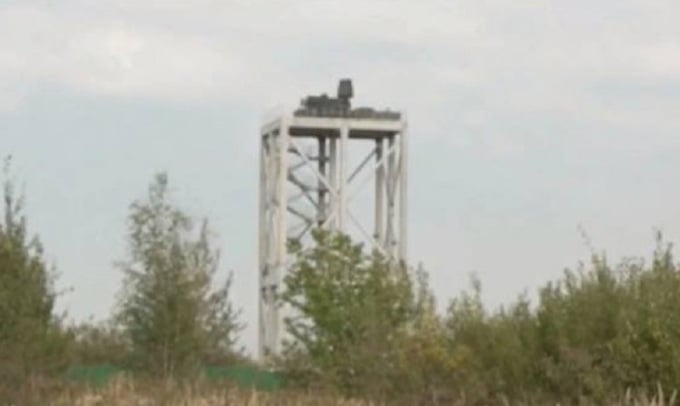
Images of the Pantsir-S1 missile system mounted on tall towers were released by the Russia 24 television channel on September 4th. Photo: Rossiya-24
The Flak Tower is a massive concrete structure, approximately 70 meters tall—equivalent to a 21-story building—equipped with dozens of anti-aircraft weapons, including 128 mm cannons, to provide air cover and increase firing range.
Russian anti-aircraft towers are not as tall as the Flak Tower. Some are as tall as a three-story building, while others are even shorter, resembling a ramp about 6 meters high. The Pantsir S-1 systems appear to be lifted onto the tops of these towers using cranes or heavy helicopters.
Ukraine has recently carried out numerous drone strikes targeting objectives within Russian territory. BBC estimated on September 1st that there have been over 190 such drone attacks since the start of the conflict, with Moscow alone suffering more than 10 of them.
On August 30, Ukrainian drones simultaneously attacked at least six areas in Russia, damaging four Ilyushin Il-76 heavy transport aircraft in the city of Pskov. This is believed to be the largest drone attack on Russian territory since the beginning of the year.
According to military expert Michael Peck, Russia's placement of the Pantsir S-1 system on a tall tower increases its target detection range and firing capability. This is not a new idea, as Russia has previously placed Pantsir systems on the rooftops of high-rise buildings in Moscow, but this is the first time the country has constructed a dedicated structure to house this type of weapon.
Peck also suggested that Russia's tactics had a psychological effect, as these tall towers served as symbols of the government 's ability to protect its citizens.
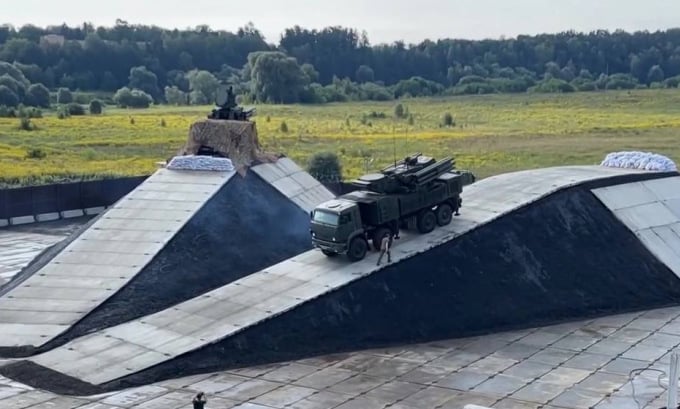
A Russian Pantsir-S1 anti-aircraft gun emplacement positioned on a steep slope. Photo: Rossiya-24
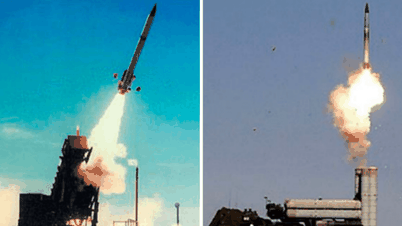
Developed in the 1990s and put into service with the Russian army in 2003, the Pantsir-S1 is equipped with two 30 mm cannons and 12 anti-aircraft missile launchers with a range of 18 km.
The Pantsir-S1 can detect and counter missiles, rockets, helicopters, and various types of unmanned aerial vehicles (UAVs) that Ukraine commonly uses for reconnaissance or suicide attacks.
The Pantsir system has a thermal imaging camera that allows the operator to detect whether the plastic casing of the UAV is fitted with explosives and a detonator. The Russian Ministry of Defense stated that Pantsir operating crews detect and destroy numerous targets during each combat shift. The Russian Ministry of Defense's Zvezda channel reported that Ukraine is hunting for Pantsir systems because they are "100% effective" on the battlefield.
Pham Giang (According to Business Insider, Defence Blog )
Source link




![[Image] Nearly 125,000 Hanoi students completed the Literature exam for the 10th grade entrance exam.](https://vphoto.vietnam.vn/thumb/1200x675/vietnam/resource/IMAGE/2026/05/30/1780117233041_ndo_br_thiet-ke-chua-co-ten-2-png.webp)
























![[Photo] Admire the coral "masterpiece" amidst the million-year-old heritage of Dak Lak province.](https://vphoto.vietnam.vn/thumb/1200x675/vietnam/resource/IMAGE/2026/05/30/1780107638639_y25-jpg.webp)










































































Comment (0)