

Russia is building steel-framed structures with mesh coverings for fighter jets, aiming to protect the aircraft from attacks by suicide drones.
On September 10th, a Russian fighter pilot's account, Fighter Bomber, posted an image on Telegram showing a Russian fighter jet placed inside a large, securely braced metal frame.
Above this frame is a completely covered steel mesh, forming a sturdy metal cage. Fighter Bomber claims this is a new Russian method to counter Ukrainian drone attacks, but does not mention the location where the photo was taken.
"Given the size of the structure, almost any type of strategic aircraft and some helicopters could use it," the Russian pilot noted. "Fire-retardant canvas curtains could be added to the front and rear for increased protection."
The person also stated that the project cost approximately 10 million rubles (over $100,000) and was donated to the Russian military by a business.
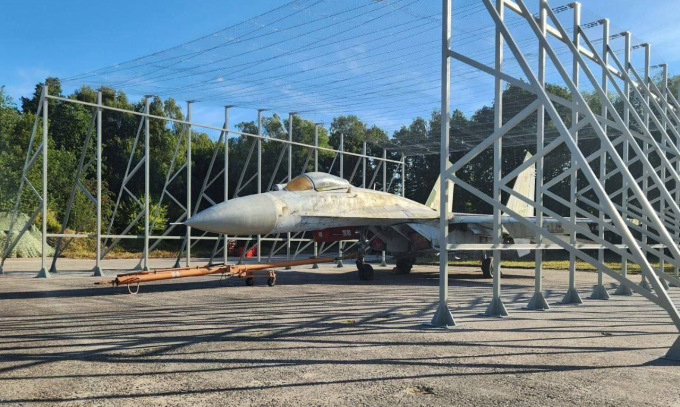
A Russian aircraft is seen inside a steel mesh anti-UAV structure in a photo released on September 10. Photo: Telegram/Fighter_Bomber
The exact mechanism of the structure is currently unclear. Military expert David Cenciotti of Aviationist suggests that the steel mesh serves to shield the aircraft from debris after an enemy suicide drone explodes, or to trap the drone before it reaches its target, similar to what Ukraine has done.
Kyiv had previously released images of Russian Lancet UAVs trapped in nets that Ukrainian soldiers had made themselves to protect military vehicles, such as self-propelled artillery or tanks.
According to Cenciotii, the fighter jet in the Fighter Bomber photo appears to be a decommissioned Su-27, suggesting that the project is still undergoing testing and may be further modified before being deployed on the battlefield.
This is Russia's latest method of protecting military equipment from enemy UAVs. Previous satellite imagery showed Moscow had covered the fuselages of Tu-95 bombers and Su-34 fighter jets with tires, providing an extra layer of protection for the Russian aircraft against debris from UAV explosions, as well as making them harder to detect at night.
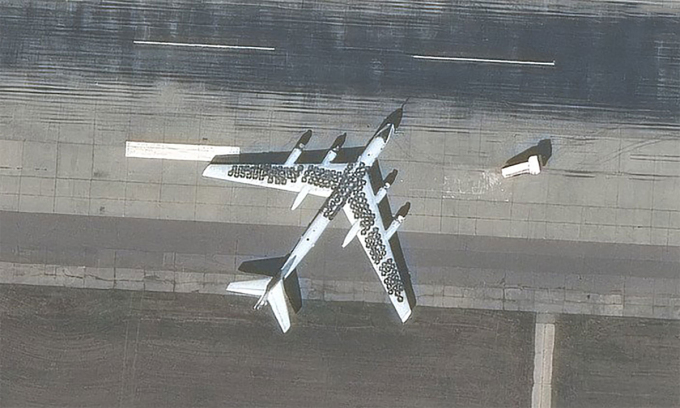
Satellite imagery shows an aircraft covered with tires at Russia's Engles air base on August 28. Photo: Maxar Technologies
However, some experts argue that covering Russian aircraft with tires cannot conceal them from modern Western reconnaissance equipment, and only wastes time when they need to be deployed for missions, as the tires must be removed before the aircraft can take off. Russia's new method of installing a steel cage will not suffer from this drawback.
"Russia's new anti-UAV structure could be more effective than using tires," expert Cenciotii said. "Aircraft can move in and out of this structure just like in a normal hangar, without wasting extra time."
Russia has recently suffered numerous drone attacks on military bases within its territory. The August 30th drone attack destroyed four Il-76 transport aircraft at an air base in the Pskov province. Ukrainian military intelligence officials subsequently stated that their agents carried out the attack from inside Russian territory.
Pham Giang (According to Aviationist, Defense Express )
Source link





![[Photo] General Secretary and President To Lam presides over a meeting on preparations for the review of one year of operation of the three-tiered government system.](https://vphoto.vietnam.vn/thumb/1200x675/vietnam/resource/IMAGE/2026/06/02/1780391821195_a1-bnd-4595-9717-jpg.webp)





















































































Comment (0)