

Bank employees "hunt" for deposits.
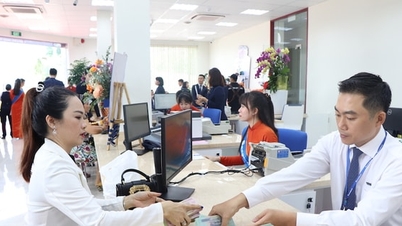
As a priority customer of Vietcombank , Ms. NK (residing in Ho Chi Minh City) was contacted by a bank employee at the end of May to advise her on optimizing her deposit amount. The employee also asked her to enter their phone number in the "referrer" section of the app when making online savings deposits to meet KPIs. Less than a week later, another Vietcombank employee contacted Ms. NK with the same request.
It's clear that the competition for deposits among banks is increasingly fierce, so the pressure to meet KPIs on employees is equally intense. At the end of May, Ms. Tran Thu (Ho Chi Minh City) was informed by a Bank B employee that the interest rate for 6- and 12-month savings deposits was 8.4% per year, nearly 2% higher than the interest rate she had paid six months earlier. However, shortly afterward, Ms. Thu received an offer from another bank to deposit her money at an interest rate of up to 9% per year. Seeing that Ms. Thu wanted to withdraw her money to deposit it elsewhere, the Bank B employee pleaded: "Could you please increase the interest rate a little? If you have to withdraw your money near the end of the month, you won't be able to make up for it."

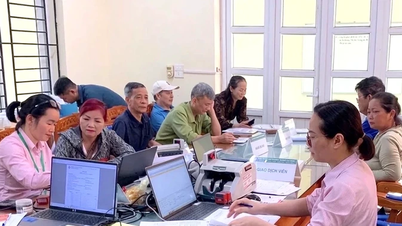
Bank deposits increased.
PHOTO: NGOC THANG
Entering June, savings interest rates have not fluctuated much, although some banks have slightly reduced them, most still maintain high rates. For example, VPBank's Cake By branch continues to offer an additional 1.5% interest rate to new customers, bringing the rate to 8.7-8.9% per year. This bank gives an example: a customer deposits 2 billion VND for a 12-month term, with an interest rate of 7.4% per year, the interest received after the deposit period is 148 million VND. The 1.5% bonus interest alone is equivalent to 30 million VND. The total profit after the deposit period is 178 million VND.
According to the Vietnam Banking Association, deposit interest rates at banks in the last week of May decreased slightly and stabilized at short-term maturities by 0.1-0.2% per year, depending on the term. The Big 4 (four state-owned commercial banks: Agribank , BIDV, VietinBank, Vietcombank) offered interest rates ranging from 2-4.75% per year for terms under 6 months, 3.5-6.6% per year for terms between 6-9 months, and 5.9% per year for terms of 12 months or more. Small and medium-sized joint-stock banks maintained more competitive interest rates, with common rates of 6-7% per year for 6-month terms and 6.9-8% per year for 12-month terms (a 10% per year rate requires a large deposit).
According to data from the State Bank of Vietnam, household deposits in banks reached VND 10,561 trillion by the end of March, an increase of VND 226 trillion, or 2.19%, compared to the end of 2025. This marks the third consecutive month of increased deposits from the household sector. Household deposits exceeded corporate deposits by VND 4,547 trillion. In the third consecutive month, deposits from economic organizations in banks increased by VND 143 trillion after two months of decline. Nevertheless, businesses depositing money into banks still recorded a decrease of VND 166,000 billion, down to VND 6,014 trillion, equivalent to a 2.69% drop compared to the end of 2025. The interest rate race, which began in the last months of 2025 and accelerated in the last week of March, reaching rates of 7-8% per year and maintaining them until now, has attracted savings flows.
Liquidity pressure
Despite the continued increase in deposits at banks and the State Bank of Vietnam's (SBV) implementation of several liquidity support measures, liquidity pressure remains high. In May, after urging banks to reduce interest rates to support lower lending rates, the SBV injected a net VND 30,732.83 billion into the market through the Open Market Operations (OMO) channel in the last week of May. In fact, capital injections into the market through the OMO channel were carried out regularly throughout May and the first few days of June. However, interbank transaction interest rates continued to rise slightly and remained around 7% per annum. Specifically, on May 29th, overnight interest rates were 6.97%/year, 1 week 7.14%/year, 2 weeks 7.34%/year, 1 month 7.16%/year, 3 months 7.45%/year, 6 months 7.53%/year… Transaction volume surged in the overnight term, reaching 1.09 trillion VND, an increase of approximately 200,000 billion VND compared to the previous day. This was a rare day when overnight transaction volume exceeded 1 trillion VND.
According to an analysis by Rong Viet Securities Joint Stock Company (VDSC), the liquidity pressure on the banking system and the upward trend in interest rates are not expected to end anytime soon, as the fundamental factors still show no clear signs of improvement. As of the end of April, deposit growth only reached 2.2% while credit growth was 4.4%, as banks were no longer subject to growth ceilings from the second quarter. This indicates that the gap between deposits and credit continues to widen. Furthermore, the cumulative budget surplus by the end of April 2026 continued to escalate to VND 445,000 billion, a figure reflecting the slow progress of public investment disbursement compared to the plan, meaning a large amount of money has yet to be circulated back into the market. "We expect liquidity pressure to ease significantly in the second half of 2026 if the disbursement of public investment shows a stronger breakthrough. This will be the most important signal to monitor in order to assess when the pressure on capital costs for banks begins to ease," the VDSC report stated.
Mr. Nguyen Phi Lan, Director of the Department of Forecasting, Statistics, and Monetary and Financial Stability (State Bank of Vietnam), analyzed: In the remaining months of the year, several risks exist, including increasing pressure on the banking and financial system as the gap between credit growth and capital mobilization tends to widen, while Vietnam's credit-to-GDP ratio is currently very high compared to many countries in the region. In this context, the room for maneuver in monetary policy is limited compared to previous periods, especially when monetary policy must simultaneously address multiple objectives such as controlling inflation, stabilizing exchange rates, supporting growth, and ensuring system safety. This necessitates a more balanced development between the money market and the capital market, diversification of capital channels for the economy, and a gradual reduction of excessive dependence on bank credit.
According to Mr. Nguyen Phi Lan, the State Bank of Vietnam and the banking system will continue to proactively, flexibly, and cautiously manage monetary policy, coordinating it synchronously with fiscal policy and other macroeconomic policies to control inflation, stabilize the money and foreign exchange markets, and support reasonable economic growth. Meanwhile, banks will have to reduce operating costs, accelerate digital transformation, and enhance the application of technology to reduce capital costs, thereby striving to maintain reasonable lending interest rates to support businesses and individuals in accessing credit.
Easing credit for social housing, industrial zones, and export processing zones.
The State Bank of Vietnam (SBV) has recently sent a document to 25 commercial banks regarding credit growth, specifically credit for real estate, with a focus on easing lending for social housing and industrial parks/export processing zones. Accordingly, from January 1, 2026 to December 31, 2026, banks will not be required to include the additional outstanding credit compared to the end of 2025 for social housing and industrial parks/export processing zones in their real estate credit balance when controlling real estate credit growth, as stipulated in point 4 of Document No. 11686 dated December 31, 2025.
Source: https://thanhnien.vn/ngan-hang-chay-dua-huy-dong-von-185260602204012493.htm

![[Photo] Secretary of the National Assembly Party Committee, Chairman of the National Assembly presides over the meeting of the Standing Committee and Executive Committee of the National Assembly Party Committee.](https://vphoto.vietnam.vn/thumb/1200x675/vietnam/resource/IMAGE/2026/06/03/1780480353201_ndo_br_bnd-2585-jpg.webp)

![[Photo] First session of the 14th Congress of the Vietnam Trade Union](https://vphoto.vietnam.vn/thumb/1200x675/vietnam/resource/IMAGE/2026/06/03/1780465947883_ndo_br_img-3852-jpg.webp)

![[Photo] General Secretary and President To Lam presides over a meeting with the Central Organizing Committee.](https://vphoto.vietnam.vn/thumb/1200x675/vietnam/resource/IMAGE/2026/06/03/1780482764658_a1-bnd-4741-3342-jpg.webp)























































![[Video] Sunset at Lap An Lagoon – Where the sun sets over the fishing nets](https://vphoto.vietnam.vn/thumb/1200x675/vietnam/resource/IMAGE/2026/05/31/1780192137701_beach-landscape-sea-water-nature-grass-745871-pxhere-com.jpeg)


































Comment (0)