

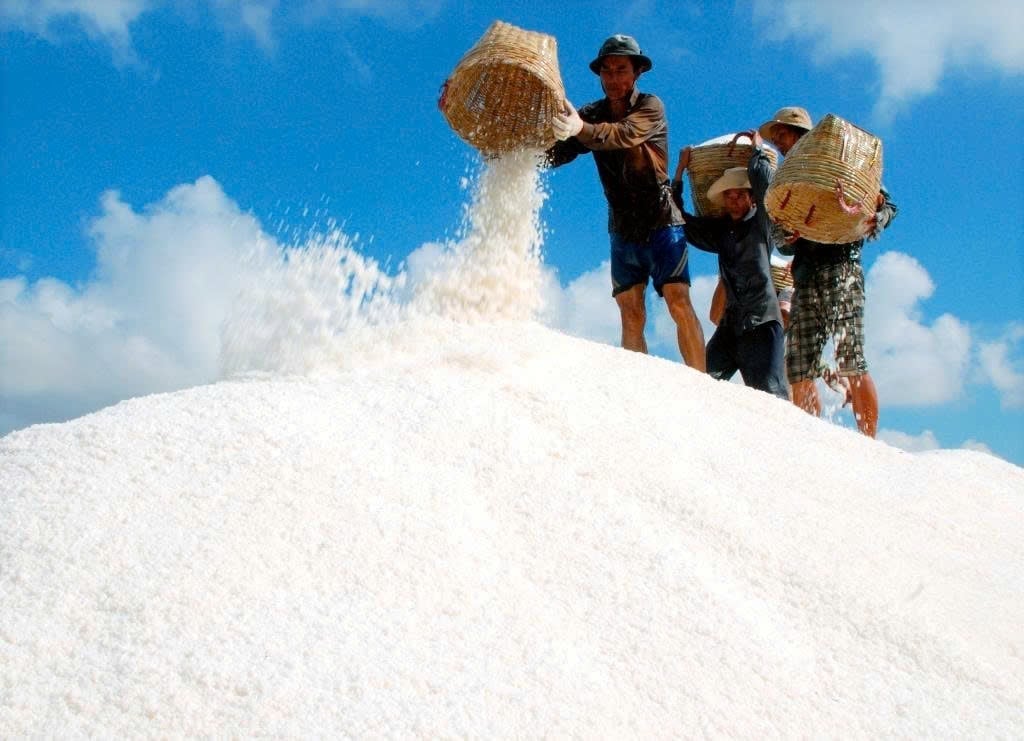
The mechanisms and policies for the salt industry need to be improved to suit the new development context. Photo: Le Hoang Vu.
In recent years, the Party and State have issued many major policies and guidelines for the development of agriculture, rural areas, marine economy , science and technology, digital transformation, private sector development, and institutional reform. This has created a need to review and improve the mechanisms and policies for the salt industry to suit the new development context.
The Ministry of Agriculture and Environment (MARD) has chaired and coordinated with other ministries, sectors, and localities to draft a Decree on the development of the salt industry, replacing Decree No. 40/2017/ND-CP dated April 5, 2017, of the Government on the management of salt production and business.
On the surface, the salt industry seems largely unchanged. The salt fields remain white during the dry season. Salt farmers still go to the fields early in the morning. Salt is still present in every kitchen and on every store shelf. But behind this familiarity lies a different reality: production scale is shrinking, the livelihoods of salt producers are becoming increasingly difficult to maintain, and many policies are no longer keeping pace with the changing times.
Decree 40/2017/ND-CP (Decree 40) was once a significant milestone as it created a separate legal framework for the salt industry for the first time. However, after eight years of implementation, many regulations are no longer suitable for the new legal system and current development requirements.
The draft decree on the development of the salt industry is therefore not simply an amendment to a document. It is considered a necessary update to reshape the approach to this unique production sector.

Salt production area in Khanh Hoa province. Photo: Kim So.
Policies are no longer keeping pace with reality.
From 2017 to the present, a series of laws directly related to the salt industry have been amended, such as: the Land Law 2024, the Cooperative Law 2023, the Price Law 2023, the Law on Government Organization 2025, the Law on Local Government Organization 2025, and the Law on Promulgation of Legal Normative Documents 2025.
These adjustments entailed major changes in land management, production organization, investment mechanisms, and implementation decentralization.
In this context, many provisions of Decree 40 are no longer appropriate. According to the assessment of the policy-making agency, the proportion of content requiring adjustment is so large that it is no longer suitable for a partial revision approach.
According to data from the Ministry of Agriculture and Environment, the area for salt production is projected to be only about 8,600 to 10,000 hectares by 2030, significantly lower than previously planned. Demand continues to increase while domestic supply remains limited.
The reasons don't stem from nature but from competitive pressure from low-priced imported salt, low production efficiency, difficulties in investing in technology, and the trend of land-use conversion, which is causing many salt-producing areas to shrink.
Young people are leaving the profession. Those who remain lack the resources to innovate production. These changes are slow but continuous. It's concerning that Vietnam has many natural advantages for salt production, with over 3,200 km of coastline, yet it is becoming increasingly dependent on external sources.
It's no longer just a story about a traditional profession, but one that relates to self-reliance and sustainable development.

Salt harvesting in Khanh Hoa province. Photo: Kim So.
What needs to change is not just the decree.
The most noteworthy aspect of this draft lies in its approach. While Decree 40 focused on managing production and business, the new draft shifts towards orienting the development of the salt industry. A small change in name, but it shows a shift in management thinking.
The draft proposes many new contents such as identifying key production areas, prioritizing investment by region, promoting science and technology, digital transformation, developing a circular economy, and building an industry database.
These are all development tools that have become common in many agricultural sectors, but they are still relatively new to the salt industry.
After more than a year of development, consultation, and refinement, the draft has received feedback from numerous agencies, localities, and businesses. If promulgated as planned in June 2026, it will serve as a new legal framework for the next phase of the industry.
However, a decree alone cannot bring about change. The ultimate effectiveness still depends on how it is implemented at the local level, the quality of accompanying policies, and the actual investment resources. In the current context, perhaps the first thing that needs to be done is to create a sufficiently new legal framework to give the salt industry a better chance to flourish.
Source: https://nongnghiepmoitruong.vn/nganh-muoi-den-luc-can-mot-khung-phap-ly-moi-d813425.html
![[Photo] The heat at the fireworks display site on the opening night of the Da Nang International Fireworks Festival 2026](https://vphoto.vietnam.vn/thumb/1200x675/vietnam/resource/IMAGE/2026/05/27/1779889741485_ndo_br_z7872039145157-fecaba5112f39e8352544099d7ef4738-5140-jpg.webp)


![[Photo] The courage of new recruits of Brigade 144 on the training ground.](https://vphoto.vietnam.vn/thumb/1200x675/vietnam/resource/IMAGE/2026/05/27/1779881651341_anh-man-hinh-2026-05-27-luc-18-32-52.png)





















































![[Photo] The courage of new recruits of Brigade 144 on the training ground.](https://vphoto.vietnam.vn/thumb/402x226/vietnam/resource/IMAGE/2026/05/27/1779881651341_anh-man-hinh-2026-05-27-luc-18-32-52.png)



























Comment (0)