

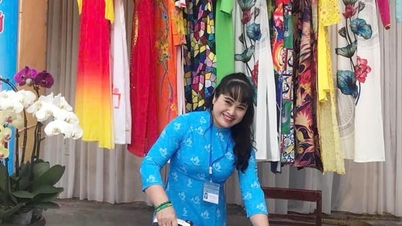
Miss Ngoc Han braved the cold while modeling the ao dai (traditional Vietnamese dress) she designed at several temples and pagodas in Japan.

The photoshoot was done by Ngoc Han in Fukuoka Prefecture in 0-2°C weather during a business trip in early February. The event was part of a cultural exchange program for Vietnamese people in Japan. She launched two ao dai (Vietnamese traditional dress) collections, one inspired by Kim Hoang paintings and the other by Obi - the belt worn on traditional kimono.

Ngoc Han poses in a modernized dress featuring a dragon motif from Kim Hoang's painting, paired with a straw bag.

The Kim Hoang style of Vietnamese painting originated in the latter half of the 18th century from the merger of two villages, Kim Bang and Hoang Bang, later known as Kim Hoang. The paintings depict everyday life, featuring images of pigs, chickens, and the Northern Vietnamese countryside. Painted on red paper, they are also known as red paintings. People often buy and exchange these paintings during Tet (Vietnamese New Year) with the hope of bringing blessings and prosperity to their homes. Following floods, crop failures, and famine, this style gradually declined and disappeared after 1945. It was revived in 2015 thanks to the artist Dao Dinh Chung.

Kim Hoang's paintings are a skillful combination of printing, coloring, and drawing to create artworks with decisive lines. Ngoc Han faced difficulties when transferring the artworks onto clothing because she had to try many times on different materials.

With such diverse themes, she sought advice from artisans to incorporate images of dragons, phoenixes, and carp transforming into dragons onto her dresses using 3D printing techniques.

Using familiar materials like silk, taffeta, and raw silk, Ngoc Han focuses on promoting traditional fitted or loose-fitting dress styles that are currently popular.

In her collection of ao dai (Vietnamese traditional dress) inspired by the obi (sash) of kimonos, Ngoc Han revealed that she collected obi during many trips to Japan and had long dreamed of making ao dai from these very fabrics. She launched the collection last year but hasn't had the opportunity to showcase it on a large stage yet.

The pieces of Obi fabric were sewn together and used to make the skirt.
Photo credit : Le Trong
Vnexpress.net
Source




















































































Comment (0)