


According to the inscriptions on the stele here, the temple originated during the Early Le Dynasty (980-1009).
Towards the end of the reign of King Le Dai Hanh, a founding monk came here to preach and enlighten the Buddhist doctrine. During the Tran dynasty (1225-1400), the founding monks of the Truc Lam Zen sect at Yen Tu Son had close ties with the temple.

Over the years, Hang Pagoda has maintained the tradition of commemorating the birthday of the first patriarch of the Truc Lam sect, "Dien Ngu Giac Hoang Tinh Tue Zen Master," King Tran Nhan Tong, on the 2nd day of the 11th lunar month, and the third patriarch of the Truc Lam sect, Zen Master Huyen Quang Ly Dao Tai, on the 3rd day of the 11th lunar month every year.
During the reign of King Le Gia Tong (1672), Venerable Nguyen Dinh Sach (also known as Chan Huyen) used his money to buy land and renovate the temple into a large and spacious structure, complete with a bell tower, ancestral worship hall, monks' quarters, etc.
During the reign of Emperor Thành Thái (1899), the temple continued to be renovated. In 1917, a library, a statue garden, a pagoda garden were added, and several other structures were repaired. From then on, despite the many ups and downs of history, this ancient temple has been continuously renovated and beautified by generations of abbots, monks, nuns, and Buddhist followers working together.

During the pre-revolutionary period, Hang Pagoda was a center of revolutionary activity for the Communist Party of Vietnam . In 1926, a large number of monks, nuns, Buddhists, and students held a memorial service for the patriot Phan Chu Trinh right at the pagoda.
After the August Revolution of 1945, the pagoda also served as the venue for the inauguration ceremony of the Hai Phong Buddhist Sangha for National Salvation, and the organization of the "Golden Week"...
In 1986, Hang Pagoda was honored to be classified by the State as a national historical and cultural relic.

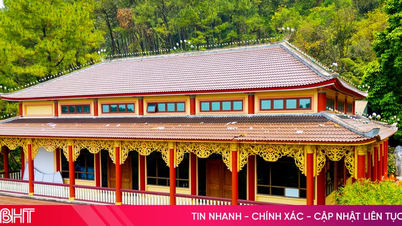
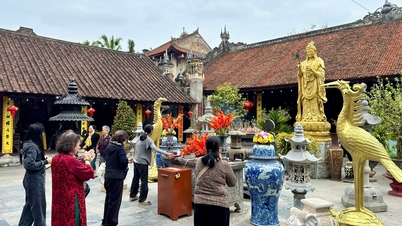
Despite being thousands of years old, Hang Pagoda today still retains its original appearance and ancient features quite well. The pagoda was built in the ancient architectural style, in the shape of the Vietnamese character "Đinh".
At the center is a seven-bay wooden Buddhist temple with a tiled roof, built in the traditional truss-frame style, supported by rows of large, weathered ironwood columns.
The interior is decorated with numerous gilded and lacquered horizontal and vertical plaques, and ornate archways with exquisite carvings in the artistic and aesthetic style of the Nguyen Dynasty (late 19th and early 20th centuries), featuring diverse themes such as plum blossoms and birds, five blessings, dragons and clouds, etc.

In front of the main Buddhist hall, across a wide courtyard, is the triple gate, which houses a five-bay bell tower with three tiers of curved, undulating roofs resembling dragons and phoenixes; inside is a large bronze bell inscribed with the words "Phuc Lam Temple Bell," meaning the bell of Phuc Lam Temple; to the right are five bays of the Ancestral Hall, the refectory, and the side building; to the left are five bays of the rear building. In addition, the temple also has a Mother Goddess shrine, the abbot's residence, monks' quarters, etc.
To the right of the main gate, as you approach from the main entrance, is the temple's sculpture garden, where many kinds of fruit trees and ornamental flowers thrive and bloom brightly all year round.
What makes this place particularly special, resembling an art garden, is the placement of 12 exquisitely crafted statues around the lake, with the main highlight being the statue of the Buddha Shakyamuni seated on a lotus pedestal, under the shade of a majestic and serene Bodhi tree.
Opposite the statue of the Buddha, across the lake, is a black statue of Maitreya Buddha, in a joyful and happy pose. Around the lake and in the garden are statues of the ten Venerable Ones, carved from white stone, in various appearances, postures, and poses.

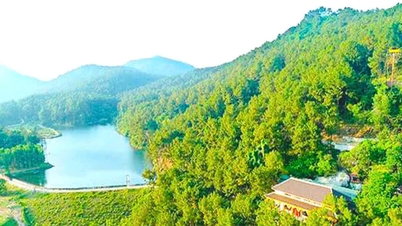
To the left of the main gate is a tranquil pagoda garden, comprising 11 small stone pagodas, where the relics of the founding masters of the Truc Lam Yen Tu Zen sect and other abbots who have passed away at the pagoda are enshrined. All of this creates a solemn architectural complex, harmoniously integrated with nature, peaceful despite the pagoda being located in the heart of a bustling and vibrant city.
Besides its architectural value, which has been formed and enhanced over time, Hang Pagoda currently preserves many artifacts from the feudal period, which are of high material and spiritual value, such as bells, gongs, bronze incense burners, decorative art objects made of ceramics and blue stone, bronze statues (the Three Buddhas set; the Nine Dragons altar - the infant Buddha, protecting good and eliminating evil; the Buddha Hall of the King of Wisdom set) and beautifully carved cabinets…
In particular, the Agama Sutra collection – an ancient document on Buddhist doctrine, known as the first part of the collection of early Buddhist scriptures, an ancient Buddhist doctrine passed down from the first generations of monks and of historical and spiritual value to Vietnamese Buddhism.
Containing invaluable values in terms of landscape, architecture, and artifacts, Hang Pagoda has long been a place frequently visited by people to express their reverence, pray for wealth, peace, and health for themselves and their families. It is also a place where people participate in the pagoda's charitable activities such as scripture lectures, charity work, or simply to admire the scenery and immerse themselves in the sacred, serene, and peaceful atmosphere of the Buddhist sanctuary.

During the Lunar New Year and the first days of the year, the atmosphere at the temple becomes even more bustling with many people coming to pray for peace and well-being, hoping for a year of health and safety. Activities such as chanting scriptures, listening to Dharma talks, releasing animals, and distributing lucky money not only have spiritual significance but also create a space for community connection.
Source: https://baovanhoa.vn/van-hoa/ngoi-chua-ngan-nam-tuoi-con-mai-voi-thoi-gian-227847.html















![[Photo] Reception to welcome General Secretary and President To Lam and his wife on their State visit to the Philippines](https://vphoto.vietnam.vn/thumb/1200x675/vietnam/resource/IMAGE/2026/06/01/1780295488620_vna-potal-chieu-dai-chao-mung-tong-bi-thu-chu-tich-nuoc-to-lam-va-phu-nhan-tham-cap-nha-nuoc-toi-philippines-8798060-7855-jpg.webp)






































Comment (0)