

(NLĐO) - Excavations at 30 sites across the emirate of Fujairah reveal a different picture of the Arabian region at the end of the Ice Age.
Fujairah is one of the emirates that make up the United Arab Emirates (UAE), a land believed to have been uninhabited until 7,000 years ago.
However, a major archaeological excavation has recently taken place that has changed history.
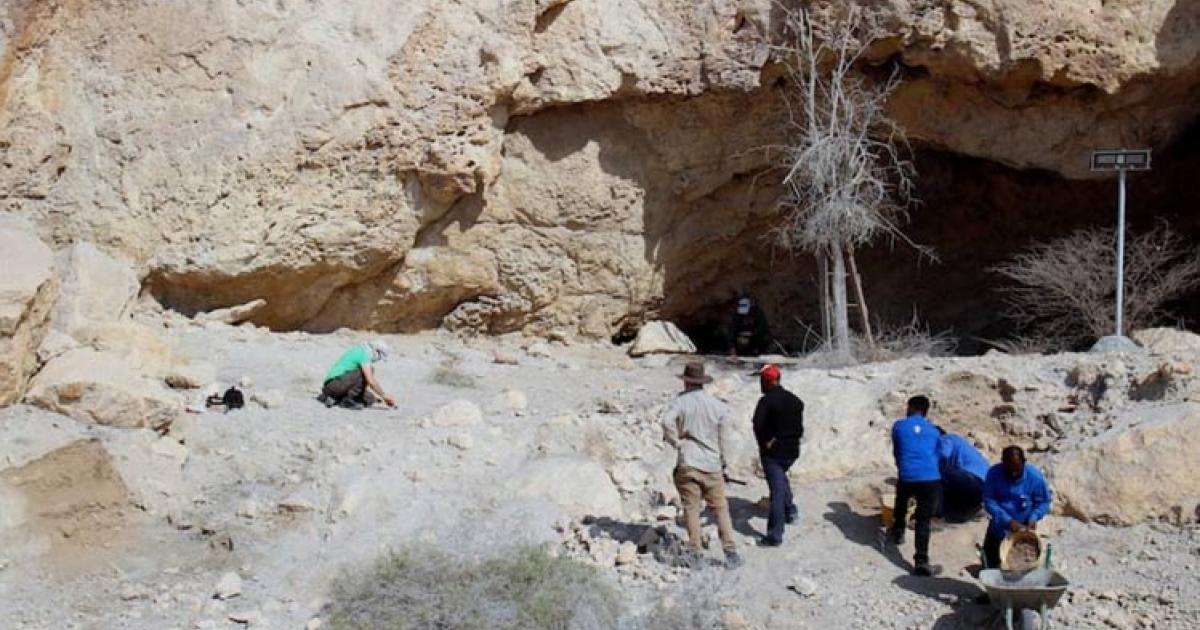
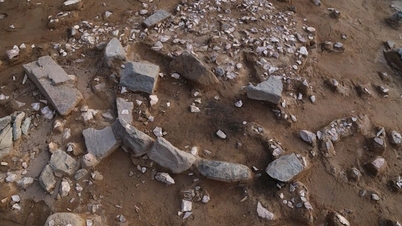
An excavation at Jabal Kaf Addor - Photo: Fujairah Tourism and Antiquities Authority - United Arab Emirates (UAE)
According to Ancient Origins, the Fujairah Natural Resources Corporation, in collaboration with international experts, has identified more than 30 sites with significant geological features, indicating the existence of a large community at a time when Fujairah was thought to be uninhabitable.
The sites form a large settlement called Jabal Kaf Addor, where early forms of houses were built using high-quality limestone from the area.
This rocky refuge offers access to a variety of landscapes, including the inland plains, the western foothills of the Al Hajar Mountains, and nearby canals.
Up to three layers of sediment containing stone tools, animal bones, and hearths have been discovered at the sites, suggesting that humans lived here between 13,000 and 7,500 years ago, according to GDN Online.
Previously, there was also a hypothesis that this area may have been inhabited, but by very ancient people who left during the Last Ice Age (around 20,000 years ago), or even earlier, during a prolonged drought lasting up to 6,000 years.
Around 10,500 years ago, this area gradually began to become wetter over the course of thousands of years due to a shift in the balance between two climate systems.
Fujairah is currently located at the intersection of mid-latitude western regions, which bring winter rains and hot summer Shamal winds, as well as summer monsoon winds from the Indian Ocean.
Along with other evidence, it is thought that humans only truly began to settle permanently here around 7,000 years ago.
But the evidence suggests that despite the harsh conditions of 13,000 years ago – a time when the world was still engulfed in a cold, dry ice age – humans still chose to take refuge in this Arabian land.
It was a significant milestone, especially since the period of settlement coincided with the time when agriculture began to develop in the area.
The Near East – encompassing the countries of the Arabian Peninsula – is believed to be the site of the world's first agricultural civilization, dating back approximately 12,000 years, encompassing both crop cultivation and animal husbandry.
Meanwhile, the melting of the Northern Hemisphere ice sheets only began around 11,700 years ago, and the ice age didn't end until just over 10,000 years ago.
Source: https://nld.com.vn/ngoi-nha-da-a-rap-13000-tuoi-viet-lai-lich-su-196240630105739922.htm

![[Photo] The General Secretary, President and his wife begin their state visit to the Philippines.](https://vphoto.vietnam.vn/thumb/1200x675/vietnam/resource/IMAGE/2026/05/31/1780230559452_anh-man-hinh-2026-05-31-luc-19-28-11.png)

![[Photo] Admire the coral "masterpiece" amidst the million-year-old heritage of Dak Lak province.](https://vphoto.vietnam.vn/thumb/1200x675/vietnam/resource/IMAGE/2026/05/31/1780221235105_anh-man-hinh-2026-05-31-luc-16-53-27.png)
![[Photo] Solemn bathing ceremony and Buddha procession in Hue](https://vphoto.vietnam.vn/thumb/1200x675/vietnam/resource/IMAGE/2026/05/31/1780228263543_1-jpg.webp)


















![[Video] Sunset at Lap An Lagoon – Where the sun sets over the fishing nets](https://vphoto.vietnam.vn/thumb/340x192/vietnam/resource/IMAGE/2026/05/31/1780192137701_beach-landscape-sea-water-nature-grass-745871-pxhere-com.jpeg)




































![[Photo] Admire the coral "masterpiece" amidst the million-year-old heritage of Dak Lak province.](https://vphoto.vietnam.vn/thumb/402x226/vietnam/resource/IMAGE/2026/05/31/1780221235105_anh-man-hinh-2026-05-31-luc-16-53-27.png)
































Comment (0)