

Vocational transformation in the coastal commune of Quỳnh Long.
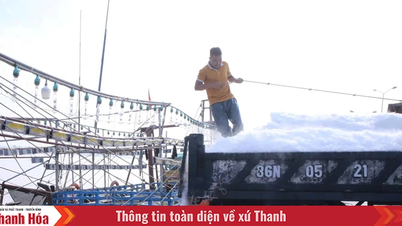
Quynh Long commune (Quynh Luu district) is a locality with a long-standing tradition of seafood fishing, boasting the largest fishing fleet in the province. Unlike before, where the story was solely about getting rich from the sea, now people are also interested in seeing their children switch to other industries and professions that provide stable incomes, making the villages and hamlets much more vibrant.

“He himself went to sea with his father from the age of 16. After 33 years of working at sea, he has become a seasoned and skilled fisherman. The sea has provided income and a stable home for his family. However, instead of inheriting his father's position as captain, he decided to become a worker on a domestic cargo ship, earning a stable salary of nearly 20 million VND per month,” Ms. Vu Thi Van revealed.

It's not just Mrs. Van's family; many young workers in this coastal commune have also switched to jobs on land. The most common are overseas employment and working as factory workers. As a result, the number of people working in the fishing industry is gradually decreasing. "Finding a long-term partner for fishing is harder than finding a large school of fish now," fisherman Tran Dinh Thien in Quynh Long commune remarked.
The Party Secretary of Quynh Long commune, Mr. Ho Nhat Anh, shared: "As a locality with a long-standing tradition of seafaring, at its peak, Quynh Long commune had 86 large-capacity fishing vessels, but now that number has decreased to 35. One of the reasons for the decline in the fishing fleet is the shortage of labor in the maritime industry."

Young people are no longer interested in seafaring and are developing local service industries such as: hairdressing, beauty services, construction, electronics repair, electrical repair, refrigeration repair, etc. In particular, women who previously only knew how to mend nets and sell fish at the market are now working as factory workers. Statistics show that before 2010, 70% of the workforce in Quynh Long commune worked in seafaring and related occupations, but now this number has decreased to 40%.
"As society develops, people shifting to other industries and professions is the right direction, in line with new trends. When children work in other industries and professions, people's perceptions change, and their economic thinking becomes more dynamic," Mr. Ho Nhat Anh shared.

Dien Ngoc's direction
Dien Ngoc commune is known as a dynamic coastal area of Dien Chau district. Besides fishing , the people here have developed diverse industries such as service businesses, fisheries logistics, and seafood processing. Of the commune's more than 7,700 inhabitants, 3,000 are involved in fishing and fisheries logistics, while the rest are engaged in other industries and occupations.
Mr. Nguyen Van Dung, Vice Chairman of the People's Committee of Dien Ngoc commune, said that in addition to solutions to improve the efficiency of seafood exploitation, the locality is striving to expand and diversify other industries and occupations to increase people's income. Currently, the entire commune has 47 enterprises and nearly 2,000 production and commercial service establishments, including 117 fisheries logistics service establishments with annual revenue of hundreds of billions of VND. This is a new direction that the people of Dien Ngoc commune are interested in.
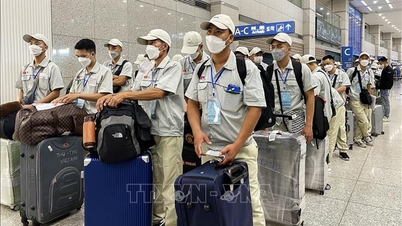
“For the past two years, Dien Ngoc commune has been implementing a vocational retraining program in two ways: Firstly, the local government has been promoting and guiding young people of working age to participate in overseas labor export programs and work in companies and factories... Among them, a shipping company in Hai Phong has recruited nearly 300 young people to work as laborers on cargo ships. This is a suitable profession for people from coastal areas, and when working on cargo ships, they receive a salary of 30-40 million VND per month.”
"The second approach is to encourage fishermen to switch from trawling to other environmentally friendly fishing methods such as purse seine fishing, longline fishing, and scoop fishing... Due to the effective conversion of occupations, Dien Ngoc commune has reduced the number of fishing boats from 456 to 232, and by 2030, it will be reduced to only 100 fishing boats," Mr. Nguyen Van Dung shared.

Over the years, in addition to solutions to improve the efficiency of seafood exploitation, the authorities of coastal communes in Dien Chau, Quynh Luu, and Hoang Mai town have been striving to expand and diversify industries and shift the labor structure. Each year, Dien Chau district has nearly 500 fishermen working abroad, and thousands of workers employed in factories in industrial zones both within and outside the district.
According to Mr. Bui Xuan Truc, Deputy Head of the Agriculture and Rural Development Department of the district, currently more than 20% of the district's fishing workforce has switched to other industries and occupations.
Nghe An currently has a fishing fleet of 3,336 vessels. The province aims to reduce this number to 3,250 by 2030.

![[Image] First Congress of the Vietnam Science and Technology Trade Union](/_next/image?url=https%3A%2F%2Fvphoto.vietnam.vn%2Fthumb%2F1200x675%2Fvietnam%2Fresource%2FIMAGE%2F2025%2F12%2F24%2F1766552551054_ndo_tr_img-1801-jpg.webp&w=3840&q=75)


















![[VIMC 40 Days of Rapid Progress] VOSCO Container Transportation Department | Perseverance – Connection – Innovation – Breakthrough](https://vphoto.vietnam.vn/thumb/402x226/vietnam/resource/IMAGE/2025/12/24/1766545965846_vimc-40day-vosco-24-12-25.jpeg)












































Comment (0)