

Back in 1976, when Silicon Valley was still a wild, untamed land of electronic dreams, there were two brilliant, passionate but completely penniless young men: Steve Jobs and Steve Wozniak. They had an idea, an ambition, but lacked someone to keep their feet on the ground.
That person is Ronald Wayne.
At the time, Wayne was a seasoned 41-year-old engineer at Atari, while Jobs and Woz were only in their twenties. He was the "adult in the room"—the one who mediated the disagreements between the two young men, personally sketched Apple's first logo (a complex drawing of Isaac Newton sitting under an apple tree), and most importantly, he typed the first partnership agreement, officially giving birth to Apple.
Given that pivotal role, he was given 10% of the shares. Jobs and Wozniak each held 45%. On paper, he was part of a trio shaping the future.
But just 12 days later, the "adult" decided to back out. He sold his 10% stake to two young friends for $800. A few months later, he received an additional $1,500 to officially relinquish all rights related to Apple. History has recorded this as perhaps one of the worst financial decisions of all time.
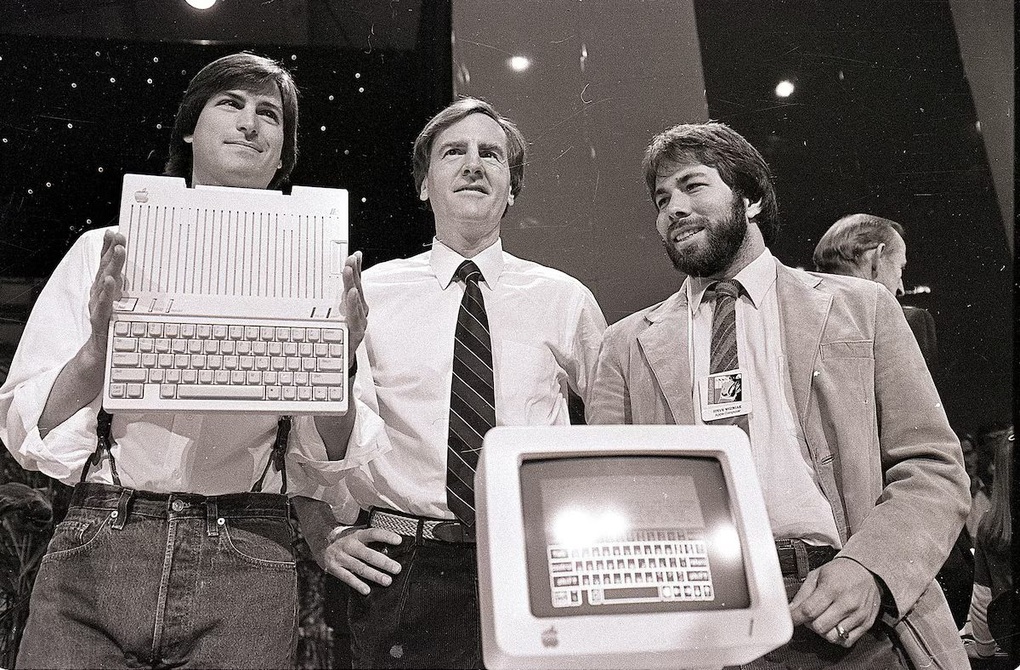
Steve Jobs, John Sculley, and Steve Wozniak in 1984. Jobs and Wozniak were two of the famous co-founders of Apple. The third co-founder, Ron Wayne, left after two weeks and sold his 10% stake for $800 (Photo: AP).
Why would an experienced person make such a "foolish" decision?
From a present-day perspective, with Apple as a $3 trillion empire, Wayne's actions seem like a joke. But if you put yourself in the shoes of a middle-aged man with a family, a home, and assets in 1976, his decision is perfectly logical and understandable.
Expert analysis reveals two core fears that motivated him:
First, there's the tangible fear called "personal financial risk."
In the early days, Jobs borrowed $15,000 (a huge sum at the time) to buy components for his first order from Byte Shop. The problem was, Byte Shop was notoriously a "stubborn" partner, frequently making late payments.
Wayne recounted, "Jobs and Wozniak didn't have a penny at the time, while I had a house, a car, and a bank account."
According to the law at the time, in a partnership, the owners were personally liable without limit for the company's debts. This meant that if Apple went bankrupt and couldn't pay its $15,000 debt, the creditors would turn to the only person with assets to seize. That person was Ronald Wayne.
He faced a difficult choice: gamble his entire life savings on a vague project by two young men, or protect his family's financial security. And he chose the safe option.
The second fear is the shadow of the giants – the fear of being overshadowed.
This reason is perhaps the most profound and human of all. Wayne knew who he was and where he stood. He realized that Jobs and Wozniak were shining stars with an energy and vision that he could not match.
"I know I'm standing in the shadow of giants," he shared. "And I'll never have a project of my own."
He envisioned a future where he would be relegated to the documentation department, toiling away with paperwork for the next 20 years. That wasn't the life he wanted. He wanted the freedom to create and pursue his own projects. In a bitter but famous quote, he said, "If I had stayed at Apple, I would probably be the richest man in the cemetery by now."
He chose independence over wealth in captivity.
A life without regrets?
Today, at age 91, Ronald Wayne lives a quiet life, relying on social security benefits and renting out part of his house. He's not rich, but as he says, "I've never been hungry."
Although he initially stated he had no regrets, he later admitted that if he had retained even a small portion of those shares, his financial life would have been "much easier."
Ronald Wayne's story is more than just an anecdote about missed opportunities. It's a true slice of the nature of entrepreneurship: a gamble between risk and reward, between safety and ambition, between mastering one's own life and being part of something greater.
Wayne didn't make the wrong choice; he simply chose a different path—one that didn't lead to the glass skyscrapers of Cupertino, but to a peaceful, independent life. And that, in a way, is also a priceless asset that no number can measure.
Source: https://dantri.com.vn/kinh-doanh/nguoi-co-sang-lap-bi-lang-quen-cua-apple-va-sai-lam-lon-nhat-lich-su-20250625065226318.htm


![[Photo] Enchanting ancient rose garden on the mountainside in Nghe An](/_next/image?url=https%3A%2F%2Fvphoto.vietnam.vn%2Fthumb%2F1200x675%2Fvietnam%2Fresource%2FIMAGE%2F2025%2F12%2F19%2F1766109900916_vuon-hong-chin-do-thu-hut-du-khach-toi-check-in-o-ha-noi-3-20162778-1671624890024-1671624890104198100259.jpeg&w=3840&q=75)

![[Photo] General Secretary To Lam visits the exhibition space showcasing books, photo exhibitions, and achievements of digital transformation in journalism.](/_next/image?url=https%3A%2F%2Fvphoto.vietnam.vn%2Fthumb%2F1200x675%2Fvietnam%2Fresource%2FIMAGE%2F2025%2F12%2F19%2F1766110879215_1766110240024-jpg.webp&w=3840&q=75)

































![[INFOGRAPHIC] Overview of the Hoa Phat Dung Quat Rail and Special Steel Production Plant Project](https://vphoto.vietnam.vn/thumb/402x226/vietnam/resource/IMAGE/2025/12/19/1766111183203_z7339170069817-126a3e5a095f62e606a0be41015c1b80.jpeg)











































Comment (0)