

C CHOOSE 7 YOUNG MEN TO GO FIND COAL
Amidst the scorching, humid March sun that blankets Dak Rang village (Duc Nong commune, Quang Ngai province), the atmosphere in this community tourism village remains vibrant. Elder Brol Ve, over 80 years old, still possesses bright eyes and a warm, deep voice. In his house, which houses dozens of traditional musical instruments, he recounts the story of Cha Chaih, a ritual dating back to ancient times when the Gie Trieng people lived off the forest.
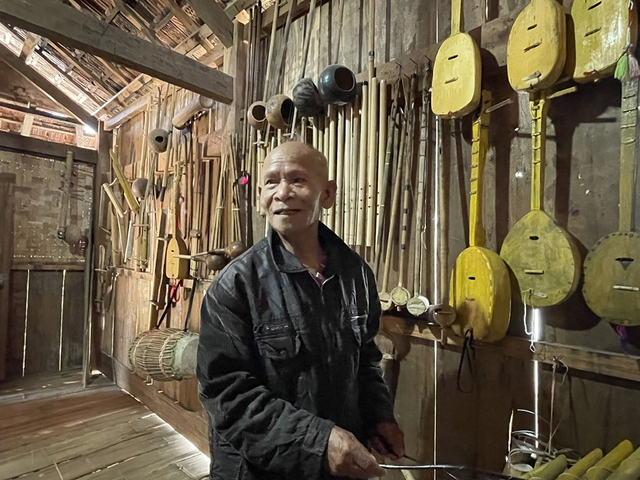
Elder Brol Vẻ, a participant in the charcoal-eating rituals.
PHOTO: PHAM ANH
According to legend, the Gie Trieng people only cultivate one crop per year. After the harvest, around the end of December, when the moon is waning, the villagers hold a "charcoal-eating" ceremony to thank the spirits and pray for a bountiful harvest the following season. This is also an important occasion to obtain charcoal from the chaih tree, believing it to be the best type of charcoal for forging and repairing agricultural tools.
What's special is that not everyone is allowed to participate in the charcoal-gathering expedition. The village council will meet and select seven healthy young men, and more importantly, they must be "clean" both physically and mentally: they must not have done anything wrong, and their families must not have experienced any misfortune. However, the final decision still rests with the spirits. The village elder splits a bamboo tube in half and tosses it into the air. If one half lands face down and the other face up, it means the spirits approve. If not, the selection process must start again. "Gathering charcoal requires not only strength but also an honest heart," Elder Brol Vẻ concluded.
On the appointed day, from early morning, seven young men silently left the village. Their baskets contained sticky rice cooked in bamboo tubes, wild game meat, and other familiar forest tools. From that moment on, they had to maintain absolute secrecy, not meeting anyone in the village to ensure the sacredness of the ritual. After many hours trekking through the forest, they reached a place with many chaih trees. Before cutting down the trees, the village elder performed a ritual, praying to the spirits for permission to "take from the forest."
The first chaih tree was not to be cut down with axes or knives. The men had to use their strength to uproot the tree as a way of showing respect and a direct connection with nature. Only when the tree fell did they use axes, machetes, etc., to chop it into pieces for charcoal. Accompanying this were long, echoing howls through the deep forest, blending with the sounds of the mountains, creating a moment that was both sacred and majestic. The chopped tree trunks were stacked on top of each other. At midnight, a fire was lit. After three days, when the wood had turned into charcoal, they began carrying it back home.
A VOW TO THE FOREST
Coal is not allowed to be brought directly into the village. One person goes ahead, places the coal at the edge of the village, then returns to the forest, and only then do the villagers come to collect it. The person who went into the forest and the villagers who come to collect the coal are absolutely forbidden to meet – a ritualistic rule demonstrating a clear separation between the "sacred space" and everyday life.
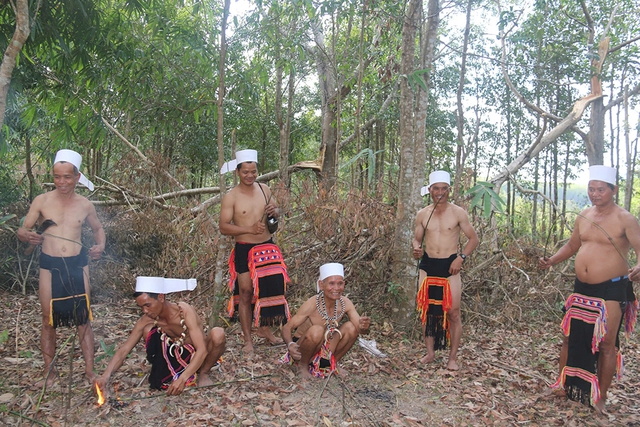
The villagers went into the forest to perform a ritual to find a tree to bring back charcoal.
PHOTO: NGOC QUYEN
Before returning to the village, each person who went into the forest also made themselves a hat from the bark of the long kliă klao tree, a simple material but one that held significance as a "mark" of those who had completed the sacred journey. When the group returned, they circled the bonfire four times, blew horns, creating a transitional ritual: from the forest to the village, from nature to life.
At the communal house, when the charcoal is brought in, the sound of gongs and drums resounds joyfully. The villagers gather in large numbers to welcome the "fire bearers" back. The charcoal is put into the forge, igniting a new fire, the fire that marks the beginning of a new production season. The ritual of forging agricultural tools takes place solemnly. The blades of knives, machetes, and axes are coated with a mixture of reed leaves and roasted stone crabs, a folk secret passed down through generations. According to the Gie Trieng people, this forging method makes agricultural tools durable and prevents them from bending or warping.
A special detail of the Cha Chaih festival is that the charcoal gatherers are carried from the blacksmith's house to the communal house as a form of honor. Amidst the gongs and drums, they become heroes of the community, those who bring livelihood to the entire village. After the festival, the whole village eats, drinks, and performs the xoang dance. Any conflicts or grudges are thus resolved. The festival is not only a ritual but also an opportunity to strengthen community bonds.
The following day, the villagers once again went to the forest together to clear land for farming. Those who went to collect charcoal would choose a shared farming spot, a way of organizing themselves that clearly demonstrated their community spirit. On their way back, each person planted a branch of a bamboo tree at the edge of the village, expressing their hope for a bountiful harvest.
Elder Brol Vẻ slowly said, "The Giẻ Triêng people live off the forest, so they must know how to protect it. We only burn charcoal once a year. If we destroy the forest indiscriminately, the spirits will punish us." The elder's words were clear: Exploit but not destroy, rely on nature but preserve it.
Today, as modern life permeates every village, Cha Chaih is no longer celebrated as regularly as it once was. The recent revival of the festival is not only an effort to preserve the heritage, but also a way for the younger generation to better understand their roots. Some argue that Cha Chaih is not just a story about "eating charcoal," but a story about how people keep the fire burning. The village fire and the fire of faith have burned through generations amidst the vast forest.
According to the Department of Culture, Sports and Tourism of Quang Ngai province, the aforementioned festival belongs to the Gie Trieng ethnic group in the border communes of Dak Plo, Dak Mon, and Duc Nong. In Dak Plo commune, two villages (Dak No and Dak Ga) still maintain the annual Cha Chaih ritual. Of these, Dak Ga village has preserved the traditional rituals and distinctive cultural values of the "eating charcoal" ceremony most intact. (to be continued)
Source: https://thanhnien.vn/nguoi-gie-trieng-with-tuc-an-than-185260531210906969.htm




![[Photo] General Secretary and President To Lam and the President of the Philippines hold talks.](https://vphoto.vietnam.vn/thumb/1200x675/vietnam/resource/IMAGE/2026/06/01/1780283481955_vna-potal-tong-bi-thu-chu-tich-nuoc-to-lam-va-tong-thong-philippines-hoi-dam-8797519-1429-jpg.webp)
























































































Comment (0)