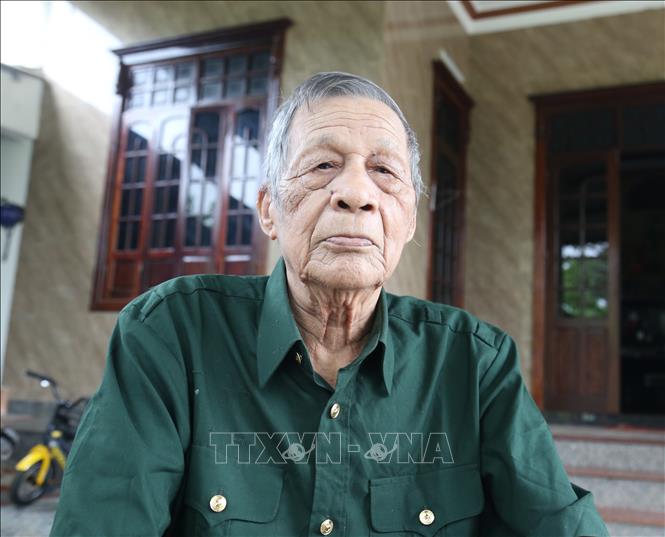
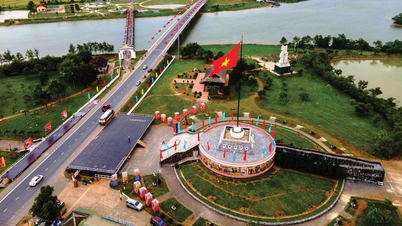
Mr. Nguyen Van Tro, former militia squad leader of Hien Luong Platoon, participated in protecting bridges, flagpoles, and patrolling along the Ben Hai River.
This place has etched its name into history, enduring through the years with ordinary people who contributed to a silent epic that has become a symbol for an entire generation, living and dedicating themselves with all their patriotism and faith in a unified future.
These are "wars" without gunfire.
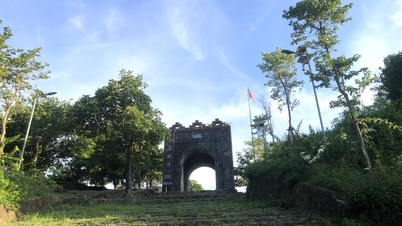
For those living in the border region like Mr. Nguyen Van Tro (born in 1936, 55 years of Party membership, residing in Hien Thanh commune, Vinh Linh district), memories of the days spent living and fighting near Hien Luong Bridge remain vivid. In 1954, after the Geneva Accords were signed, establishing the Ben Hai River and Hien Luong Bridge as the temporary demarcation line, Mr. Tro, then a militia squad leader in the Hien Luong Platoon, was assigned to maintain a fighting position there. During the day, he and others engaged in normal production activities. At night, he coordinated with the police force at Hien Luong Post to protect the bridge, the flagpole, and patrol along the river.
Recalling a historical period, Mr. Tro shared: "At that time, the battles were fierce, from political struggles to disputes over bridge paint colors, loudspeaker battles, and even chess battles... Few could imagine that the paint color of the Hien Luong bridge was once the subject of intense struggle. Our side wanted to paint the entire bridge green, a symbol of peace and the aspiration for reunification. But the South Vietnamese government repeatedly repainted half of the bridge on their side with a different color."
Each time the bridge was divided by two contrasting colors, our soldiers and civilians immediately repainted it, ensuring it remained a single color, a steadfast message of unwavering unity for a unified nation. Not stopping there, on the North bank, a large loudspeaker system was erected, broadcasting the voice of the Government , the people, and the aspiration for peace. Music, plays, and revolutionary folk songs echoed across to the South bank, deeply touching people's hearts. The opposing side quickly erected an even larger loudspeaker system, broadcasting distorted and misrepresented information. Thus, a "sound war" continued for a long period.
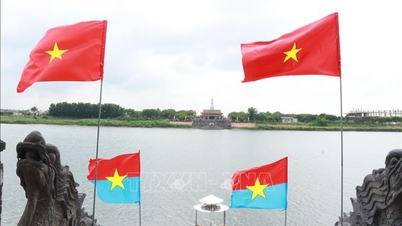
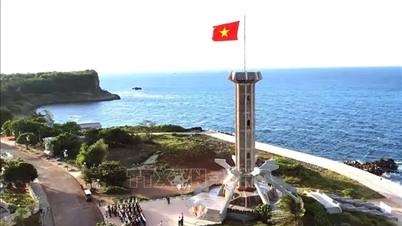
Among countless silent battles, the flag-waving contest, or "flag-fighting," was considered the most sacred and moving symbol. The red flag with a yellow star, fluttering atop the flagpole on the North bank, was not only a symbol of the Fatherland but also a message of faith and support for the people of the South. Every time the flagpole was broken by bombs, every time the flag was torn, the militia immediately re-erected it. Bamboo and casuarina trees were searched for, carried back, and erected amidst the hail of bullets.
By 1962, the Government commissioned the Vietnam Machinery Installation Corporation to construct a special flagpole, 38.6 meters high, hoisting a flag measuring 134 square meters and weighing 15 kg, making it the tallest flagpole on the demarcation line. During the fierce years of war, when Hien Luong was the frontline subjected to "bombing and shelling," Mr. Tro, along with his comrades and the people, did not hesitate to face danger, ready to sacrifice their lives to protect the flag, every inch of land, every branch of a tree with all their will and patriotism until the day the country was reunified.
The flag maker at the border
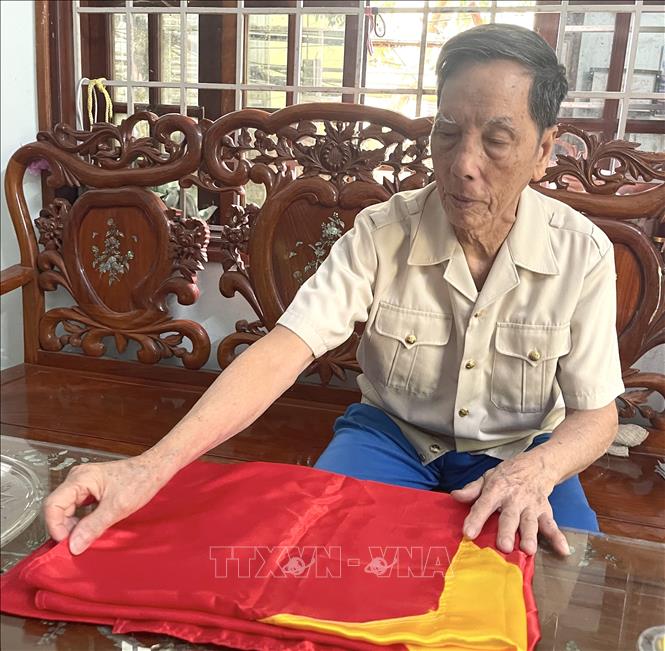
Mr. Nguyen Duc Lang, from Dong Ha city ( Quang Tri province ), has been sewing flags for Hien Luong for 13 years.
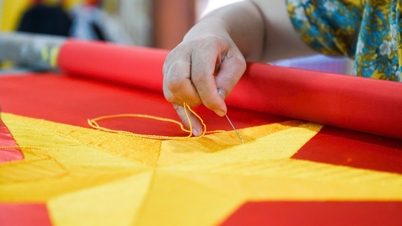
For the people of Quang Tri, no one can forget the image of a soldier who spent 13 years meticulously sewing the red flags with yellow stars that fluttered atop the Hien Luong monument. He is Nguyen Duc Lang (born in 1937), currently residing in Ward 5, Dong Ha City. In 1959, he enlisted and became a Logistics Assistant in the Logistics Department of the Border Police in Vinh Linh District. From 1960, he was in charge of military equipment, including a seemingly simple but extremely special and sacred task – sewing the national flag to be hung on the Hien Luong monument and along the route from Hien Luong to Huong Lap commune (Huong Hoa district). At that time, the red flag with a yellow star was not simply a symbol of a nation, but a powerful declaration of justice, a burning desire for independence and reunification, and a testament to the unwavering will of the North towards its fraternal South.
Recalling those unforgettable years, Mr. Lang emotionally recounted: "Initially, lacking experience, it took me 7 days to sew a large flag measuring 96 square meters. Later, with practice, I could shorten it to 2.5 days. To make such a flag, I needed 122 square meters of red fabric and 10 square meters of yellow fabric. The most difficult period was from April 1965 to 1970, when the war was fierce, with bombs raining down day and night. This was the time when the US imperialists began expanding their war of destruction to the North, with intense bombing raids targeting military and civilian targets. The area below the 17th parallel, where the Hien Luong bridge was located, became one of the key targets for concentrated US air attacks."
We had to evacuate, take shelter in bomb shelters, and spread out tarpaulins to sew flags. In those times of scarcity, every meter of fabric was as precious as blood. From measuring and cutting to sewing, everything had to be meticulously calculated to avoid waste. The hardest part was assembling the five-pointed golden star, each point 5 meters long, which had to be spread out on the ground in a cramped bomb shelter. Sitting hunched over amidst the dust, stretching each piece of fabric, stitching each thread, at that moment, the aspirations and dreams of a peaceful tomorrow, of a united nation, filled our hearts. Those national flags were not just fabric, but the spirit, the blood, the image of a resilient people who refused to be subjugated...
The flags that Mr. Lang sewed fluttered proudly amidst the smoke and flames of war, shining brightly on the Hien Luong monument. That image lives on in the nation's memory as a part of the sacred spirit of the land. Today, returning to everyday life, he still maintains the habit of sewing national flags to hang on important occasions of his homeland such as National Day, Victory Day on April 30th, and Lunar New Year... For his silent but immense contributions, Mr. Nguyen Duc Lang was awarded the First Class Resistance Against America Medal, the Liberation Fighter Medal (First, Second, and Third Class), and the Glorious Fighter Medal (First, Second, and Third Class).
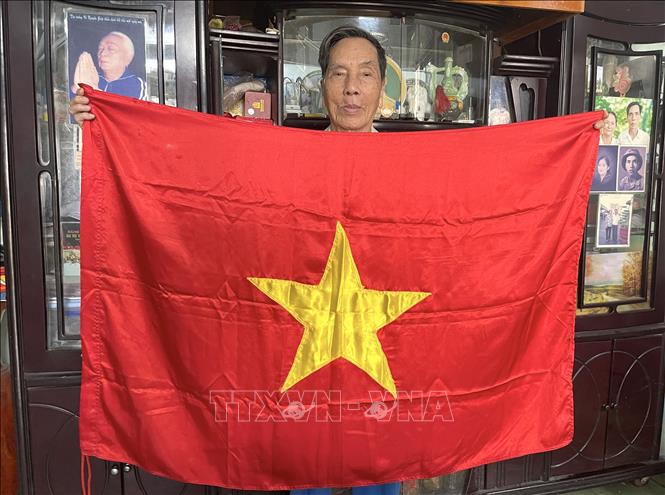
The flag was sewn by Mr. Nguyen Duc Lang to be displayed on important occasions in his hometown.
Ordinary soldiers like Mr. Tro and Mr. Lang are living witnesses of history, reminding us, the younger generations today, to be grateful to our forefathers who selflessly sacrificed and silently contributed to building the nation for reunification. Those who have experienced war, sacrifice, pain, and loss understand the full value of peace better than anyone else. And today, against the blue sky of Hien Luong, the red flag with a yellow star flies proudly, a symbol of a strong nation reborn and rising in a new era...
Major General Ho Thanh Tu, Chairman of the Quang Tri Provincial Veterans Association, shared: "Mr. Nguyen Van Tro and Mr. Nguyen Duc Lang are exemplary figures who made significant contributions to the nation's historic victory in the resistance war against the American imperialists. Although the war ended more than half a century ago, their contributions remain invaluable. Each held a different position and had a different task, but all made silent, persistent contributions to the victory."
During the resistance war, Quang Tri had over 20,000 veterans who participated in combat, served in combat, and contributed to the cause of national liberation. Many of them have become historical figures, contributing to writing the heroic epic of the nation on many fronts, from politics and military to logistics and culture. In today's peaceful life, these former soldiers of Uncle Ho continue to play their role in the new era on the fronts of building, protecting, and developing the homeland, as well as educating the younger generation...
Source: https://baotintuc.vn/xa-hoi/nguoi-may-niem-tin-chien-thang-20250414165532812.htm


















































Comment (0)