

The more than 15-year journey of farmer Nguyen Cong Bang in raising pheasants clearly demonstrates a reality: To preserve this profession, one needs not only experience but also the ability to adapt flexibly to constant changes.
FROM PASSION TO BUSINESS
Mr. Nguyen Cong Bang's story of raising pheasants began quite simply, stemming from his fondness for this eye-catching bird species. More than 15 years ago, when many people were still unfamiliar with this model, he boldly tried raising a few in his garden, mainly for ornamental purposes. At that time, pheasants were not common and were subject to regulatory controls, so buying and selling them was not straightforward.

Recalling the early days, Mr. Bang shared: "Back then, I raised very few pheasants, just a few at a time, mainly selling them to enthusiasts. At that time, management was strict; buying and selling required complete paperwork, and the prices were high. Sometimes, the value of a pair of breeding pheasants was equivalent to one gold coin."
Driven by passion, he decided to experiment, despite facing numerous setbacks. His first few breeding cycles resulted in significant losses due to a lack of technical expertise. From maintaining temperature and caring for the chicks to preventing diseases, he had to figure everything out on his own. At one point, the flock died in large numbers, almost causing him to give up.
"I tried raising them, but at first I lacked experience, and many of the chicks died. I got used to it and gained a lot of experience, which helped me raise them more successfully," Mr. Bang recalled.
The real turning point came when the market began to show more interest in pheasants, especially the demand for breeding stock. Recognizing the opportunity, he gradually shifted from raising them for recreation to raising them commercially, boldly expanding the scale of his operation.
According to Mr. Bang, the most favorable period was when the market for breeding pheasants was booming. “At times, I could sell 400-600 breeding pheasants every four days. Customers would place orders a month in advance, and only then would I have pheasants to deliver. The price was around 30,000 VND per bird, and demand was very strong in the Mekong Delta provinces,” Mr. Bang said.
At that time, pheasant farming was a significant source of income. Thanks to stable demand and a fast production cycle, farmers could reinvest continuously. Many households both within and outside the locality also began to adopt this model.
However, this rapid development laid the groundwork for subsequent difficulties.
MARKET REVERSAL AND THE CHALLENGE OF RETAINING ONE'S JOB
As more and more people get involved in pheasant farming, the market for breeding stock is gradually becoming saturated. Selling prices are no longer as high as before, while input costs, especially feed, are constantly increasing.
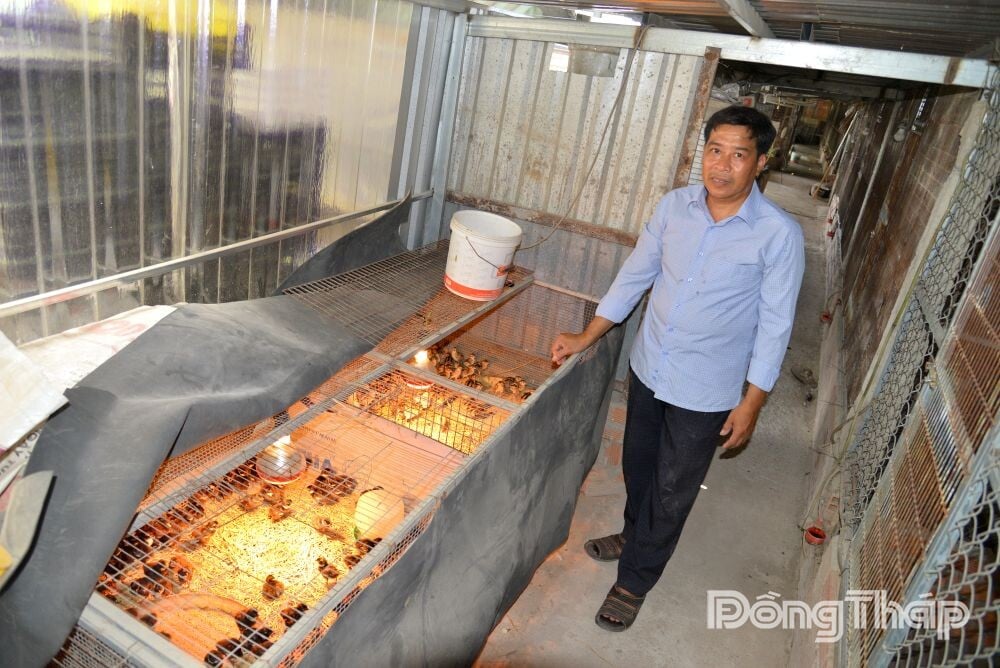
According to Mr. Bang, this is a period that forces farmers to change. "When many people follow suit, the breeding stock becomes difficult to sell, and the price is no longer as high as before. I have to switch to producing eggs and meat to make ends meet," he said.
Currently, Mr. Bang's farm maintains a scale of several thousand chickens, sometimes reaching 3,000-4,000. Each month, the egg production reaches over 20,000 eggs, with selling prices ranging from 7,000 to 8,000 VND per egg.
The price of chicks remains around 30,000 VND/chick for newly hatched birds, while meat birds cost about 160,000 VND/kg if sold live, and when processed or frozen, the price ranges from 180,000 to 200,000 VND/kg.
However, the output is no longer as stable as before. "Now, selling pheasants is more difficult than before. If we have a contract, we can supply a few hundred birds each month, otherwise, we only produce at a moderate pace," Mr. Bang frankly stated.
The greater pressure comes from production costs. Feed prices have increased while selling prices haven't risen proportionally, leading to a significant decrease in profits. "Compared to before, profits have dropped considerably. If someone is starting to raise livestock now, it will be very difficult to recoup their investment," he commented.

Besides being affected by market conditions, pheasant breeders now also have to comply with stricter management regulations. All breeding stock must have a clear origin, be fully monitored and documented. Valid documentation is required for transportation and sale.
Mr. Bang said that the procedure involves many steps: "We have to prepare a breeding plan, submit it through a single point of contact, then the relevant authorities conduct an on-site inspection and confirmation before granting a license. Each time we import new breeds, we have to redo the process, which is very time-consuming."
Although somewhat complex, Mr. Bang believes that compliance with regulations is essential for long-term development. "Doing things right builds credibility. In the province, many people know that our farm has a clear origin and is fully registered, so they trust us more," he said.
Thanks to this adherence to regulations, the farm's products, including pheasant eggs and meat, have been recognized as meeting OCOP standards. This is an important step in enhancing product value and expanding market opportunities.
Not stopping at pheasants, Mr. Bang also raises other species such as teal, civets, and ornamental birds to diversify his products, mainly to meet the demand for breeding stock and satisfy his passion. Some of the ornamental bird breeds are highly valuable, even imported from abroad to serve collectors.
However, according to him, the decisive factor remains technique and experience. Compared to raising chickens and ducks, pheasants are more difficult to raise, especially in the early stages. "The brooding period requires maintaining a higher temperature and lasts about 20 days. When they grow up, pheasants tend to peck at each other, so their beaks must be trimmed or their eyes covered, they must be raised at a reasonable density, and the enclosures must be well-ventilated," he shared.
In addition, full vaccination is a mandatory requirement given the current disease situation. The time required to raise them for meat is about 5 months, while breeding takes 7-8 months. The peak breeding season usually falls around March-April (lunar calendar).
After more than 15 years of dedication, Mr. Bang's pheasant farming model still brings in several hundred million dong in income each year. Although the income is not as high as it was before, according to Mr. Bang, the more important thing is maintaining stability.
Looking to the future, Mr. Bang is neither overly optimistic nor pessimistic. He believes this model can still develop if done properly. "Anyone with experience, following regulations, and with a market for their products can still do it. But newcomers need to think carefully, because it's not as easy as it used to be," he said.
The story of Mr. Nguyen Cong Bang illustrates a familiar reality in agricultural production: When the market is favorable, many people participate, but when difficulties arise, only those with sufficient experience and adaptability can survive.
Amidst market fluctuations, preserving the profession is not just a story for individual farmers, but also reflects the transformation from spontaneous to professional production, from following trends to calculated action. And in that journey, farmers like Mr. Bang are gradually adapting so as not to be left behind.
LE MINH - HUU THONG
Source: https://baodongthap.vn/nguoi-tam-huyet-voi-nghe-nuoi-chim-tri-a240816.html
![[Photo] First session of the 14th Congress of the Vietnam Trade Union](https://vphoto.vietnam.vn/thumb/1200x675/vietnam/resource/IMAGE/2026/06/03/1780465947883_ndo_br_img-3852-jpg.webp)

![[Photo] Secretary of the National Assembly Party Committee, Chairman of the National Assembly presides over the meeting of the Standing Committee and Executive Committee of the National Assembly Party Committee.](https://vphoto.vietnam.vn/thumb/1200x675/vietnam/resource/IMAGE/2026/06/03/1780480353201_ndo_br_bnd-2585-jpg.webp)
![[Photo] General Secretary and President To Lam presides over a meeting with the Central Organizing Committee.](https://vphoto.vietnam.vn/thumb/1200x675/vietnam/resource/IMAGE/2026/06/03/1780482764658_a1-bnd-4741-3342-jpg.webp)



































![[Video] Sunset at Lap An Lagoon – Where the sun sets over the fishing nets](https://vphoto.vietnam.vn/thumb/1200x675/vietnam/resource/IMAGE/2026/05/31/1780192137701_beach-landscape-sea-water-nature-grass-745871-pxhere-com.jpeg)






























Comment (0)