

Hanoi – Becoming a principal at the age of 20 and dedicating many years to teaching, Mr. Vinh felt disillusioned upon retirement and decided to open a private school with many bold steps.
One day in early November, Mr. Nguyen Trong Vinh, the founder of Nguyen Sieu Primary and Secondary-High School in Hanoi, sat in front of his computer, wearing headphones, and playing the song "The Song of the People's Teacher" before drafting a document.
At the age of 88, with 69 years of teaching experience, this year he is the only educator nominated by the Hanoi Department of Education and Training for the title of People's Teacher. He is also the oldest person on the list of 34 nominees for this title.
"I am very happy and would like to dedicate this honor to the generations of teachers and students, especially the parents who have helped me fulfill this task," Mr. Vinh said.
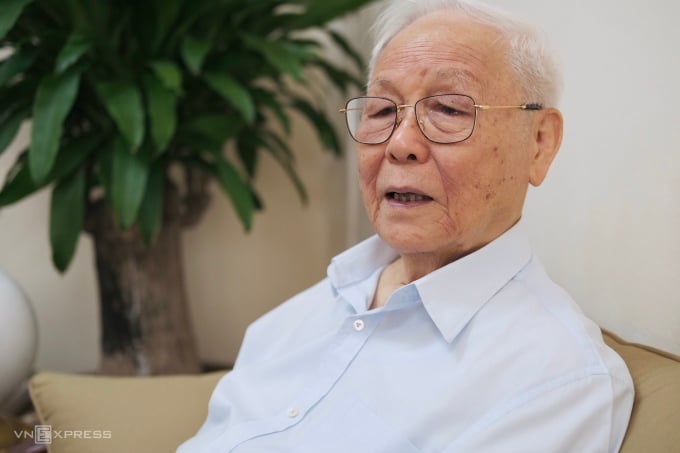
Mr. Nguyen Trong Vinh in his office at Nguyen Sieu School. Photo: Duong Tam
Mr. Vinh was born in a poor rural village, now part of Hai Phong City. Orphaned at the age of 13, he joined the revolution, working as a liaison for the Viet Minh in the commune. With his "small and agile" build, after traveling dozens of kilometers on foot and swimming across rivers to complete his missions, he was retained by the district Party committee, then the provincial Party committee, and later the city Party committee.
Highly regarded but with limited education, Mr. Vinh was sent to attend a literacy class in the Viet Bac war zone. He recounted that upon arriving, he met Deputy Minister Nguyen Khanh Toan and was given an office job thanks to his ability to "type with ten fingers" while waiting for the next literacy class.
He recounted that one day the deputy minister asked, "Would you like to go to China to study?", and he immediately agreed. After three years of teacher training at the Nanning campus, when Hanoi was liberated in 1954, he was granted special permission to graduate and, along with 14 others, returned to take over youth work in schools.
At the age of 20, Mr. Vinh was assigned to be the principal of Dong Ngac Primary School, an old school with 5-6 classes.
"That was a profound memory in my life, an honor but also a heavy responsibility. But during that period, my comrades were very enthusiastic. So wherever we went, whatever environment we were in, we brought with us a new atmosphere of revolution," Mr. Vinh said.
The young teacher Trong Vinh later became a specialist at the Hanoi Department of Education, before attending a political education training school and then becoming a philosophy lecturer at the Hanoi Teacher Training College, now the Metropolitan University.
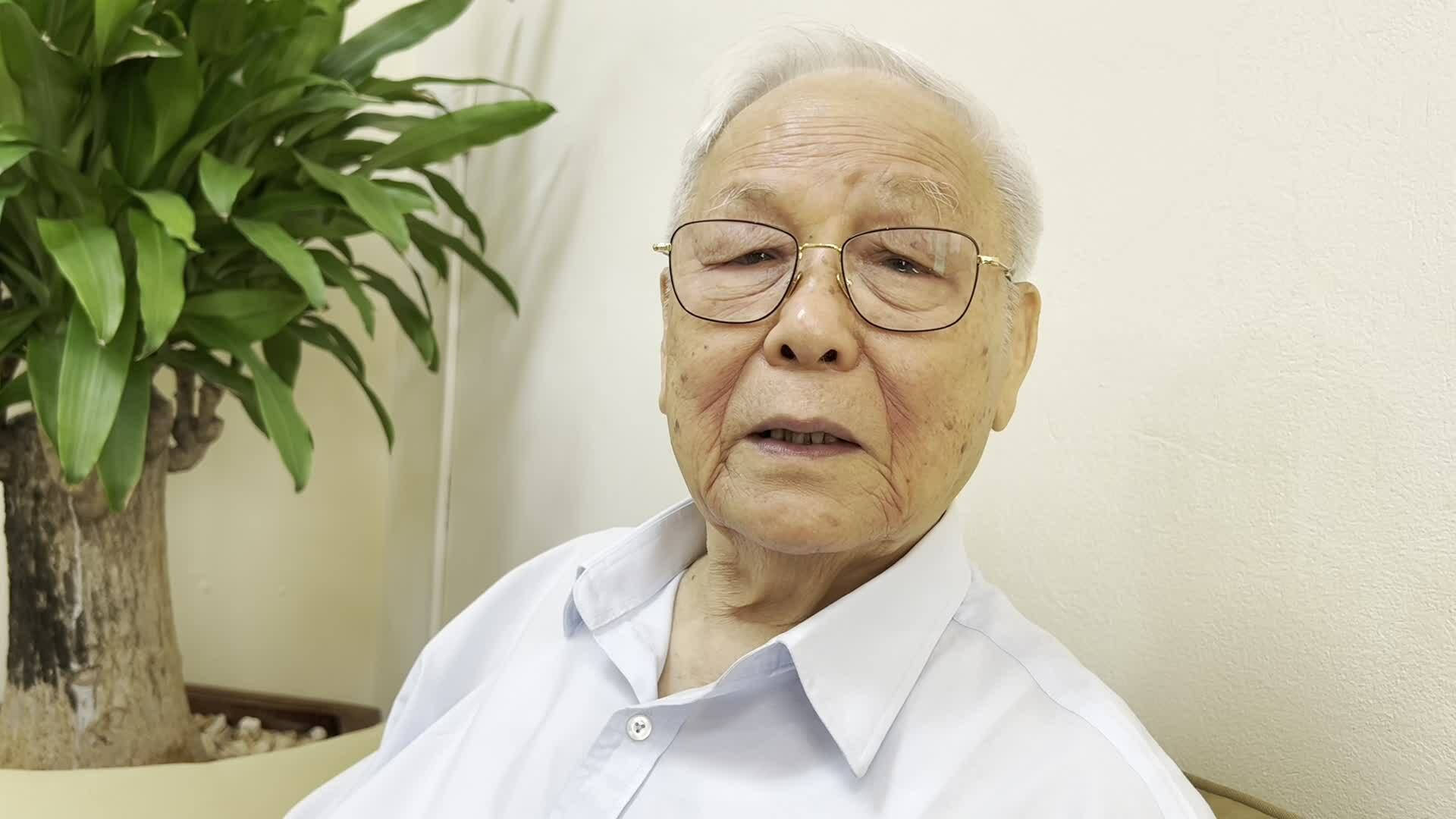
Mr. Vinh recounts his journey from China to Hanoi to take over the capital. Video: Duong Tam
In 1965, when the resistance war against the US reached its most critical stage, the Party and the State deployed political officers to reinforce the army. After months of intensive training at the Political Officer School, the 30-year-old teacher became a political officer in the Engineering Corps.
For 25 years, he traveled extensively across battlefields, suffering a collapsed lung and two ruptured eardrums that left him deaf in his right ear. In 1989, he retired with the rank of Colonel. Feeling a sense of emptiness, he felt he had to do something. And he did, both in construction and in building makeshift stalls to sell water in Phung Hung. Sometime later, he joined the Center for Supporting Education in Mountainous Areas, traveling to remote schools from Muong Khuong to the northern mountainous provinces. Meeting many teachers, he recalled his time teaching and wondered, "Why not open a school to teach?"
With the help of the then Director of the Department of Education, Mr. Vinh and his wife opened a private school, named Nguyen Sieu, after "taking attendance but only finding a school named after Saint Quat and not Saint Sieu".
Although the school received its establishment decision on September 11, 1991, it didn't have its first opening ceremony until the 1992-1993 school year with 132 students divided into 5 classes for grades 7-12. The following year, he established an additional primary school with two first-grade classes, each with 40 students.
He explained that the school had legal status, but was merely a "school on a makeshift platform" because it had to rent eight different locations over 12 years. These rented places were all in poor condition, such as the overgrown backyard of Thanh Cong School with its rows of dilapidated houses for workers. He had to find a way to make the school more presentable.
"The engineering corps helped me a lot, from bricks and tiles, cement, and sand, to sending people to help with the renovations. The local people also supported me by donating old tables and chairs," Mr. Vinh recounted.
Despite having to borrow money, Mr. Vinh's principle was "excellent teachers, diligent students." Students with low entrance scores, having failed to get into public schools, were admitted to private schools, but they had to be well-behaved to be accepted. Regarding teachers, he invited excellent teachers from Hanoi-Amsterdam High School and Chu Van An High School to teach. He also provided computer science lessons for students, inviting instructors from the Military Technical Academy. At that time, few schools could do this. The couple borrowed money to pay the teachers' salaries.
At that time, students usually addressed their teacher as "teacher" and referred to themselves as "student," but Mr. Vinh believed that the teacher-student relationship should be like that of a father or mother teaching their child, so he required students to address him as "child." While students at other schools only attended one session a day, all students at Nguyen Sieu School attended two sessions due to their low entry level and the need to compensate for knowledge gaps.
As a result, 100% of the first graduating class completed high school, and 72% went on to attend universities, colleges, or vocational schools.
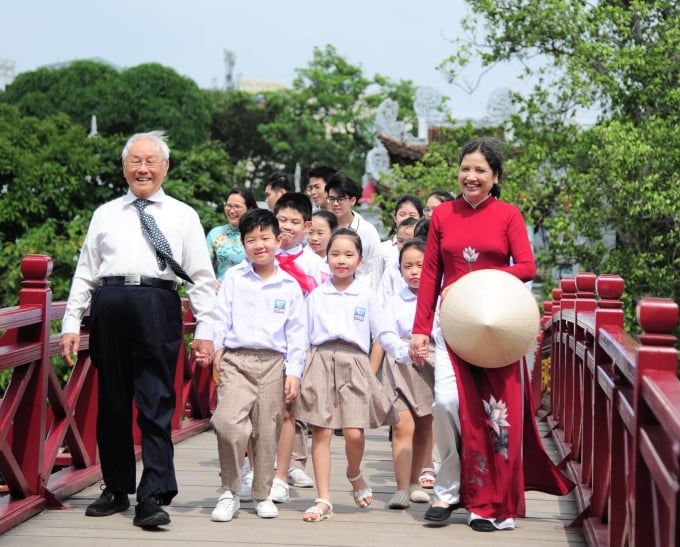
Mr. Vinh and Ms. Duong Thi Thinh with students from Nguyen Sieu School. Photo: Provided by the school.
Later, Nguyen Sieu School was granted land and preferential loans for construction. In 2004, the school moved to its current location in Cau Giay District. The university entrance exam pass rate has been 100% for the past five years, and the school has also developed into a Cambridge International Bilingual School, with many students receiving scholarships to study abroad.
Mr. Vinh's wish is for Nguyen Sieu to become an international school, teaching in English and allowing all students to learn a second language, possibly Chinese.
"I also want the school to have a preschool level to educate students from the age of 3," the nearly 90-year-old teacher shared.
Source link
![[Photo] First session of the 14th Congress of the Vietnam Trade Union](https://vphoto.vietnam.vn/thumb/1200x675/vietnam/resource/IMAGE/2026/06/03/1780465947883_ndo_br_img-3852-jpg.webp)
![[Photo] Secretary of the National Assembly Party Committee, Chairman of the National Assembly presides over the meeting of the Standing Committee and Executive Committee of the National Assembly Party Committee.](https://vphoto.vietnam.vn/thumb/1200x675/vietnam/resource/IMAGE/2026/06/03/1780480353201_ndo_br_bnd-2585-jpg.webp)



![[Photo] General Secretary and President To Lam presides over a meeting with the Central Organizing Committee.](https://vphoto.vietnam.vn/thumb/1200x675/vietnam/resource/IMAGE/2026/06/03/1780482764658_a1-bnd-4741-3342-jpg.webp)












































![[Video] Sunset at Lap An Lagoon – Where the sun sets over the fishing nets](https://vphoto.vietnam.vn/thumb/1200x675/vietnam/resource/IMAGE/2026/05/31/1780192137701_beach-landscape-sea-water-nature-grass-745871-pxhere-com.jpeg)





























Comment (0)