

The price of pepper has jumped from 50,000 VND/kg to 160,000 VND/kg, but supply is insufficient to meet demand, so it is predicted that the price of pepper will continue to rise without a clear end in sight…
In recent days, pepper farmers in Duc Linh and Tanh Linh districts have been very happy because the price of pepper has been skyrocketing. However, many areas have suffered crop failure due to pests and diseases, or prolonged heatwaves and insufficient irrigation, resulting in limited supply to the market. Mr. Nguyen Dung, in the Suoi Lanh area of Da Kai commune, Duc Linh district, has a 3-hectare cashew orchard. He intercrops pepper plants under the cashew trees. In previous years, pepper only sold for 50,000-60,000 VND/kg, so his family didn't invest much in fertilizer, as investing too much would lead to losses. They simply let the pepper plants grow and harvest whatever they could. At the end of last year's harvest, pepper prices showed signs of increasing, so many pepper growers began to carefully fertilize and spray pesticides. Mr. Dung said: "Pepper is very difficult to grow. My family had a pepper plantation that was grown exclusively as a monoculture, but two years ago it all died. Only 3 hectares remain, intercropped under cashew trees, but the yield is not as high as monoculture." Ms. Le Chien, Vice Chairman of the People's Committee of Da Kai commune, said: "In the past 3 years, a large area of pepper plantations in the commune has died off. Currently, only about 90 hectares of pepper plants grafted with cashew trees remain. Pepper grown as a monoculture can yield from 15 quintals to 3 tons per hectare, but grafted pepper only yields 5-8 quintals per hectare." This year, pepper prices have risen sharply, but when the price reached around 100,000-110,000 VND/kg, people sold a lot. Only a few families with the means to store their pepper have now struck it rich…”. In Duc Tin commune, Duc Linh district, many pepper growers have invested systematically in methods such as drip irrigation from root to tip and isolating the gardens to prevent disease transmission. Mr. Nguyen Ry in Duc Tin, who has a pepper garden of over 3 hectares, said: “Growing and caring for pepper plants is very hard work. Currently, there is no specific cure for pepper diseases, so when a plant gets sick, it must be isolated and no one can enter or leave the isolated area to prevent infection from spreading to other plants. Because pepper plants are difficult to care for, but the price hasn't met expectations, while some other crops like coffee and durian have seen record price increases in recent years, many households have cut down their pepper gardens to plant other crops…”
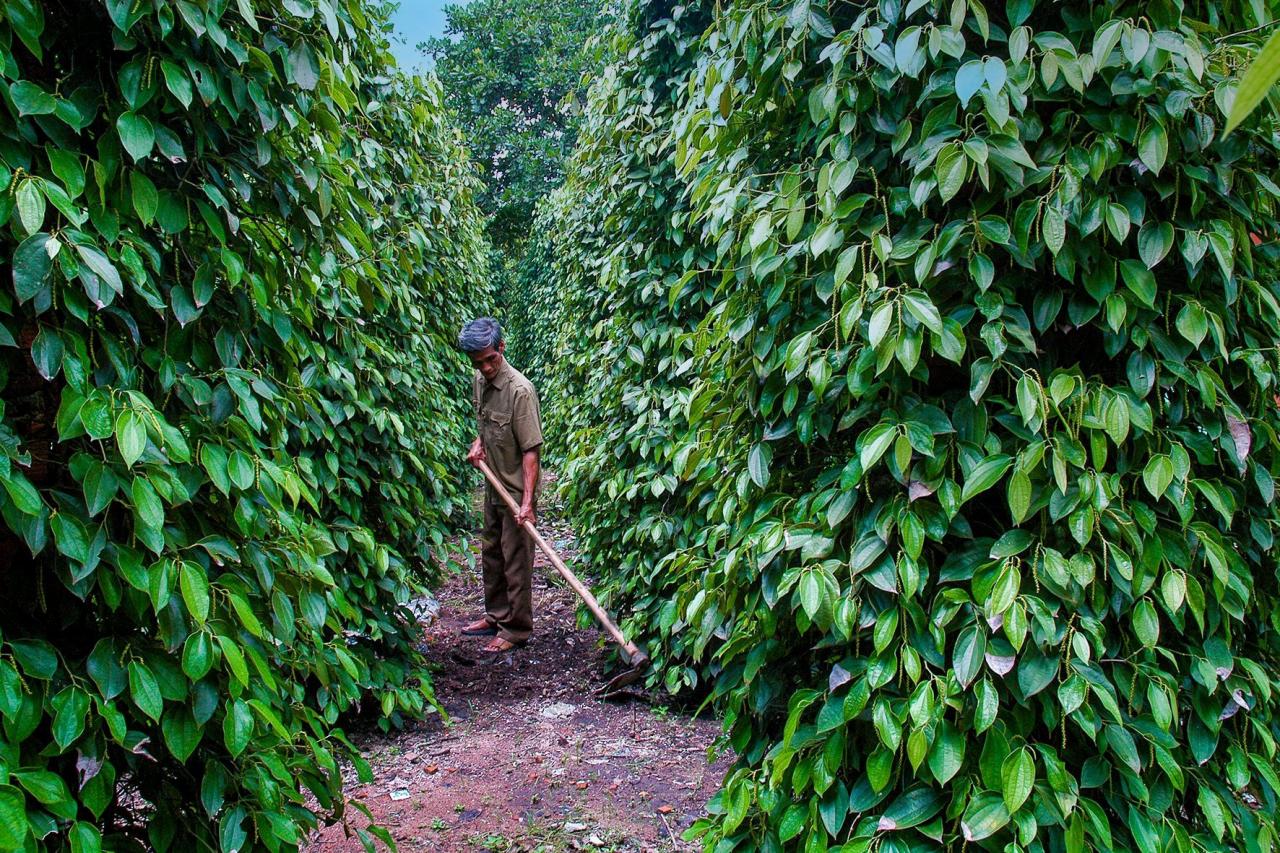
According to Mr. Truong Quang Den, Head of the Agriculture and Rural Development Department of Duc Linh district: The entire district currently has 628 hectares of pepper, most of which are at harvesting age, with an average yield of 15-16 quintals/hectare, and a total production of approximately 972 tons.
While pepper is included in the strategic crop planning in Duc Linh, it is not included in Tanh Linh due to soil quality and other conditions. However, many households in Tanh Linh with the means still grow pepper. Mr. Phan Dai in Duc Thuan commune invested in building brick pillars for pepper cultivation a few years ago, but after three years of harvesting, the entire plantation died from disease. Undeterred, he planted pepper on over 1 hectare of hillside land, persevering through several seasons of low prices. This year, he harvested nearly 2 tons of commercial pepper, making him very happy. He shared: "All agricultural products follow market prices, so some years, when prices are low, many households cut down their pepper plants and plant other crops. But when it's time to harvest, the other crops are past their prime while pepper prices rise, causing heartbreak. Therefore, not only with pepper but with other crops, one must determine the long-term market value before planting and must be persistent to achieve good revenue." Currently, Tánh Linh has about 114 hectares of pepper plantations concentrated in the northern part of the district, from Huy Khiêm to Đức Phú…
According to statistics, Vietnam exported 113,000 tons of various types of pepper in the first five months of 2024, while supply is increasingly shrinking. The amount needed for export has decreased significantly, while the 2025 harvest season is still eight months away. This poses a considerable challenge for the pepper market as supply is projected to be lower than global demand. In the context of low global pepper inventories and low pepper production in many countries due to the negative impact of El Niño, pepper prices are likely to continue rising. Regarding the reasons for the continuous increase in pepper prices, experts from the pepper association believe that low pepper inventories in major producing countries such as Vietnam, India, and Brazil, coupled with high consumption demand in recent times, are contributing factors. Pepper purchasing activities by businesses have also increased sharply in preparation for the upcoming holiday season. Furthermore, domestic and international demand for pepper is trending upwards due to consumers' increasing preference for natural, healthy spices. In addition, the demand for pepper stockpiling is also increasing due to concerns that supply may continue to decline in the future; many investors and businesses have increased their purchases for storage.
Pepper prices are rising daily and are likely to continue increasing, reaching a peak similar to 2015 at 250,000 VND/kg. This is a "golden" opportunity for pepper farmers to generate high revenue for reinvestment…
Source

![[Image] Hanoi Police officially crowned champions of V-League 2025/2026](https://vphoto.vietnam.vn/thumb/1200x675/vietnam/resource/IMAGE/2026/05/31/1780244769054_ndo_br_039d561b692be875b13a-jpg.webp)
![[Photo] The General Secretary, President and his wife begin their state visit to the Philippines.](https://vphoto.vietnam.vn/thumb/1200x675/vietnam/resource/IMAGE/2026/05/31/1780230559452_anh-man-hinh-2026-05-31-luc-19-28-11.png)
![[Photo] Admire the coral "masterpiece" amidst the million-year-old heritage of Dak Lak province.](https://vphoto.vietnam.vn/thumb/1200x675/vietnam/resource/IMAGE/2026/05/31/1780221235105_anh-man-hinh-2026-05-31-luc-16-53-27.png)
![[Photo] Solemn bathing ceremony and Buddha procession in Hue](https://vphoto.vietnam.vn/thumb/1200x675/vietnam/resource/IMAGE/2026/05/31/1780228263543_1-jpg.webp)









![[Video] Sunset at Lap An Lagoon – Where the sun sets over the fishing nets](https://vphoto.vietnam.vn/thumb/340x192/vietnam/resource/IMAGE/2026/05/31/1780192137701_beach-landscape-sea-water-nature-grass-745871-pxhere-com.jpeg)





































![[Photo] Admire the coral "masterpiece" amidst the million-year-old heritage of Dak Lak province.](https://vphoto.vietnam.vn/thumb/402x226/vietnam/resource/IMAGE/2026/05/31/1780221235105_anh-man-hinh-2026-05-31-luc-16-53-27.png)


































Comment (0)