

First meeting
In his small office, Professor Hoang Xuan Sinh flipped through photographs and pages of books, recalling memories from exactly 35 years ago, about a brief meeting that changed the landscape of Vietnamese education at the time.
Back then, the country had just opened up, and everything was still very difficult. Public agencies and schools operated entirely on state subsidies. Therefore, applying to establish a private university was incredibly difficult. Just mentioning the word "private" would immediately lead to rejection because it was such a novel concept.
Professor Hoang Xuan Sinh during the period 1981 - 1994.
In early December 1988, after his proposal to open the first private university was repeatedly rejected by various organizations, Professor Hoang Xuan Sinh decided to meet with General Secretary Nguyen Van Linh alone.
To meet the General Secretary, Professor Sinh had to go through many levels of authority, including the Department of Science and Technology, which vouched for him. "I don't know why I was so reckless at that time. I nervously walked into General Secretary Nguyen Van Linh's office," Professor Hoang Xuan Sinh recalled.
During that brief, precious time, Ms. Sinh briefly presented her goals and ideas for opening a private school, without requesting state funding. "Surprisingly, General Secretary Nguyen Van Linh immediately agreed and promised to direct relevant units to support the establishment of this new model," she said.
Immediately after that fateful meeting, Professor Hoang Xuan Sinh went to General Vo Nguyen Giap, who was then the Deputy Prime Minister in charge of science and education, to ask him to further consider and quickly promote the creation of this new model.
"A few days later, the Central Committee for Science and Education, Ministry of Higher Education, invited me to speak about establishing the school," she recounted.
She persuaded General Secretary Nguyen Van Linh and leaders at all levels to allow the opening of a private school for two reasons: to alleviate the hardships of lecturers, enabling them to earn a living from their profession, and to change the curriculum, bringing knowledge gained from studying abroad to future generations of students.
Everything is difficult to start.
According to the female professor, on the path to establishing the private university model, one must mention Professor Bui Trong Lieu - the first person to conceive the idea. At that time, Professor Bui Trong Lieu, who was teaching at the University of Paris 5 (France), sent letters to five renowned professors in Vietnam, including: Hoang Xuan Sinh, Hoang Tuy, Phan Dinh Dieu, Nguyen Dinh Chi, and Bui Trong Luu.
In the letter, Professor Lieu suggested that domestic scientists establish a private university, both to overcome the shortcomings of public universities at the time and to allow teachers to live on their salaries, dedicating themselves wholeheartedly to education without being affected by financial concerns.
This was the initial inspiration for her. "All five professors who received the letter discussed this matter many times. However, few dared to take the initiative and propose this groundbreaking idea," Professor Sinh shared.

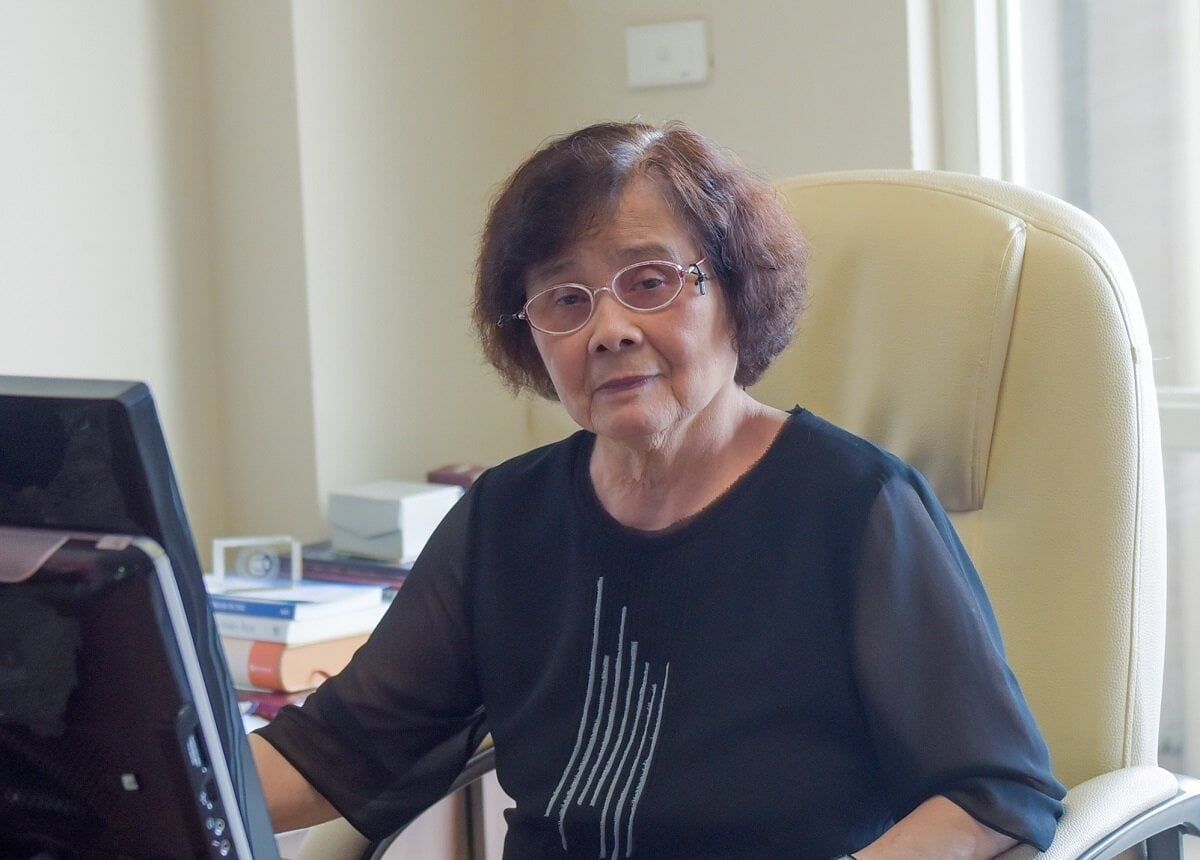
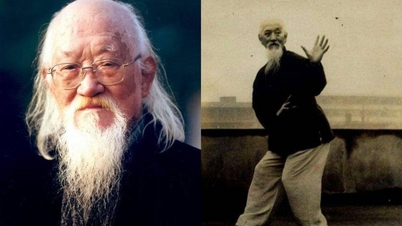
Vietnam's first female professor of Mathematics, Hoang Xuan Sinh.
She took a gamble and wrote a letter, signed by other scientists, to the Ministry of Higher Education. As expected, the Ministry of Higher Education did not respond to her petition. And not only the management levels, but many others were skeptical and discouraged her from trying to pave the way. However, having studied abroad and interacted with many outstanding scientists and leaders around the world at that time, she remained steadfast in her belief that this model would succeed.
After months of effort, knocking on the doors of various agencies and organizations, she was fortunate to receive approval from the highest-ranking leaders to test this model. On December 15, 1988, the Thang Long Private University Center - the first private university in Vietnam - was officially established, seen as a second chance for those who had failed the university entrance exam.
The school's first cohort welcomed many talented students, who were only 1-2 points short of getting into prestigious universities at the time such as the Polytechnic University, the University of Technology, and the Teacher Training University.
Regarding tuition fees, Ms. Sinh calculated that during the subsidy period, government officials received 13 kilograms of rice; students received 17 kilograms; and soldiers received 21 kilograms. “For me, with 13 kilograms of rice, I only ate 8, leaving 5 kilograms to exchange for other necessities. In a family, two government officials would have 10 kilograms of rice left over each month, which would be enough to pay for our children's tuition. Therefore, I decided to charge tuition fees equivalent to 10 kilograms of rice,” the professor recounted.
However, this money was only enough to pay for the rent of the premises, including one classroom, and the office staff. Half of the room was partitioned off to accommodate students. Without money to hire a cleaner, the professor herself woke up at 6 a.m. to carry water to wipe the blackboard and desks, and to sweep the classroom.
Despite limited funds, Professor Sinh still met with many professors and invited talented individuals to the university. “At that time, we didn’t have much money, but I paid the professors $5 per hour, which was quite a high rate. To be honest, the professors were also struggling financially, so when I made the offer, they all agreed immediately,” the female professor recalled. All the salaries for the lecturers relied on donations from Vietnamese expatriate professors in France, sent by Professor Bui Trong Lieu.
Initially, everything was fine, but after three years, the professors and intellectuals in France stopped donating. The school lost a major source of funding. “That period was incredibly difficult, but I thought, if the school closes, where will the students go? I need to be responsible for my students,” Professor Sinh confided. In this desperate situation, she stepped up and poured all of her family's financial resources into the school. She personally went to France to find new sources of donations to keep it running.
Adding to the difficulties, on the day the first cohort of students graduated, they encountered problems with the diploma issuance procedure. The Education Law at that time did not yet have regulations for private schools, so Thang Long University could not issue diplomas to its graduating students.
“I was in a dilemma, unable to move forward or backward. The Ministry of Education and Training wouldn't grant the degrees, parents were complaining, and students were disappointed. Every night, I would jump at the sound of the phone ringing, because parents always called at that time to try and calm me down. Not only that, but the teachers and administrative staff at the school had all quit,” Professor Hoang Xuan Sinh lamented.
It took two years after the first cohort of students graduated for the Ministry of Education and Training to issue temporary regulations for private universities, and Professor Hoang Xuan Sinh escaped being sued by students and parents.
Source









![[Image]: AIMO 'master' joins international competition team](https://vphoto.vietnam.vn/thumb/402x226/vietnam/resource/IMAGE/2026/05/24/1779615449852_aimo-chungket-quocgia25-969-jpg.webp)

































































Comment (0)