


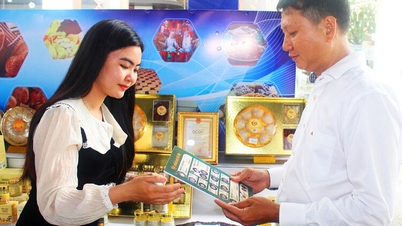
Consumers inquire about purchasing an AI product - Photo: LE MY
"More and more food is being put in the refrigerator, each family member putting in their own food without much thought. After a while, no one remembers or knows exactly what's in the refrigerator," said Ms. Hoang Phuong (Ho Chi Minh City), sharing her frustration.
Now, refrigerators are integrated with new technologies and AI. "It not only reminds you of items that are about to expire but also suggests recipes for dishes made with the items in the refrigerator, which is great when you don't have much time to pay close attention," Ms. Phuong shared.
AI as a butler
As for Ms. Lan Anh (Ho Chi Minh City): "Previously, cooking was a tiring process, but now with a multi-functional blender and cooker with integrated AI, all you have to do is put the ingredients in, choose the dish via the app, and it automatically calculates the time, temperature, and even adjusts to your family's taste."
Even on busy weekends, I can still make sour fish soup without having to stand and watch it." Or with a modern smart oven, "I can combine it with Google's connected management app and order a chicken to be baked in 40 minutes. Of course, I have to put the chicken in the oven myself; the machine will automatically adjust the temperature accordingly."
"This will be very convenient when cooking family meals or entertaining guests," said Mr. Thanh Trong (Ho Chi Minh City).
According to Tuoi Tre newspaper's research, many AI-integrated household products are increasingly present in Vietnamese families. For example, washing machines (priced at around 8-25 million VND) are equipped with AI sensors that automatically analyze the weight of the clothes, the softness and thickness of the fabric, and the level of dirt in the detergent during the washing process.
From there, the machine automatically dispenses the appropriate amount of detergent and fabric softener, and sets the washing time and drum rotation speed to best protect the fabric fibers and prolong their lifespan.
Currently, some air conditioners (priced from 9 to 25 million VND) have AI that recognizes when a person enters the room, immediately increasing cooling power for rapid cooling, then automatically reducing power and noise when it's time for the user to go to sleep.
The machine can also scan the room, measure the ambient temperature and the number of people in the room to adjust the cooling power optimally, helping to save an additional 20-30% of electricity compared to conventional inverter machines...
Having AI is gradually becoming the standard.
Speaking to Tuổi Trẻ newspaper, Ms. Truong Uyen Thanh, Head of Consumer Marketing at Electrolux Vietnam, said that AI is gradually reshaping how household appliances operate, making them not only smarter but also more proactive.
"We see AI as a platform that helps devices 'understand' users, thereby automatically optimizing the cooking process, reducing manual operations, and minimizing errors. In Vietnam, we see that consumers are increasingly open to smart solutions," Ms. Thanh said.
According to Ms. Dinh Thi Lan Huong, Deputy Director of the Household Appliances divisionat FPT Shop retail system, the demand for AI-integrated devices is clearly increasing, as consumers prioritize products that save time and reduce manual operations.
Consumers are no longer interested in AI as a "nice to have" feature, but rather view it as a near-standard factor when choosing household appliances. In particular, features such as "intelligent automation" and "predictive needs" are highly favored.
According to FPT Shop representatives, several AI-powered home appliances are becoming popular choices, such as water purifiers (priced from 5 to 15 million VND, capable of measuring dissolved solids and accurately predicting when to replace filters based on actual water quality, giving users more peace of mind compared to fixed-time reminders); robot vacuum cleaners (priced from 9.5 to 12 million VND); and ovens/fryeres (1 to 4 million VND, capable of automatically recognizing food and suggesting suitable cooking modes)...
Meanwhile, according to CellphoneS, AI-integrated smart fans (priced from 1 to 7 million VND) currently account for up to 40% of sales in the fan industry, gradually replacing traditional fan models.
This growth stems from major brands like Sharp, Aqua, Fujihome, and Xiaomi continuously launching new AI-integrated products in 2026, focusing on voice control, automatic environmental adjustments, and more.
In the air purifier segment, AI is applied to identify air quality in real time, especially fine dust, and then automatically adjust the operating power. Consumers now have many choices from high-end to budget segments with brands such as Xiaomi, Dyson, LG, Sharp, and Levoit (prices ranging from over 1 million VND to 25 million VND).
The race to incorporate AI into new products.
During its 2026 product launch event in early May 2026, LG introduced a range of exciting AI features equipped on its new TV products. For example, features like AI Voice ID help recognize users by voice, thereby personalizing the home screen interface, suggesting content, and providing useful features.
The AI Concierge feature not only suggests keywords but also searches for information related to the content the user is watching or the program currently airing...
Ecovacs' AI Stain Detection 2.0 technology allows its robotic vacuum cleaners to flexibly detect stains and clean them immediately based on the type and severity of the stain. For stubborn stains, the robot will automatically activate deep cleaning mode.
Xiaomi's AI Smart Wash technology automatically detects the weight and dirtiness of clothes to optimize water usage, washing time, and washing mode, while saving electricity and water.
With AI-powered indoor security cameras, you can intelligently recognize sounds and situations such as strangers, monitor pets, and detect crying children or falling objects.
Source: https://tuoitre.vn/nha-ai-len-ngoi-20260517234158092.htm
![[Photo] National Assembly Chairman Tran Thanh Man attends the groundbreaking ceremony for the National Highway 1A spatial axis project.](https://vphoto.vietnam.vn/thumb/1200x675/vietnam/resource/IMAGE/2026/05/19/1779161360398_ndo_br_bnd-1412-jpg.webp)


![[Photo] Capturing the moment the tide recedes at Yen Binh Son rapids - a million-year-old scenic spot in Quang Ngai.](https://vphoto.vietnam.vn/thumb/1200x675/vietnam/resource/IMAGE/2026/05/19/1779175463885_yen9-1199-jpg.webp)
























































![[Photo] General Secretary and President To Lam receives Indian Defense Minister Rajnath Singh](https://vphoto.vietnam.vn/thumb/402x226/vietnam/resource/IMAGE/2026/05/19/1779184046302_anh-man-hinh-2026-05-19-luc-16-46-58.png)















Comment (0)