

.jpeg)
1. In the past, the grounds of the Twelve Clans Church covered more than 3,000 square meters. Throughout the 20th century, the Twelve Clans Church was located right on the border between La Qua and Bong Lai villages (after the villages were separated), overlooking rice fields and ponds. The point of contact was the bamboo hedge and the old La Qua village shrine, before it was demolished in the 1980s.
The village shrine is located almost at the border between La Qua village and Vinh Dien town. "The village is far from the village gate, but Vinh Dien and La Qua are also close" (folk song).
In the old days in Quang Nam province, temples, communal houses, and pagodas often faced fields or rivers, meaning their views were unobstructed; and when people built houses, they would deliberately avoid facing the eastern facade and the main beam of the temple, communal house, or pagoda.
Nowadays, this is rarely respected or preserved, so construction is quite "uncontrolled," with many houses and shops encroaching directly on the facades of temples and pagodas, creating a very unsightly appearance. The Twelve Clans' Church is also in a similar situation; with the current rate of urbanization, in about 20 years, it will be difficult to recognize the poetic and sacred position it once held.
According to Mr. Nguyen Nho Can (head of the La Qua village church), he doesn't remember exactly when the first church for the 12 clans was built using bamboo and leaves. He only knows that after the inauguration of the La Qua tutelary deity shrine, construction of the church for the 12 clans began. The La Qua tutelary deity shrine was built before King Gia Long ascended the throne (i.e., before 1802).
.jpeg)
To elaborate a bit, in 1832, King Minh Mạng decided to move the Thanh Chiêm garrison to La Qua village, renaming it the Quảng Nam Provincial Citadel, but the locals commonly referred to it as La Qua Citadel or La Qua communal house, built of earth.
"As imposing as the La Qua communal house," or "As magnificent as the La Qua communal house"—an idiom describing something enormous. From 1836, the La Qua citadel was rebuilt with bricks. This means that the La Qua tutelary deity temple and the Church of the Twelve Clans predate the La Qua citadel itself.
2. Since 1908, the Twelve Clans' Ancestral Temple has worshipped the twelve founding ancestors of the twelve clans, hence the administrative and local people commonly refer to it by that name. By 1946, it worshipped 17 clans, and since 2018, it has worshipped the ancestral tablets of 22 clans. However, in the minds and speech of the people, most still habitually refer to it as the Twelve Clans' Ancestral Temple.
On December 30, 2020, this church was classified as a provincial-level historical relic by the People's Committee of Quang Nam province, with the official document stating it as the Ancestral Church of La Qua Village.
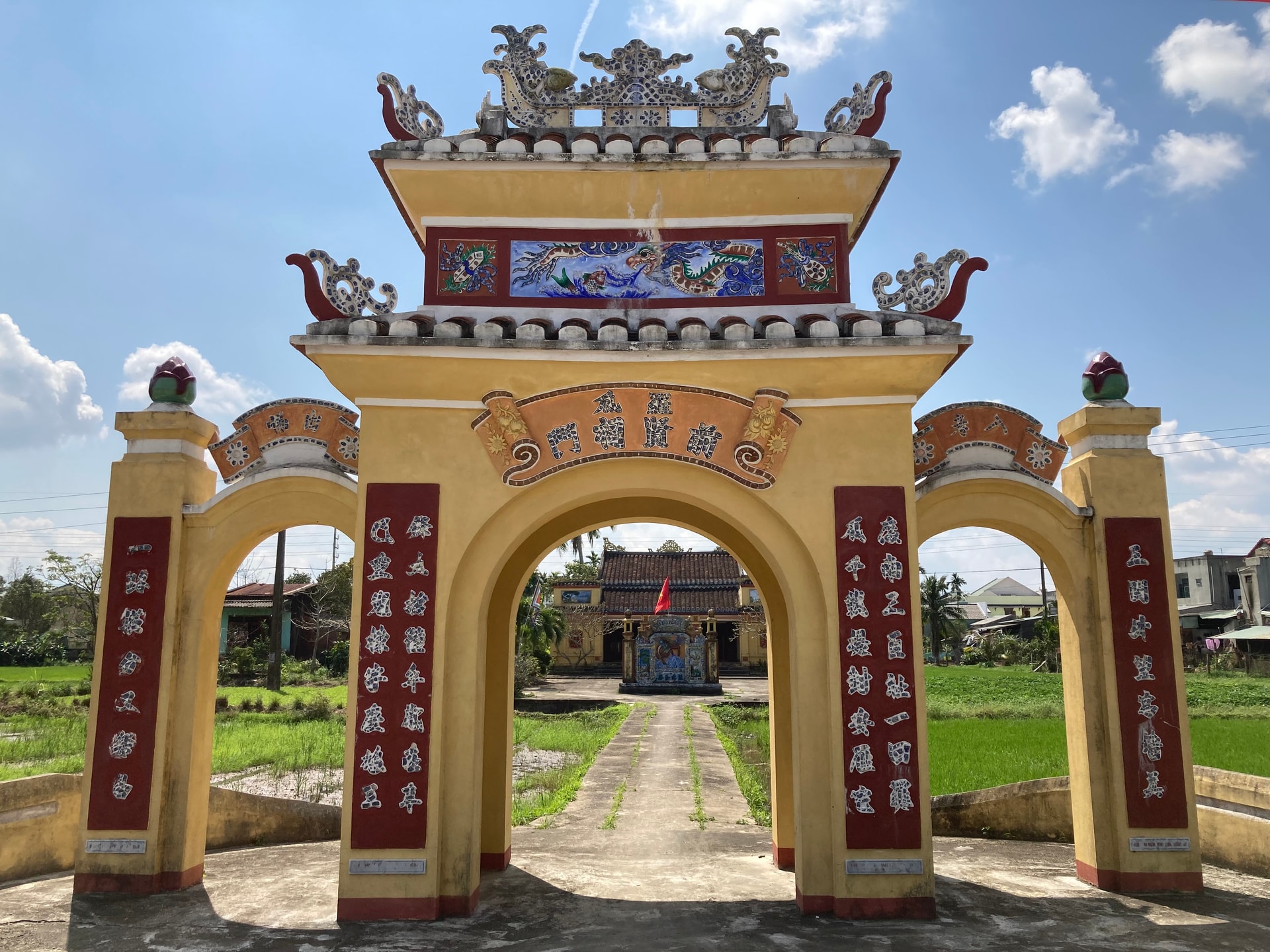
In 2023, when the La Qua tutelary deity temple was inaugurated at its new location, the temple's signboard (allegedly copied from the Twelve Clans Church) listed 17 clans: Nguyen Cong, Pham Hung, Le Vinh, Nguyen Nho, Do Van, Nguyen Dinh, Nguyen Duc, Nguyen Van, Nguyen Phuoc, Luong Van, Vo Van, Nguyen Tan, Ngo Duc, Tran Huynh, Mac Nhu, Nguyen Nhu, and Le Cong.
Why are five clans omitted from the list, even though the ancestral tablets list 22 clans? There are several explanations, but the following is widely accepted: These five clans do not have ancestral tombs in La Qua land, and therefore their names are not included in the shrines dedicated to the village guardian deity or the ancestral shrines.
However, there are some interesting exceptions, for example, the Tran Huynh clan, which, despite not having ancestral tombs here, is still recorded. The ancestral founder of the Huynh clan, Mr. Nghe Hoc/Nghe Sach from Tam Quang, Binh Dinh (formerly), served as a general for the Tay Son dynasty and was therefore executed along with his entire family during the reign of Gia Long. Only three people managed to escape: one went to La Qua - Dien Minh and changed his surname to Tran Huynh, one went to Phan Thiet, and one went to Gia Lai, only returning to Tam Quang after the major political crisis, thus maintaining the Huynh lineage.
So why was the Tran Huynh clan granted special permission by the local village to build a tomb equivalent to that of their ancestral founder, from the time of Tran De and later his son Tran Huynh Sach (also known as Nghè Học)? Perhaps it was due to the immense contributions of the Tran Huynh clan to this locality, not only at the village level, including the construction of many public works.
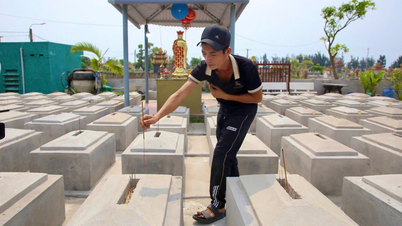
Sadly, these two very large and beautiful tombs no longer exist. Due to prioritizing agricultural land and road construction, they were relocated in the early 2000s. The tomb of Mr. Nghè Học is now located in the abandoned site of the Vinahouse cafe, near the underpass by the rice fields, on the road to Hoi An.
Of the six renovations of the Twelve Clans' Church, the one in 1957 was a major restoration, involving the construction of a new triple-arched gate, screen wall, and front hall. Besides Mr. Nghè Học, the project also benefited significantly from the contributions of Mr. Cửu Phán, Mr. Xã Năm, Mr. Đỗ Lý, Mr. Xã Ái, Mr. Phó Tá, Mr. Cửu Tải, Mr. Án Quằng, and others. Despite having arrived in the ancient La Qua land (much larger than present-day La Qua and Bồng Lai villages) quite early, and having made significant contributions and received special treatment, the Trần Huỳnh clan was still listed 14th (in chronological order), and had an ancestral tablet since 1946. Strictly speaking, the Trần Huỳnh clan and many other clans could have been excluded from the Twelve Clans' Church, but folk sentiment and beliefs always embrace and embrace this tradition.
There isn't enough information to confirm how many ancestral temples over 200 years old exist in Dien Ban or Quang Nam province, but to have a name like "Temple of the Twelve Clans" in the folk consciousness is truly rare.
Source: https://baodanang.vn/nha-tho-12-toc-trong-tam-thuc-nguoi-la-qua-3330909.html

![[Photo] Standing Committee member of the Party Central Committee Tran Cam Tu working with the Central Inspection Committee](https://vphoto.vietnam.vn/thumb/1200x675/vietnam/resource/IMAGE/2026/05/28/1779969579668_ndo_br_bnd-2495-jpg.webp)


































































Comment (0)