

Podcasts first appeared in the UK in 2003. The term is a portmanteau of "iPod" (an Apple music player brand) and "broadcast," defined as "a digital audio file that can be downloaded from the internet and played on a computer or portable device."
 |
| Popular podcast apps currently available. (Source: CoreIM) |
The benefits of podcast apps for social life.
Currently, many websites specializing in podcasts are emerging in Vietnam. Domestic media experts believe that Vietnamese podcasts will be a very useful method for targeted communication, especially for Vietnamese people living abroad or foreigners interested in Vietnam. However, Vietnamese podcast news channels remain largely untapped. Besides podcasts from VOV, VTV, and some domestic radio and newspapers, there are virtually no other options except for channels run by overseas Vietnamese, which often contain unverified information or serve malicious purposes against Vietnam.
Podcasts are typically created as multiple episodes in a series with various topics; when subscribing to a podcast, it automatically downloads to the device so listeners can listen immediately. Users can download the app via Google Play, and share podcast content through popular social media channels such as Facebook, Twitter, or iMessage. Apple devices like iPhones, iPods, and iPads have the app pre-installed. Podcasts usually range in length from a few minutes to several hours. The quality of podcasts varies from channel to channel. Some podcasts are created using simple recording equipment, while others are recorded in professional studios and edited to produce the highest quality audio.
In reality, anyone can create a podcast in the form of a radio program, interviews with celebrities and experts, or even documentaries and news. Therefore, podcasts have a wide variety of content, covering anything listeners are interested in, such as pure entertainment, inspiration, education , advice, and more.
Podcasts are typically structured like radio or television programs, with individual recordings then organized into series based on a thematic connection, content, or timeframe. Podcasts and radio programs share many similarities, but podcasts offer distinct advantages such as: users can choose their favorite topic from a wide variety of subjects; they can be downloaded and listened to anytime; and they help listeners delve deeper into a particular topic or field.
Podcast applications demonstrate exceptional convenience, making them highly attractive to tech-savvy younger generations. In particular, while radio stations are subject to state-managed content and copyright regulations, podcasts are more personal and lack specific, official legal frameworks governing this type of media. This provides a fertile ground for hostile and reactionary forces to exploit and create audio recordings that distort the truth and undermine the Party and the State.
Exploiting podcast applications to spread subversive propaganda.
Recently, taking advantage of the convenience of podcasts, hostile and reactionary forces have expanded their methods of creating channels on podcast applications to spread distorted propaganda and incite opposition, using large volumes of audio files with diverse content and formats (current events, documentaries, English language learning materials, etc.). A preliminary review of the most popular podcast applications currently available (Google Podcast, Spotify, Apple Podcast, etc.) shows that exiled hostile and reactionary forces have simultaneously exploited podcast applications to create propaganda channels with large volumes of audio and video containing subversive propaganda.
To carry out their subversive schemes, hostile forces are relentlessly distorting and denying the revolutionary achievements of the Party; distorting the historical value and significance of the national revolution… They thoroughly exploit limitations and shortcomings in leadership and management to mislead and steer public opinion in a negative direction, causing cadres, Party members, and the people to lose political and ideological direction, making it easier for them to implement their " peaceful evolution" strategy and promote "self-evolution" and "self-transformation" within the Party. Their insidious subversive tactics have led to the incitement of riots and disturbances of public order that have occurred recently, and protests that have destabilized local political security in some strategic areas.
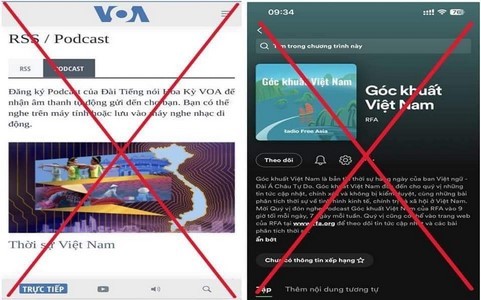 |
| Images of some negative and subversive channels on the Podcast app. |
Along with that, centers of ideological sabotage, foreign radio and media outlets (BBC, RFA, VOA, RFI, Chan Troi Moi Media, Dap Loi Song Nui, United Nations - Vietnam Indigenous People's Radio...) have created many Vietnamese-language podcast channels to intensify propaganda campaigns against the Party and State, implementing the "peaceful evolution" strategy. Some examples include: "Goc Khuat Viet Nam Radio Free Asia" by RFA, "Luat Khoa Radio" by Luat Khoa Magazine, "International News - VOA" by VOA, "Current Affairs, Live Information - Radio France International - RFI", "Vietnam Magazine" by RFI, "Interviews - Dap Loi Song Nui Radio", "Chan Troi Moi Media"... Simultaneously, they increased their collaboration with channels that are prejudiced against the Communist regime to open many programs. A typical example is the "Cuu Binh Cong Mang Tong Mang" channel, which has opened and used podcasts with many programs such as "Dissolving the Communist Party". "Party Transformation", "Nine Commentaries: Nine Essays on the Communist Party", "The Devil Is Ruling Our World", "The Ultimate Goal of Communism"...
It can be seen that almost all ideological subversive centers, radio stations, and newspapers have deployed podcasts, considering them one of their main propaganda channels; after developing diverse media, with podcasts, these ideological subversive centers have shifted their focus to impacting deeper audiences, targeting a more specific, dynamic, and tech-savvy audience.
The number of individuals involved in complex religious groups using podcasts to propagate their doctrines and recruit people into complex religious orders, strange sects, and illegal religions not recognized by law is on the rise. The current level of religious propagation, preaching, and sermons on podcasts is relatively large, with both mainstream and illegal religions concentrating their communication efforts to attract followers, confusing listeners and making it difficult to distinguish between truth and falsehood, right and wrong. This poses significant risks to religious and national security.
In particular, recently, there has been an increasing number of channels and articles using podcasts to spread subversive propaganda, such as: "The Redemptorist Congregation of Vietnam", "Suggestions on God's Calling - Pastor Pham Tuan Nhuong", "How to Hear God's Call", "God's Promises to Mankind", "Vietnam Buddhist Radio", "Vietnamese Saints", "Evangelical Church of Vietnam"...
Furthermore, numerous channels and accounts impersonating the Communist Party of Vietnam or bearing names containing content that insults, defames, or undermines the reputation of the Party and the State have been discovered on podcasting applications.
| Almost all ideological subversive centers, radio stations, and newspapers outside the government have launched podcasts, considering them one of their main propaganda channels. |
Several issues arise.
With the development and popularity of social media, podcast applications have strong potential for growth in Vietnam. This will lead to an increase in the scale and quantity of propaganda and distortion against the Party and State by hostile forces on the internet, using more sophisticated and cunning methods, especially in the context of the ongoing complex tensions in the world and the region.
To proactively combat and prevent the misuse of podcast applications for spreading distorted information and inciting subversive activities, the police force needs to focus on effectively implementing the following key areas:
Firstly, it is necessary to raise awareness among cadres, Party members, and the public about the methods and tactics of propaganda aimed at undermining the Party and the State through podcast applications. Every organization, individual, cadre, and Party member participating in and using the Internet and social media must always be proactive and vigilant, enhancing their resistance to distorted and subversive rhetoric. Only then will the fight against and eradication of fake news, harmful and toxic information quickly yield practical results, contributing to building a healthy Internet and social media environment, spreading positive values, and firmly protecting the Party's ideological foundation.
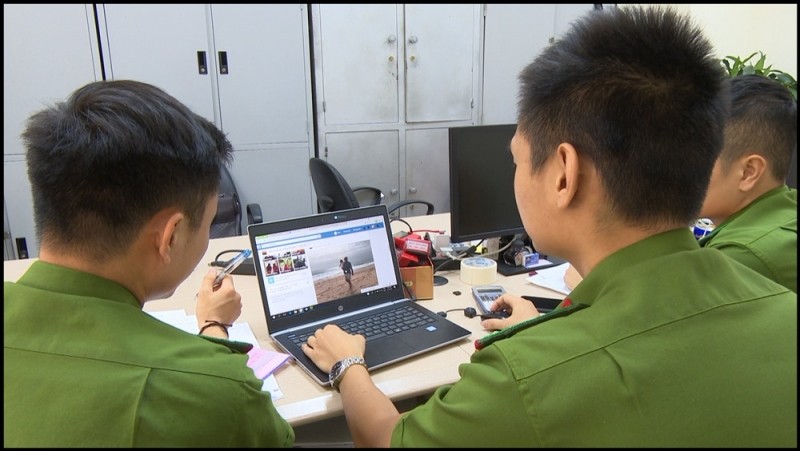 |
| The police force needs to proactively monitor the situation and promptly detect subversive activities by hostile and reactionary forces that exploit podcast applications to post harmful and malicious content. (Source: CAND) |
Secondly , proactively monitor the situation and promptly detect subversive activities by hostile and reactionary forces that exploit podcast applications to post harmful and malicious content. Utilize a comprehensive range of technical, technological, and legal measures to promptly, decisively, and effectively address organizations and individuals providing information and media services who exploit podcast applications to post, disseminate, and propagate articles, programs, and features with subversive content.
Thirdly , focus on monitoring, evaluating, and researching to clarify the new methods and tactics of subversive propaganda activities by hostile and reactionary forces, in order to promptly advise and propose appropriate solutions to the current situation. Strengthen information security and cybersecurity management, and manage officials' use of the Internet and social media; strictly implement legal regulations on raising vigilance against the "peaceful evolution" schemes and activities of hostile forces in cyberspace. Emphasis should be placed on organizing several "rehearsal exercises" to combat false and hostile viewpoints on the Internet and social media, serving as a basis for forces to refine and develop their combat skills.
Fourth , build a core, specialized force for cybersecurity and combating high-tech crime to fight and prevent activities that exploit social media in general and podcast applications in particular to spread propaganda against the Party and the State. Proactively detect, develop plans and key strategies for combating these activities, closely following the directives of the Politburo and the Secretariat; promptly anticipate the situation, and fully utilize the role of leading experts, scientists, top officials, journalists, and a large number of enthusiastic and capable collaborators to participate in the fight against and prevention of activities that exploit podcast applications to spread distorted and provocative propaganda against the Party and the State, avoiding being caught off guard or unprepared.
Fifthly , we will continue to advise on the development of sound policies to attract, select, and train skilled, high-quality human resources to serve in information management, cybersecurity, and the prevention and control of high-tech crimes, especially those with expertise and experience in ensuring information safety and security. Priority will be given to those proficient in foreign languages to effectively counter hostile forces using podcast applications to spread propaganda and undermine the revolution in foreign languages.
* Tho Xuan District Police, Thanh Hoa Province.
Source


![[Photo] Prime Minister Pham Minh Chinh attends the Conference on the Implementation of Tasks for 2026 of the Industry and Trade Sector](/_next/image?url=https%3A%2F%2Fvphoto.vietnam.vn%2Fthumb%2F1200x675%2Fvietnam%2Fresource%2FIMAGE%2F2025%2F12%2F19%2F1766159500458_ndo_br_shared31-jpg.webp&w=3840&q=75)

























































































Comment (0)