

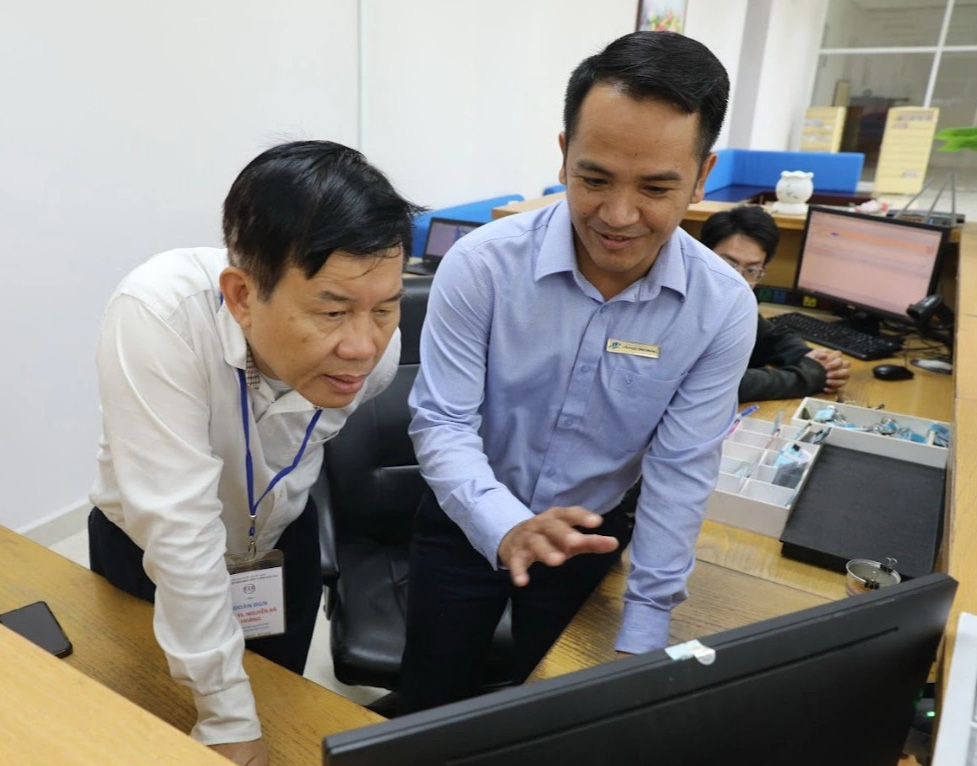
The external evaluation team from the Center for Quality Assurance of Higher Education, Vietnam National University Ho Chi Minh City, conducted a preliminary survey of 5 training programs at Ho Chi Minh City Open University - Photo: NT
The Ministry of Education and Training is seeking feedback on a draft circular amending Circular No. 04/2016 on the accreditation of quality in university and teacher training college programs (Circular 04) and replacing related circulars.
The draft of the new circular includes many changes aimed at aligning with the inspection standards of regional and international organizations.
Accordingly, compared to Circular 04, the revised draft reduces the number of standards from 11 to 8, with 52 criteria, thus resolving the overlap when evaluating according to the standards of Circular 04.
This draft also amends the regulations on 10 mandatory criteria for training programs to meet quality standards. These are regulations currently applied by the FIBAA organization.
Circular 04 stipulates that the evaluation criteria consist of 7 levels from 1 to 7. The revised draft now has only 2 levels: pass/fail.
According to the draft revised circular, the number of forms and pages in self-assessment reports, external evaluation reports, etc., have all been reduced compared to the regulations in Circular 04.
In addition, it clearly defines the responsibilities of training institutions in committing to ensuring the maintenance of the program, self-assessing to meet training program standards, and reducing the administrative workload for accreditation officers.
According to the Quality Management Department of the Ministry of Education and Training, the results of quality accreditation analysis of more than 1,200 training programs evaluated according to domestic standards from 2017 to the present show that the criteria that did not meet the standards (below 4 points) mainly relate to program design, development, and evaluation.
This also shows that the development of training programs that meet output standards and the assessment of learners, as well as gathering feedback from stakeholders to improve the quality of training programs, are weaknesses that need to be addressed through regulations that schools should prioritize.
The 7-level criteria assessment approach is suitable for developing an internal quality assurance system in the initial stages of familiarization and shaping a quality management model, appropriate to the level of higher education institutions in ASEAN countries.
However, this approach is not common in quality assurance in many countries and international accreditation organizations, so the evaluation method needs to be adjusted.
Source: https://tuoitre.vn/nhieu-thay-doi-trong-tieu-chuan-kiem-dinh-chat-luong-chuong-trinh-dao-tao-dai-hoc-20240817111330885.htm

























































































Comment (0)