

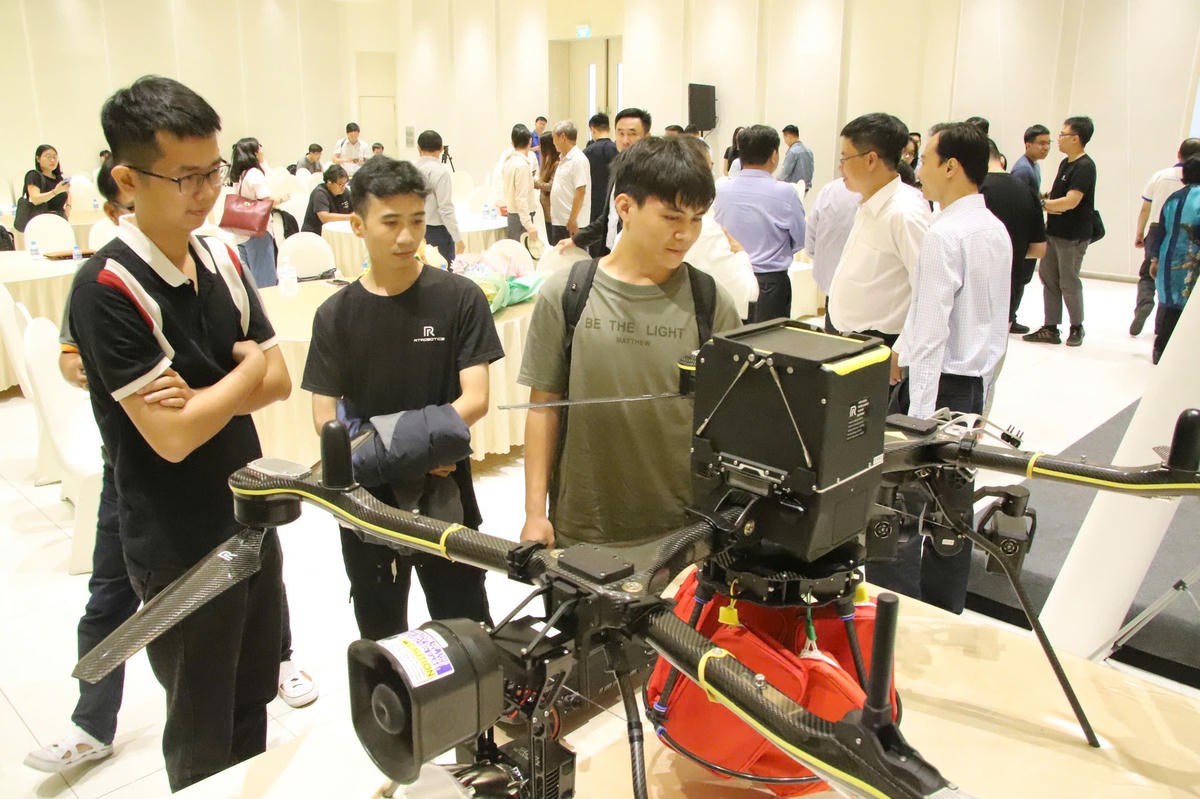
However, alongside the expected benefits, many have expressed concerns about the risk of opening too many new programs, focusing too much on theory, and lacking connection with practice.
Expanding the target group for vocational education .
The 15th National Assembly officially passed the amended Law on Vocational Education, one of the notable points being that higher education institutions are allowed to participate in vocational education activities, including some specialized fields such as arts, sports , teacher training, and national defense and security. Higher education institutions currently training in fields listed in the Strategic Technology Catalogue are permitted to offer associate degree programs in the same fields.
Previously, the 2014 Vocational Education Law only stipulated the scope of regulation for educational institutions and did not specify that higher education institutions were allowed to participate in vocational education activities. This change is explained as a way to better utilize the facilities, faculty, and research potential of universities, especially in the context of many universities facing difficulties in student recruitment. From a policy perspective, this is seen as a flexible solution, contributing to expanding the scale of training human resources at the intermediate and college levels, meeting the increasingly diverse needs of the labor market.
Dr. Le Viet Khuyen, Vice President of the Association of Vietnamese Universities and Colleges, also warned that expanding college-level training within universities poses the risk of "university-ization" of vocational education. Dr. Khuyen emphasized that the core of college-level training is vocational skills, with a large proportion of practical training time, enabling graduates to work immediately. If universities merely "label" themselves as colleges but their programs, teaching methods, and assessment remain heavily theoretical, the training objectives will be difficult to achieve.
The risk of opening new industries based on trends.
Another concern is the proliferation of new programs to attract students, especially in the context of increasingly fierce competition for enrollment. When given more authority to offer college-level programs, some schools may prioritize immediate demand, opening many "hot" programs but lacking adequate preparation in terms of practical instructors, workshops, equipment, and connections with businesses.
Recent experience shows that even at the university level, many training programs are opened for a short period and then have to be temporarily suspended or dissolved due to a lack of quality assurance and student enrollment. If this scenario repeats itself at the college level, the consequences will not only be a waste of social resources but also a direct impact on the rights of students.
Furthermore, college-level training requires close ties with businesses – where students can intern, hone their skills, and gain access to a real-world work environment. However, not all universities have readily available networks of partner businesses suitable for specific fields of study at the college level.
Therefore, experts suggest that clear regulations are needed regarding the conditions under which a university is allowed to offer associate degree programs. This should not be applied indiscriminately, but only those institutions that fully meet the requirements for practical training facilities, experienced faculty, and strong ties with businesses should be permitted to offer such programs.
Furthermore, college-level training programs within universities need to be developed independently, not copied or "simplified" from university programs. The learning outcomes should emphasize vocational skills, practical abilities, and adaptability to the labor market, rather than focusing solely on theoretical knowledge.
Dr. Le Viet Khuyen also emphasized the role of state management in rigorous accreditation, inspection, and supervision, not only regarding the conditions for opening new majors, training programs, and output standards, but throughout the entire operation process. More importantly, it is necessary to listen to feedback from businesses and students – the direct beneficiaries and evaluators of training quality. Only when college graduates find stable employment that meets job requirements will this policy truly be effective.
“Expanding training authority is always a matter that needs careful consideration, especially in the field of vocational education and training – where quality is closely linked to practical production. Allowing universities to train college-level students is a suitable step in the new context, but without clear boundaries and strict conditions, the risk of opening up too many programs without practical application is unavoidable,” warned Dr. Le Viet Khuyen, adding that caution is needed to avoid long-term consequences for students, the labor market, and the reputation of the education system itself. It should be noted that expansion does not mean laxity; on the contrary, the more expansion there is, the more the requirements for quality and responsibility must be prioritized.
Source: https://daidoanket.vn/dao-tao-he-cao-dang-trong-dai-hoc-noi-lo-ly-thuyet-lan-at-tay-nghe.html


![[Photo] Enchanting ancient rose garden on the mountainside in Nghe An](/_next/image?url=https%3A%2F%2Fvphoto.vietnam.vn%2Fthumb%2F1200x675%2Fvietnam%2Fresource%2FIMAGE%2F2025%2F12%2F19%2F1766109900916_vuon-hong-chin-do-thu-hut-du-khach-toi-check-in-o-ha-noi-3-20162778-1671624890024-1671624890104198100259.jpeg&w=3840&q=75)
![[Photo] General Secretary To Lam visits the exhibition space showcasing books, photo exhibitions, and achievements of digital transformation in journalism.](/_next/image?url=https%3A%2F%2Fvphoto.vietnam.vn%2Fthumb%2F1200x675%2Fvietnam%2Fresource%2FIMAGE%2F2025%2F12%2F19%2F1766110879215_1766110240024-jpg.webp&w=3840&q=75)


























































































Comment (0)