

 |
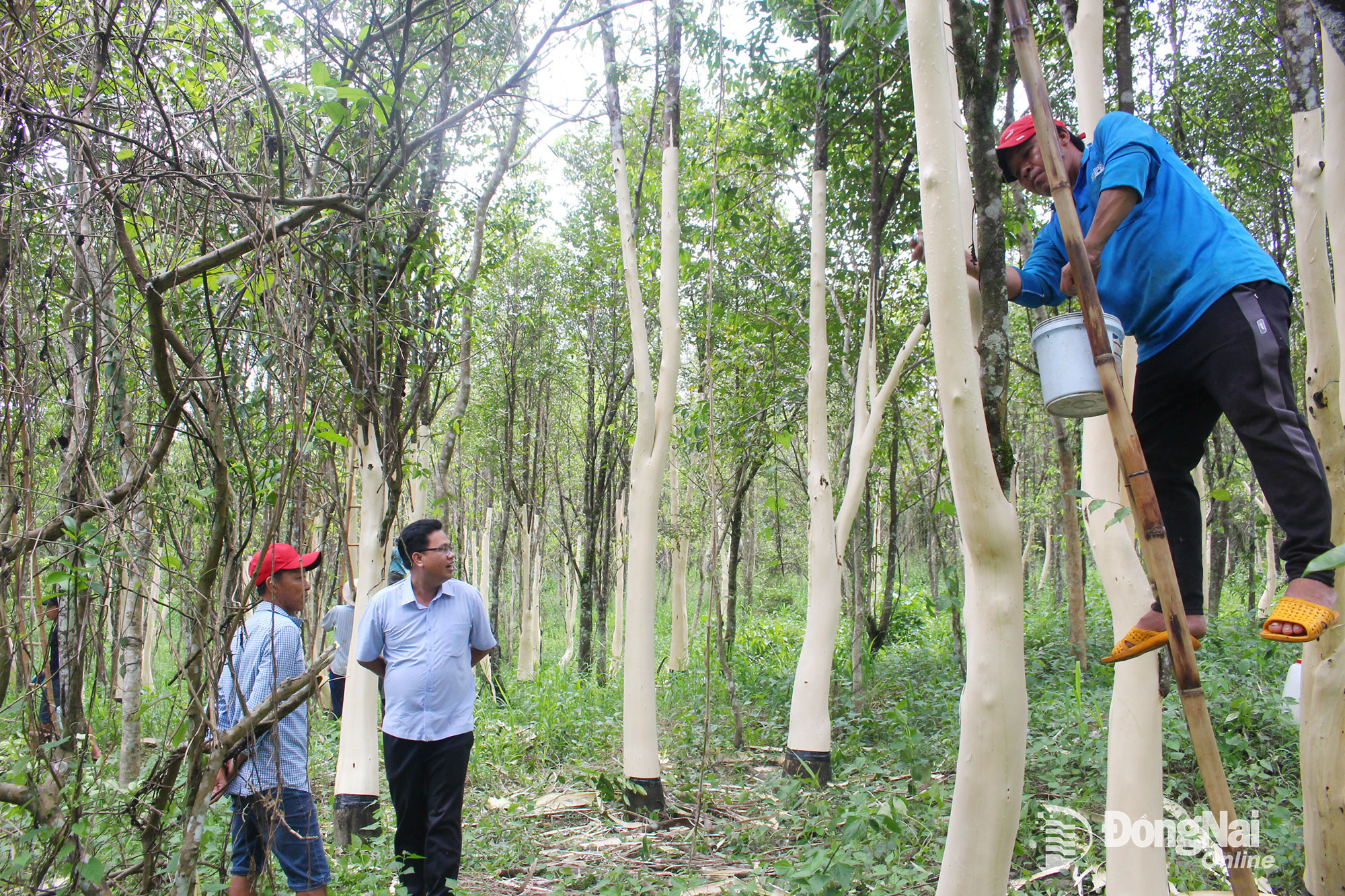
| A garden of agarwood trees grown for resin extraction by a Khmer ethnic minority household in Phu Loi hamlet, Phu Lam commune. |
In recent years, along with the transformation of the new rural areas, the material and spiritual lives of ethnic minority people in the locality have increasingly improved. From applying technology in agricultural production to participating in labor in industrial, commercial, and service zones, the people are gradually integrating into the overall development of the locality.
The sunshine of abundance
At 84 years old, Mr. To Van Ha (of Hoa ethnicity, Phu Thanh hamlet, Phu Lam commune) still regularly rides his motorbike to visit his farm in Phu Cuong hamlet. When he returns, he always brings back bunches of bananas, vegetables, and fruits grown along the boundaries of his fields or under the canopy of durian and rambutan trees. Mr. Ha confided: "Farming is much easier now than it used to be" because from tending the plants and watering to fertilizing, everything is supported by machinery.
Before 1977-1990, Mr. Ha's family and many other ethnic minority people from the Hoa, Tay, and Nung ethnic groups from Quang Ninh and Cao Bang provinces chose Phu Thanh hamlet to settle and start their lives under extremely difficult conditions. Agricultural land near the residential area had already been cleared, so people had to seek out remote, rocky areas in Phu Cuong hamlet to establish gardens and cultivate tobacco, bananas, coffee, and vegetables. In the days before motorcycles and with difficult roads, transporting agricultural products was mainly done by carrying them on backs along narrow paths.
Now, those old dirt roads have been paved with concrete and asphalt, providing easy access to gardens, markets, and purchasing agents. The hardships of the early days of establishing a business are gradually fading into memory.
Like Mr. Ha, Mr. Ly Van Minh (Nung ethnic minority, in Phu Lam 1 hamlet) expressed: "Nowadays, farmers don't fear the sun; in fact, they look forward to more sunshine to water their plants so they can thrive, flower, and bear fruit in the right season, and to minimize pest and disease damage. Unlike before, during the dry season, people worried about many things such as food shortages, unemployment, and a lack of water for daily use, having to scramble to fill buckets for storage... This year's sun, although intense, is shaded by fruit trees such as tissue-cultured bananas, durian, rambutan, and various industrial crops."

![[Video] Sunset at Lap An Lagoon – Where the sun sets over the fishing nets](https://vphoto.vietnam.vn/thumb/1200x675/vietnam/resource/IMAGE/2026/05/31/1780192137701_beach-landscape-sea-water-nature-grass-745871-pxhere-com.jpeg)



![[Image] A brilliant symphony and explosive power in the skies of Da Nang.](https://vphoto.vietnam.vn/thumb/1200x675/vietnam/resource/IMAGE/2026/05/31/1780193150738_anh-bia-copy-jpg.webp)







![[Video] Sunset at Lap An Lagoon – Where the sun sets over the fishing nets](https://vphoto.vietnam.vn/thumb/800x450/vietnam/resource/IMAGE/2026/05/31/1780192137701_beach-landscape-sea-water-nature-grass-745871-pxhere-com.jpeg)






























![[Video] Sunset at Lap An Lagoon – Where the sun sets over the fishing nets](https://vphoto.vietnam.vn/thumb/402x226/vietnam/resource/IMAGE/2026/05/31/1780192137701_beach-landscape-sea-water-nature-grass-745871-pxhere-com.jpeg)





























Comment (0)