

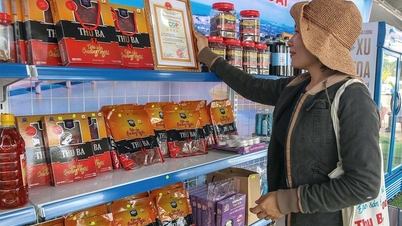
In education, the spirit of learning from President Ho Chi Minh is spread through flag-raising ceremonies, stories about him, and student volunteer movements. In economic life, that spirit is manifested in the changes on the farmlands as farmers boldly apply science and technology, link production, and build agricultural product brands... From once-difficult areas, many localities have become bright spots in agricultural economics, and they understand that diligence and creativity are the path to progress, and at the same time, the most practical way to express gratitude.
Beyond economic development, the spirit of sharing is spreading strongly through bridges, charitable houses, and scholarships built through community efforts. People in the Mekong Delta, already known for their compassion and solidarity, are now even more deeply moved by the teachings of love and unity, helping each other like family members, because they believe that a good society begins with small acts of kindness.
In the southernmost region of Vietnam, the affection for President Ho Chi Minh and the learning and emulation of his teachings hold special stories. Here, there's the story of how, after destroying an enemy outpost, the commune's Party Congress was concluded, and a temple dedicated to President Ho Chi Minh was built right on the site of the former outpost (the Ho Chi Minh Temple in Cai Nuoc commune), associated with the name of the female Hero of the People's Armed Forces, Pham Thi Bay, affirming that victory was not only for liberation but also for the creation of a spiritual symbol. In Chau Thoi commune, the ritual of sacrificing the lives of the guerrilla fighters protecting the Ho Chi Minh Temple has become a moving story for generations, as it is the way the people entrust their vow to preserve the sacred site with their own lives. For over half a century, veteran Nguyen Van Khoa has voluntarily guarded the temple... From this, Ca Mau has become a locality with many temples dedicated to President Ho Chi Minh built since his passing.
 The flamboyant trees are in full bloom in the grounds of the Ho Chi Minh Memorial Area (An Xuyen ward).
Moreover, there are hamlets here named after President Ho Chi Minh's birthday, such as Hamlet 19/5 (Khanh Binh commune); some localities, after building a shrine to commemorate him, named their hamlet Phu Tho (Tri Phai commune); or like Ba Chang hamlet (Chau Thoi commune), where people set up an altar to President Ho Chi Minh, burning incense day and night in his memory... All of these are like "fragrant incense sticks" that never fade in the southernmost part of the country.
In such heartwarming stories, the unwavering loyalty of the people of the southernmost tip of the country to Uncle Ho is clearly and profoundly revealed. This affection is not only expressed in words but also in actions, in memories, and in daily life. Therefore, when May returns, memories and the present intertwine, making the longing even deeper.
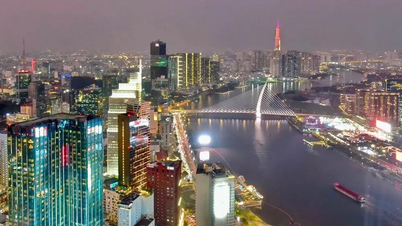
Amidst the ever-changing pace of life, the song "Remembering Father in the Season of Red Phoenix Flowers" serves as a red thread connecting the past with the present, for the phoenix flower is not just a flower but a memory, the bird's wings are not just an image but an aspiration, and the call "Father" is not just a form of address but a sacred sentiment of the entire nation. Therefore, when discussing Vietnam's development journey today, many people in the Mekong Delta still believe that every achievement is illuminated by the spirit of Ho Chi Minh.
This year, marking the 136th anniversary of his birth, people everywhere respectfully pay tribute to and remember the Father of the Nation with all their profound love and faith. The season of flamboyant blossoms will pass like all seasons before, but the memory of Uncle Ho will never fade, for it has anchored people's hearts with the most sacred feelings.
Abundant
Source: https://baocamau.vn/-nho-cha-trong-mua-phuong-do--a128839.html
![[Image] Hanoi's urban life under the challenge of a "scorching hot" environment](https://vphoto.vietnam.vn/thumb/1200x675/vietnam/resource/IMAGE/2026/05/25/1779706979265_nang-nong-t5-2026-minh-duy-7-4636-jpg.webp)




![[Image] Close-up view of the interchange connecting the two expressways and Long Thanh Airport.](https://vphoto.vietnam.vn/thumb/1200x675/vietnam/resource/IMAGE/2026/05/25/1779703378210_ndo_br_z7863716673926-224453a31600126cce10622af6290afd-4549-jpg.webp)








































































Comment (0)